Kirjojen hintavertailu. Mukana 11 699 587 kirjaa ja 12 kauppaa.

Kirjahaku

Etsi kirjoja tekijän nimen, kirjan nimen tai ISBN:n perusteella.

5 kirjaa tekijältä A. K. Dewdney

Stochastic Communities

Stochastic Communities

A. K. Dewdney

CRC Press
2021
nidottu
Stochastic Communities presents a theory of biodiversity by analyzing the distribution of abundances among species in the context of a community. The basis of this theory is a distribution called the "J distribution." This distribution is a pure hyperbola and mathematically implied by the "stochastic species hypothesis" assigning equal probabilities of birth and death within the population of each species over varying periods of time. The J distribution in natural communities has strong empirical support resulting from a meta-study and strong theoretical support from a theorem that is mathematically implied by the stochastic species hypothesis.
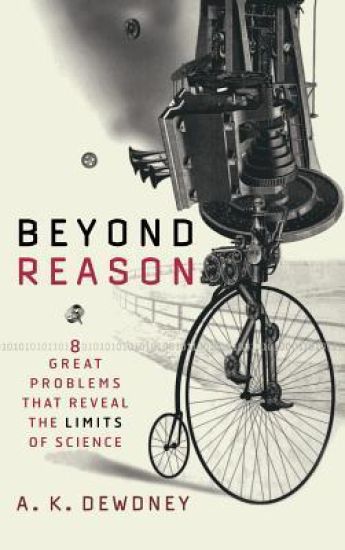
Beyond Reason

Beyond Reason

A. K. Dewdney

John Wiley Sons Inc
2004
sidottu
A mind-bending excursion to the limits of science and mathematics Are some scientific problems insoluble? In Beyond Reason, internationally acclaimed math and science author A. K. Dewdney answers this question by examining eight insurmountable mathematical and scientific roadblocks that have stumped thinkers across the centuries, from ancient mathematical conundrums such as "squaring the circle," first attempted by the Pythagoreans, to G?del's vexing theorem, from perpetual motion to the upredictable behavior of chaotic systems such as the weather. A. K. Dewdney, PhD (Ontario, Canada), was the author of Scientific American's "Computer Recreations" column for eight years. He has written several critically acclaimed popular math and science books, including A Mathematical Mystery Tour (0-471-40734-8); Yes, We Have No Neutrons (0-471-29586-8); and 200% of Nothing (0-471-14574-2).
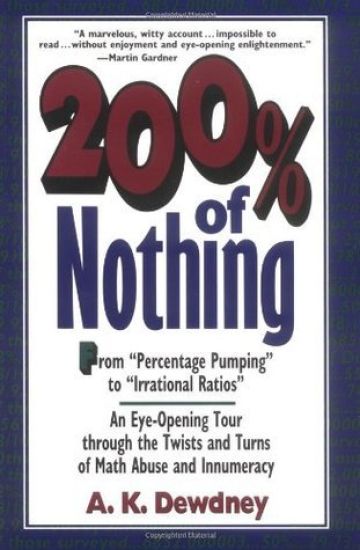
200% of Nothing

200% of Nothing

A. K. Dewdney

John Wiley Sons Inc
1996
nidottu
Acclaim for "In today's world, 'innumeracy' is an even greaterdanger than illiteracy, and is perhaps even more common.Advertisers and politicians exploit it; intellectuals (self-styled)even flaunt it. I hope that this wise and witty book will providecures where they are possible, and warnings where they arenecessary. "It's also a lot of fun. I can guarantee that 100%."--Arthur C.Clarke "Dewdney retells with charm and wit magnificent morsels ofmathematical mayhem discovered by his army of volunteer 'abusedetectives.' From 'sample trashing' to 'numerical terrorism,' from'percentage pumping' to 'dimensional dementia,' 200% of Nothingplumbs the depths of innumeracy in daily life and reveals whatordinary people can do about it. A rich, readable, instructive, and persuasive book."--Lynn ArthurSteen, Professor of Mathematics, St. Olaf College
New Turing Omnibus

New Turing Omnibus

A. K. Dewdney

PALGRAVE MACMILLAN
2003
nidottu
No other volume provides as broad, as thorough, or as accessible an introduction to the realm of computer science as A. K. Dewdney's The Turing Omnibus. For everyone from the curious beginner to the working professional, The New Turing Omnibus offers 66 concise, brilliantly written mathematically oriented articles on the major points of interest in computer science theory, technology, and applications. Foundational for this tour: information on algorithms, detecting primes, noncomputable functions, and self-replicating computers--plus fundamental sections on the Mandelbrot set, genetic algorithms, the Newton-Raphson Method, neural networks that learn, DOS systems for personal computers, and computer viruses.
Stochastic Communities

Stochastic Communities

A. K. Dewdney

CRC Press
2017
sidottu
Stochastic Communities presents a theory of biodiversity by analyzing the distribution of abundances among species in the context of a community. The basis of this theory is a distribution called the "J distribution." This distribution is a pure hyperbola and mathematically implied by the "stochastic species hypothesis" assigning equal probabilities of birth and death within the population of each species over varying periods of time. The J distribution in natural communities has strong empirical support resulting from a meta-study and strong theoretical support from a theorem that is mathematically implied by the stochastic species hypothesis.