Kirjojen hintavertailu. Mukana 11 717 486 kirjaa ja 12 kauppaa.

Kirjahaku

Etsi kirjoja tekijän nimen, kirjan nimen tai ISBN:n perusteella.

12 kirjaa tekijältä A. Mark Smith

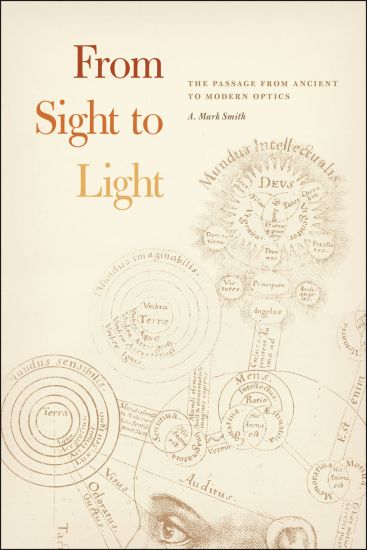
From Sight to Light – The Passage from Ancient to Modern Optics
From its inception in Greek antiquity, the science of optics was aimed primarily at explaining sight and accounting for why things look as they do. By the end of the seventeenth century, however, the analytic focus of optics had shifted to light: its fundamental properties and such physical behaviors as reflection, refraction, and diffraction. This dramatic shift which A. Mark Smith characterizes as the Keplerian turn" lies at the heart of this fascinating and pioneering study. Breaking from previous scholarship that sees Johannes Kepler as the culmination of a long-evolving optical tradition that traced back to Greek antiquity via the Muslim Middle Ages, Smith presents Kepler instead as marking a rupture with this tradition, arguing that his theory of retinal imaging, which was published in 1604, was instrumental in prompting the turn from sight to light. Kepler's new theory of sight, Smith reveals, thus takes on true historical significance: by treating the eye as a mere light-focusing device rather than an image-producing instrument as traditionally understood Kepler's account of retinal imaging helped spur the shift in analytic focus that eventually led to modern optics. A sweeping survey, From Sight to Light is poised to become the standard reference for historians of optics as well as those interested more broadly in the history of science, the history of art, and cultural and intellectual history."

Ptolemy's Theory of Visual Perception

Ptolemy's Theory of Visual Perception

A. Mark Smith

American Philosophical Society Press
1996
pokkari
This is a print on demand Publication. This is a reprint, this is not an original. Contents: Introduction; Ptolemy: A Biographical Sketch; The "Optics" A Biographical Sketch; An Overview of the "Optics"; The Historical Influence of the "Optics"; English Translation; & Bibliography. The English translation of this text is based upon Albert Lejeune's critical Latin text of 1956, which was reprinted in the 1990s along with a French translation & supplementary annotations. Illus.
Ptolemy and the Foundations of Ancient Mathematical Optics

Ptolemy and the Foundations of Ancient Mathematical Optics

A. Mark Smith

American Philosophical Society Press
1999
pokkari
Contents: (I) Ancient Theories of Visual Perception: The Physics of Vision; The Physiology of Vision; The Psychology of Visual Perception; (II) Optics Proper: Analysis of Direct Vision: The Visual Cone; The Visual Perception of Physical Space; Binocular Vision; (III) Catoptrics: Analysis of Vision by Reflected Rays: The Law of Equal Angles; Multiple Reflections and Multiple Images; The Principles of Image-Location; Image-Formation and Distortion; Visual Effecs from Composite Mirrors; (IV) Dioptrics: Analysis of Vision by Deflected Rays: Observation and Explanation of the Phenomenon; Practical Application: The Problem of Atmospheric Refraction; Image-Location as a Function of the Shape of the Refracting Surface; Size-Distortion; (V) Analysis of the Rainbow and of Burning Mirrors; (VI) Conclusion. Illus.
Alhacen's Theory of Visual Perception (First Three Books of Alhacen's De Aspectibus), Volume Two--English Translation
Sometime between 1028 and 1038, Ibn al-Haytham completed his monumental optical synthesis, Kitab al-Manazir ("Book of Optics"). By no later than 1200, and perhaps somewhat earlier, this treatise appeared in Latin under the title De aspectibus. In that form it was attributed to a certain "Alhacen." These differences in title and authorial designation are indicative of the profound differences between the two versions, Arabic and Latin, of the treatise. In many ways, in fact, they can be regarded not simply as different versions of the same work, but as different works in their own right. Accordingly, the Arab author, Ibn al-Haytham, and his Latin incarnation, Alhacen, represent two distinct, sometimes even conflicting, interpretive voices. And the same holds for their respective texts. To complicate matters, "Alhacen" does not represent a single interpretive voice. There were at least two translators at work on the Latin text, one of them adhering faithfully to the Arabic original, the other content with distilling, even paraphrasing, the Arabic original. Consequently, the Latin text presents not one, but at least two faces to the reader. Volume This two-volume critical edition represents fourteen years of work on Dr. Smith's part. Awarded the 2001 J. F. Lewis Award. Volume Two--English Translation