Kirjojen hintavertailu. Mukana 11 717 486 kirjaa ja 12 kauppaa.

Kirjahaku

Etsi kirjoja tekijän nimen, kirjan nimen tai ISBN:n perusteella.

9 kirjaa tekijältä A.M. Klein

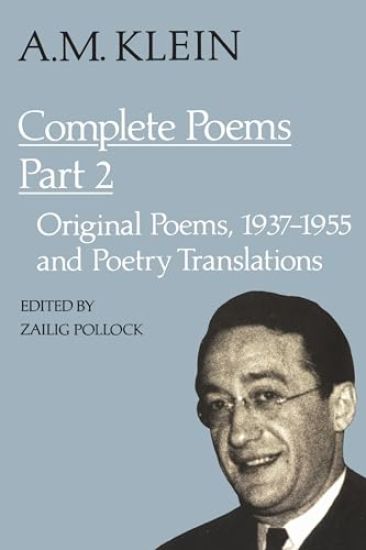
A.M. Klein: Complete Poems

A.M. Klein: Complete Poems

A.M. Klein

University of Toronto Press
1990
sidottu
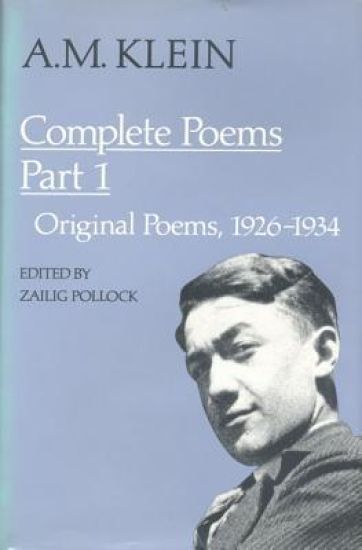
It is for his poetry that A.M. Klein is best known and most warmly remembered. This collection includes all Klein's poetry, both original works and translations from Hebrew, Yiddish, Aramaic, and Latin. Many of them, coming from all periods of his careers, have never been published. The poems are arranged chronologically according to date of composition. This makes possible, for the first time, an appreciation of Klein's poetic development. The editor's introduction places this development in the perspective of Klein's life and time, and in particular explores Klein's lifelong struggle to reconcile his dual vocations as both a Jewish and a modernist writer. The textual apparatus identifies all authoritative versions for each poem and lists all emendations and all substative variants in both published and mauscript versions. The explanatory notes gloss obscure terms and references. They also provide a rich context for appreciation and interpretation by drawing connections with Klein's life, his wide reading, and his work as a whole. Wherever possible, Klein's own numerous, but scattered, comments on his poems have been cited.
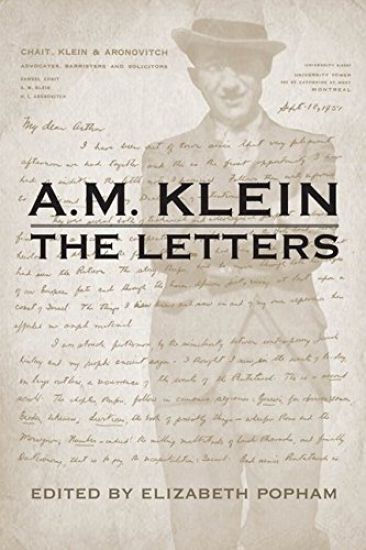
A.M. Klein: the Letters

A.M. Klein: the Letters

A.M. Klein

University of Toronto Press
2011
sidottu
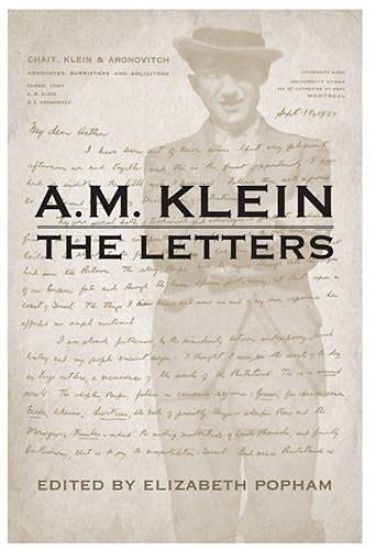
In the final volume of the Collected Works of A.M. Klein, Elizabeth Popham completes the process of restoring the public voice of one of Canada's most respected authors. A.M. Klein: The Letters is the first compilation of a significant body of Klein's correspondence. Using his communications to construct a compelling narrative, Popham traces Klein's career from his apprenticeship to great critical success and his tragically premature silence. The content of Klein's letters gives new resonance to his works, most notably to his critically acclaimed novel The Second Scroll (1951) and his Governor General Award-winning The Rocking Chair and Other Poems (1948). In his exchanges with publishers and scholars, Klein glosses his own writing and argues for the integrity of his poetic vision. Samplings of his correspondence with Seagram's Distilleries clarify Klein's controversial role as ghost-writer and PR consultant for Sam Bronfman. A valuable resource for understanding Canadian literary modernism, diasporic Judaism, and the culture of Montreal, A.M. Klein: The Letters is a remarkable portrait of an important Canadian literary figure of the twentieth century.
A.M. Klein The Letters

A.M. Klein The Letters

A.M. Klein

University of Toronto Press, Scholarly Publishing Division
2011
muu
A valuable resource for understanding Canadian literary modernism, diasporic Judaism, and the culture of Montreal, A.M. Klein: The Letters is a remarkable portrait of an important Canadian literary figure of the twentieth century.
A.M. Klein: Complete Poems

A.M. Klein: Complete Poems

A.M. Klein

University of Toronto Press
1990
pokkari
It is for his poetry that A.M. Klein is best known and most warmly remembered. This collection includes all Klein's poetry, both original works and translations from Hebrew, Yiddish, Aramaic, and Latin. Many of them, coming from all periods of his careers, have never been published. The poems are arranged chronologically according to date of composition. This makes possible, for the first time, an appreciation of Klein's poetic development. The editor's introduction places this development in the perspective of Klein's life and time, and in particular explores Klein's lifelong struggle to reconcile his dual vocations as both a Jewish and a modernist writer. The textual apparatus identifies all authoritative versions for each poem and lists all emendations and all substative variants in both published and mauscript versions. The explanatory notes gloss obscure terms and references. They also provide a rich context for appreciation and interpretation by drawing connections with Klein's life, his wide reading, and his work as a whole. Wherever possible, Klein's own numerous, but scattered, comments on his poems have been cited.
Notebooks

Notebooks

A.M. Klein

University of Toronto Press
1995
sidottu
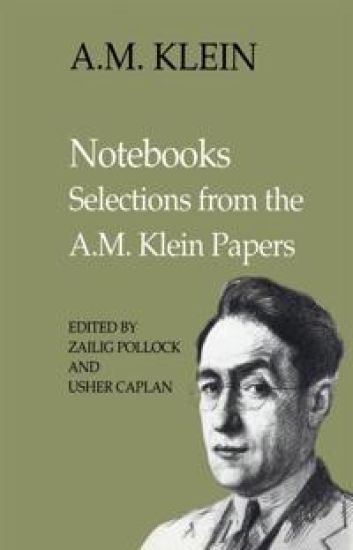
Much of A.M. Klein's finest prose is to be found in the mass of uncompleted work that he abandoned at the time of his breakdown, and that became accessible only when his papers were deposited in the National Archives. Notebooks offers a generous selection of this work, revealing previously unsuspected facets of Klein's character and artistry. The fiction, criticism, and memoirs collected here focus on Klein's exploration of the role of the artist. The works illuminate crucial periods of his career, especially the early 1940s, when he was transforming himself into a modernist, and the early 1950s, when he was struggling to overcome the misgivings about his art that were to lead to his final breakdown. The semi-autobiographical text which Klein referred to as 'Raw Material' and the unfinished novel of prison life entitled 'Stranger and Afraid' cast a new light on Klein's often frustrating relationship with the Montreal Jewish community. In 'Marginalia' he discusses poetic form and technique and makes observations on the nature of poetry, thereby providing insights into his own concerns as a writer. In 'The Golem,' a profoundly ambiguous treatment of the act of creation, a self-portrait emerges of a storyteller who has lost faith in the power and value of his story. The volume includes a critical introduction, that places the material in the context of Klein's other works, as well as textual and explanatory notes.
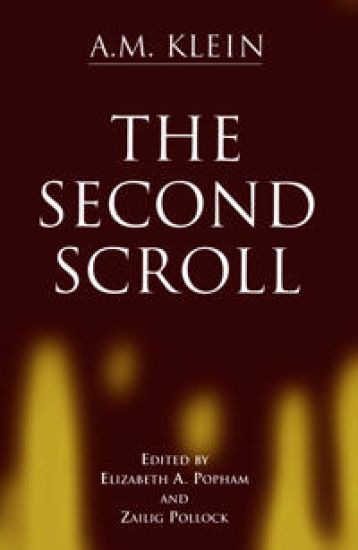
The Second Scroll

The Second Scroll

A.M. Klein

University of Toronto Press
2000
sidottu
The Second Scroll, the only novel by poet A.M. Klein, is an ambitious and complex work that interlaces prose, poetry, drama, and commentary. The narrative follows a Canadian Jew to the newly established state of Israel on a double mission - to collect the emerging national literature and to search for his Uncle Melech Davidson, a Holocaust survivor. Klein creates a modern Torah out of the uncle's crises of faith as he attempts to come to terms with the atrocities of the Second World War. The five chapters of The Second Scroll mirror the books of the Pentateuch (the 'first scroll') and the language is rich with biblical, talmudic, kabbalistic, and literary allusions as both the narrator and his uncle wrestle with the meaning of Jewish identity, messianic faith, and homecoming. Popham and Pollock's scholarly edition re-creates the feel of the Knopf publication of 1951-now a collector's item-but restores the text to Klein's original vision. This includes echoing the architectural structure of the Sistine Chapel in the physical layout of 'Gloss Gimel,' Klein's powerful commentary on Michelangelo's famous ceiling. Extensive annotations, and appendices that cross-reference the finished book to the raw material gathered during the author's trip to Israel and to the fund-raising speeches he delivered on his return, give the reader access to the process by which the novel took shape. A significant addition to UTP's Collected Works of A.M. Klein, and of interest not only to Klein scholars, The Second Scroll marks the inception of Holocaust literature and holds a central place in the Canadian literary canon.
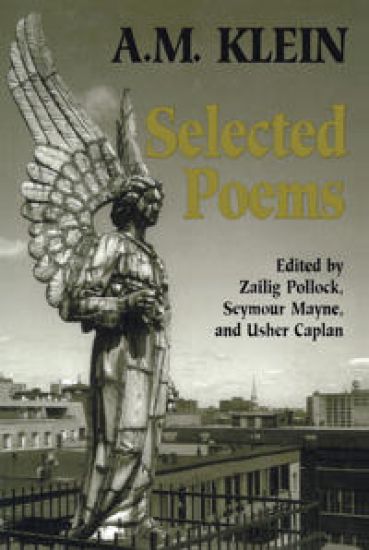
Selected Poems

Selected Poems

A.M. Klein

University of Toronto Press
1997
pokkari
Throughout his career A.M. Klein struggled to define for himself the role of the poet in the contemporary world. Deeply rooted in the traditions of Judaism, and at the same time powerfully attracted by the freedom and scope of international modernism, he sought to reconcile past and present, community and creative individuality. Whether or not he finally achieved his own high aims, it was, in his own words, 'something merely to entertain them.' The result was a body of work immensely rich and varied in tone, language, cultural resonance. This collection of eighty-four poems offers a representative sampling of Klein's finest poetry, while taking into account the changing critical discourse of the last fifty years. Anyone interested in experiencing the full range of Klein's poetic achievement, or in understanding the complex nature of the poet, need look no further than this eminently readable volume.
Notebooks

Notebooks

A.M. Klein

University of Toronto Press
1995
pokkari
Much of A.M. Klein's finest prose is to be found in the mass of uncompleted work that he abandoned at the time of his breakdown, and that became accessible only when his papers were deposited in the National Archives. Notebooks offers a generous selection of this work, revealing previously unsuspected facets of Klein's character and artistry. The fiction, criticism, and memoirs collected here focus on Klein's exploration of the role of the artist. The works illuminate crucial periods of his career, especially the early 1940s, when he was transforming himself into a modernist, and the early 1950s, when he was struggling to overcome the misgivings about his art that were to lead to his final breakdown. The semi-autobiographical text which Klein referred to as 'Raw Material' and the unfinished novel of prison life entitled 'Stranger and Afraid' cast a new light on Klein's often frustrating relationship with the Montreal Jewish community. In 'Marginalia' he discusses poetic form and technique and makes observations on the nature of poetry, thereby providing insights into his own concerns as a writer. In 'The Golem,' a profoundly ambiguous treatment of the act of creation, a self-portrait emerges of a storyteller who has lost faith in the power and value of his story. The volume includes a critical introduction, that places the material in the context of Klein's other works, as well as textual and explanatory notes.
Beyond Sambation

Beyond Sambation

A.M. Klein

UNIVERSITY OF TORONTO PRESS
1982
pokkari
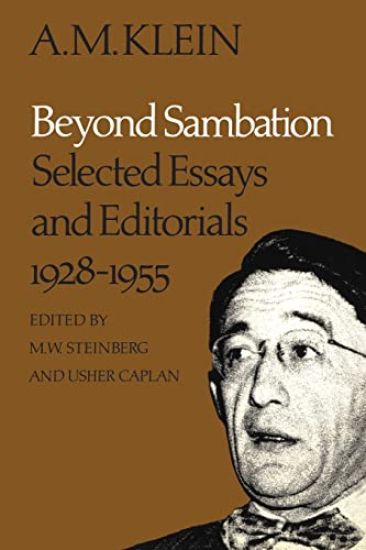
The broad range of A.M. Klein’s interests, ideas, and activities is reflected in this selection of articles, editorials, and reviews – a selection that also displays the qualities that distinguished all his creative writing and the highly idiosyncratic nature of his style. The writings in this volume span a most critical juncture in human affairs; a period that witnessed the Great Depression, the rise of fascism, Nazism, and communism, the Second World War, and the emergence of the State of Israel. As a journalist, Klein did more than record the events – he gave expression to the feelings of his people and helped shape their responses. His wide reading, sensitivity, and intelligence made him a perceptive observer and keen analyst, while his command of language, his passion, rhetoric, and wit, made him an eloquent spokesman. These qualities enabled him to carry out the responsibilities, as he saw them, of chronicler and champion. Though Klein’s major concern was with the Canadian Jewish scene, his interests were part of the mosaic of Canadian history and his work forms a chronicle and a commentary on events of world-wide significance. Klein’s journalism relates frequently, in both substance and language, to his poems and fiction, and thus provides a context for the study of his creative writing. It also reveals aspects of his personality, values, and commitments, contributing to our understanding and appreciation of one of Canada’s foremost writers.