
Kirjojen hintavertailu. Mukana 11 244 527 kirjaa ja 12 kauppaa.

Kirjahaku

Etsi kirjoja tekijän nimen, kirjan nimen tai ISBN:n perusteella.

3 kirjaa tekijältä Aaron Prevots

Bernard Vargaftig

Bernard Vargaftig

Aaron Prevots

Peter Lang International Academic Publishers
2019
nidottu
The French poet Bernard Vargaftig (1934–2012), first known in 1960s literary circles as a writer mentored by Aragon, published regularly and served on the editorial boards of Action poétique and Europe. His poetry foregrounds identity and alterity, eros and notions of self, an immediate present and an onrushing past. This book examines Vargaftig’s evolution and aims. It explores his postwar search for self-acceptance, ontological rootedness and shared forward paths. Using close readings of his poetry and prose, complemented by his comments in interviews, the book particularly considers his emphasis on the sacredness of words. His spiritual yearnings, as well as a need to heal due to lingering trauma from wartime hiding, are shown to underlie his focus on allusive imagery, recurring motifs and compact structures, where silence and sound interweave. Comparative analyses are used to show how his enthusiasm for the female Other attunes us to interpersonal bonds and to the outer world’s creative surge. The study of Vargaftig through the lens of gestures toward the sacred thus highlights poetry as a healing ritual, one that facilitates not only immersion in emotion and sensation, but also a continual process of renewal and self-discovery.
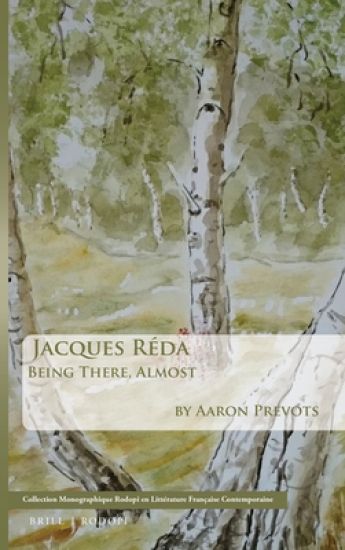
Jacques Réda

Jacques Réda

Aaron Prevots

BRILL
2016
sidottu
In Jacques Réda: Being There, Almost, Aaron Prevots studies the work of this major contemporary French writer since the 1950s—poetry, novels, literary essays, short prose, jazz histories. He particularly examines Réda’s explorations of place, including how the ‘world’s energy’ becomes the ideal dancing partner, poetry incarnate in one’s arms. Réda embodies ‘being there, almost’ because he wanders with great wisdom yet renounces any glory in this metaphorical dance. He aligns us with the outer world’s rhythms and time’s passage. Fleeting waves of perception create a voluptuous, unified whole. In considering the arc of Réda’s works from 1952-2015, Aaron Prevots locates a progression from post-Baudelairean flânerie to commemoration of childhood, classical antiquity, fellow writers, jazz, physics, swing, theology, and trains.
Esther Tellermann

Esther Tellermann

Aaron Prevots

BRILL
2022
sidottu
Dans Esther Tellermann: Énigme, prière, identité, première monographie consacrée à l’œuvre de l’écrivain, Aaron Prevots met en lumière un regard poétique novateur sur des réalités tant intérieures qu’extérieures. Il montre comment Tellermann (1947-) explore l’intime du monde, ses textures et ses contours, ses terres insituables semblant s’entrecroiser, et le rêve et le mythe faits tremplin pour une traversée renouvelée de l’Histoire et du deuil. Il appréhende le caractère énigmatique de longues suites de chants dont la forme peut s’apparenter à celle de la prière, ainsi que les enjeux identitaires d’un dire singulièrement ouvert à l’Autre. En examinant des textes de 1999-2019, Aaron Prevots souligne le lyrisme décentré d’un poète majeur et la présence de ses pairs comme interlocuteurs. In Esther Tellermann: Enigma, Prayer, Identity, the first book-length study of the writer’s œuvre, Aaron Prevots highlights her innovative poetic approach to inner and outer realities. He shows how Tellermann (1947-) explores the world’s innermost structures, its textures and contours, its indeterminate places that seemingly intersect, and dreams and myth as springboards for experiencing anew historical turning points and timeless rites of mourning. He considers the enigmatic quality of long suites of poetic song whose form can resemble that of prayer, as well as the stakes regarding identity when poetic expression foregrounds openness to the Other. In examining texts from 1999-2019, Aaron Prevots emphasizes this major poet’s decentered lyricism and the presence of fellow writers as interlocutors.