Kirjojen hintavertailu. Mukana 11 534 150 kirjaa ja 12 kauppaa.

Kirjahaku

Etsi kirjoja tekijän nimen, kirjan nimen tai ISBN:n perusteella.

15 kirjaa tekijältä Abraham Flexner

The Flexner Report: Medical Education in the United States and Canada-A Report to the Carnegie Foundation for the Advancement of Teaching
"The improvement of medical education cannot therefore be resisted on the ground that it will destroy schools and restrict output: that is precisely what is needed."-Abraham Flexner, The Flexner Report (1910)The Flexner Report-Medical Education in the United States and Canada (1910) by Abraham Flexner is the foundation for medical education today. The report was developed to investigate American medical schools and provide standards for them since few guidelines were in place in the early twentieth century. The American Medical Association contracted with the Carnegie Foundation to conduct the study and chose an educator, Flexner, as its leader. The author personally visited over 150 medical institutions and, in some cases, harshly described the conditions which consequently forced the closure of numerous schools. This book-length report is an intriguing read for anyone curious about the foundations of medical education.
The Usefulness of Useless Knowledge

The Usefulness of Useless Knowledge

Abraham Flexner

PRINCETON UNIVERSITY PRESS
2017
sidottu
A short, provocative book about why "useless" science often leads to humanity's greatest technological breakthroughs A forty-year tightening of funding for scientific research has meant that resources are increasingly directed toward applied or practical outcomes, with the intent of creating products of immediate value. In such a scenario, it makes sense to focus on the most identifiable and urgent problems, right? Actually, it doesn't. In his classic essay "The Usefulness of Useless Knowledge," Abraham Flexner, the founding director of the Institute for Advanced Study in Princeton and the man who helped bring Albert Einstein to the United States, describes a great paradox of scientific research. The search for answers to deep questions, motivated solely by curiosity and without concern for applications, often leads not only to the greatest scientific discoveries but also to the most revolutionary technological breakthroughs. In short, no quantum mechanics, no computer chips. This brief book includes Flexner's timeless 1939 essay alongside a new companion essay by Robbert Dijkgraaf, the Institute's current director, in which he shows that Flexner's defense of the value of "the unobstructed pursuit of useless knowledge" may be even more relevant today than it was in the early twentieth century. Dijkgraaf describes how basic research has led to major transformations in the past century and explains why it is an essential precondition of innovation and the first step in social and cultural change. He makes the case that society can achieve deeper understanding and practical progress today and tomorrow only by truly valuing and substantially funding the curiosity-driven "pursuit of useless knowledge" in both the sciences and the humanities.
Universities

Universities

Abraham Flexner

Transaction Publishers
1994
nidottu
Reprint of the Oxford University Press edition of 1930, with a long new introduction by Clark Kerr. Annotation copyright Book News, Inc. Portland, Or.
Medical Education in Europe: A Report to the Carnegie Foundation for the Advancement of Teaching
"...only by effective legislation can the general public be adequately protected from exploitation by an army of ill-trained doctors, quacks, and charlatans."-Henry S. Pritchett, Introduction to Medical Education in Europe (1912)Medical Education in Europe (1912) by Abraham Flexner presents further research by the author following his landmark study of medical education in the US and Canada in The Flexner Report (1910), also available from Cosimo Reports. The report contains Flexner's insightful assessment of medical institutions in England, Scotland, the German Empire, Austria, and France. Flexner's call for more rigid standards heavily influenced the European medical community. Funded by The Carnegie Foundation, this book-length report is for those interested in education and the medical world abroad.
Die Universitäten in Amerika · England · Deutschland

Die Universitäten in Amerika · England · Deutschland

Abraham Flexner

Springer-Verlag Berlin and Heidelberg GmbH Co. K
1932
nidottu
Dieser Buchtitel ist Teil des Digitalisierungsprojekts Springer Book Archives mit Publikationen, die seit den Anfängen des Verlags von 1842 erschienen sind. Der Verlag stellt mit diesem Archiv Quellen für die historische wie auch die disziplingeschichtliche Forschung zur Verfügung, die jeweils im historischen Kontext betrachtet werden müssen. Dieser Titel erschien in der Zeit vor 1945 und wird daher in seiner zeittypischen politisch-ideologischen Ausrichtung vom Verlag nicht beworben.
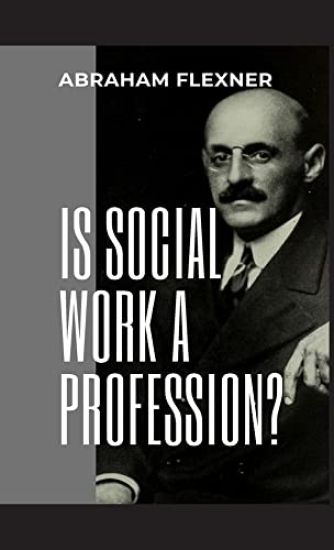
Is social work a profession?

Is social work a profession?

Abraham Flexner

Alpha Edition
2019
pokkari
This book has been considered by academicians and scholars of great significance and value to literature. This forms a part of the knowledge base for future generations. So that the book is never forgotten we have represented this book in a print format as the same form as it was originally first published. Hence any marks or annotations seen are left intentionally to preserve its true nature.
Is Social Work a Profession?

Is Social Work a Profession?

Abraham Flexner

MJP Publisher
2022
sidottu
This work has been selected by scholars as being culturally important, and is part of the knowledge base of civilization as we know it.This work is in the "public domain in the United States of America, and possibly other nations. Within the United States, you may freely copy and distribute this work, as no entity (individual or corporate) has a copyright on the body of the work.Scholars believe, and we concur, that this work is important enough to be preserved, reproduced, and made generally available to the public. We appreciate your support of the preservation process, and thank you for being an important part of keeping this knowledge alive and relevant.