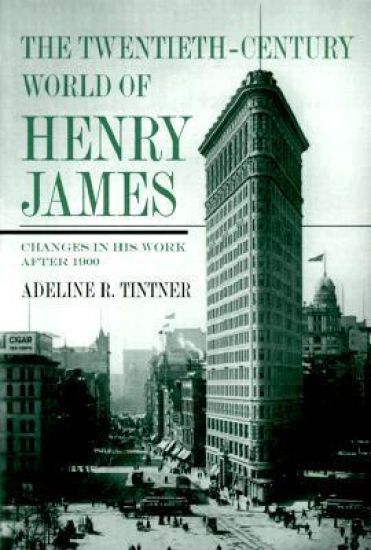
The Twentieth-Century World of Henry James
Adeline R. Tintner
Louisiana State University Press
2000
sidottu
Conventional analyses of Henry James conclude with the completed novels of the major phase and the revisions of the New York Edition (1907- 1909). -However, James lived on to write vigorously for nearly a decade longer. In this compelling study, Adeline R. Tintner- perhaps the foremost living James scholar- focuses her expertise on the writer's final years, exploring how his work developed and how his ideas changed in response to events in the twentieth century. As Tintner illustrates, despite his age and the long career behind him, James heralded in his later works the modernism that would be most fully represented by Joyce, Eliot, and Proust.The twentieth century came to life for James during his long-delayed visit to America in 1904 and 1905. This trip resulted in his critical look at his native country, The American Scene (1907), a book Tintner argues is only now beginning to be appreciated. The trip also revitalized his review of his body of work in the famed New York Edition. Tintner explores James's revisions of his earlier novels, especially of Roderick Hudson, The American, and, most important, the retouched Portrait of a Lady, in which he refined Isabel Archer's aesthetic tastes to match his own. She also reads James's late autobiographical writings as a form of experimental fiction that would be the hallmark of twentieth-century modernism. Indeed, Tintner explains that James's final writings demonstrate how he thoroughly embraced the new century and anticipated several of the chief ideas that would dominate modern literature. He reacted to the new economy and to the preoccupation with money in his unfinished novel The Ivory Tower; explored the idea of the interaction between historical time and the present with his uncompleted The Sense of the Past; and expressed concern with the deprivation of culture among the lower middle classes. The ""flying machine,"" the ""cinematograph,"" and the ""Kodak"" entered his twentieth-century vocabulary, and he parodied his own ""usurping consciousness"" in his ""Monologue for Ruth Draper."" James even relaxed his treatment of sexuality, as is apparent in his suggestion of autoeroticism in ""The Figure in the Carpet"" and in what seems to be a description of the gay scene in The Sacred Fount. He became a propagandist during World War I, devoting the end of his career to urging American entry into the conflict. His last published writings before he died of a stroke on February 28, 1916, were emotional tributes to casualties of the war. A fitting finale to Tintner's five astonishing works on ""the world of Henry James,"" The Twentieth--Century World of Henry James will stand as one of the most significant volumes on the writer's last years. Through an amazing excavation of James's life and work, Tintner uncovers many of the modernist themes that preoccupied him as he entered the new century and that, in turn, were to preoccupy many of the writers who came to maturity in the first half of the twentieth century.