Kirjojen hintavertailu. Mukana 11 509 941 kirjaa ja 12 kauppaa.

Kirjahaku

Etsi kirjoja tekijän nimen, kirjan nimen tai ISBN:n perusteella.

2 kirjaa tekijältä Adrian Anagnost

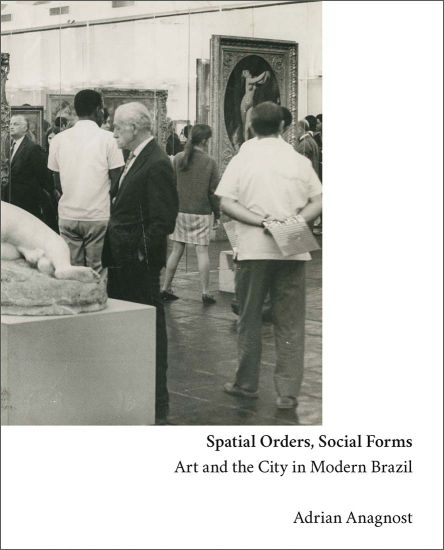
Spatial Orders, Social Forms

Spatial Orders, Social Forms

Adrian Anagnost

Yale University Press
2022
sidottu
A fascinating look at modernist urban planning and spatial theories in Brazilian 20th-century art and architecture Exploring the intersections among art, architecture, and urbanism in Brazil from the 1920s through the 1960s, Adrian Anagnost shows how modernity was manifested in locally specific spatial forms linked to Brazil’s colonial and imperial past. Discussing the ways artists and architects understood urban planning as a tool to reorganize the world, control human action, and remedy social problems, Anagnost offers a nuanced account of the seeming conflict between modernist aesthetics and a predominately poor and historically disenfranchised urban public, with particular attention to regionalist forms of urban development. Organized as a series of case studies of projects such as Flávio de Carvalho's performative urbanism, the construction of the Ministry of Education and Public Health building, Lina Bo and Pietro Maria Bardi's efforts to modernize Brazilian museums, and Hélio Oiticica's interstitial works, this study is full of groundbreaking insights into the ways that modernist theories of urbanism shaped the art and architecture of 20th-century Brazil.
De-Globalizing the Art World

De-Globalizing the Art World

Adrian Anagnost

ANTHEM PRESS
2026
nidottu
This book examines documenta fifteen (2022) as a turning point in global art politics, from ruangrupa's Indonesian lumbung model to Palestinian cultural infrastructures. It traces how debates over collectivity, decolonisation, and memory politics reveal the contradictions of globalisation, financialisation, and contemporary art's search for rootedness. De-globalizing the Art World charts the shifting terrain of contemporary art, from the ambitious internationalism of the 1990s to the fractured, contested landscapes of the 2020s. At its centre is documenta fifteen, curated by the Indonesian collective ruangrupa, whose lumbung model sought to reimagine artistic infrastructure around resource-sharing and collectivity. While celebrated globally, the exhibition also became the site of fierce controversy in Germany, revealing how postcolonial critique collided with national memory politics and entrenched debates on antisemitism. The book situates documenta fifteen within a longer history of biennials, mega-exhibitions, and collective practices, while tracing the insufficiencies of these models for grappling with cultural infrastructures in politically fractured contexts. This book highlights how cultural infrastructures from Jakarta to Ramallah navigated NGOisation, donor regimes, and financialised economies. By pairing close analysis of Indonesian and Palestinian art worlds with German debates (especially those of the Antideutsche), this book reveals documenta fifteen as a crucible for broader questions about globalisation, memory politics, and the contradictions of collective art-making today. Drawing on curatorial theory, political economy, and cultural infrastructures, this book shows how the art world has shifted from expansive visions of transnational solidarity to a more fraught politics of rootedness, identity, and site-specific belonging. De-globalizing the Art World provides a critical lens for understanding contemporary art's role in broader debates on globalisation, decolonisation, and the limits of collectivism in a de-globalising world.