Kirjojen hintavertailu. Mukana 12 016 292 kirjaa ja 12 kauppaa.

Kirjahaku

Etsi kirjoja tekijän nimen, kirjan nimen tai ISBN:n perusteella.

11 kirjaa tekijältä Adrian Bejan

Convection Heat Transfer

Convection Heat Transfer

Adrian Bejan

John Wiley Sons Inc
2013
sidottu
A new edition of the bestseller on convection heat transfer A revised edition of the industry classic, Convection Heat Transfer, Fourth Edition, chronicles how the field of heat transfer has grown and prospered over the last two decades. This new edition is more accessible, while not sacrificing its thorough treatment of the most up-to-date information on current research and applications in the field. One of the foremost leaders in the field, Adrian Bejan has pioneered and taught many of the methods and practices commonly used in the industry today. He continues this book's long-standing role as an inspiring, optimal study tool by providing: Coverage of how convection affects performance, and how convective flows can be configured so that performance is enhancedHow convective configurations have been evolving, from the flat plates, smooth pipes, and single-dimension fins of the earlier editions to new populations of configurations: tapered ducts, plates with multiscale features, dendritic fins, duct and plate assemblies (packages) for heat transfer density and compactness, etc.New, updated, and enhanced examples and problems that reflect the author's research and advances in the field since the last editionA solutions manual Complete with hundreds of informative and original illustrations, Convection Heat Transfer, Fourth Edition is the most comprehensive and approachable text for students in schools of mechanical engineering.
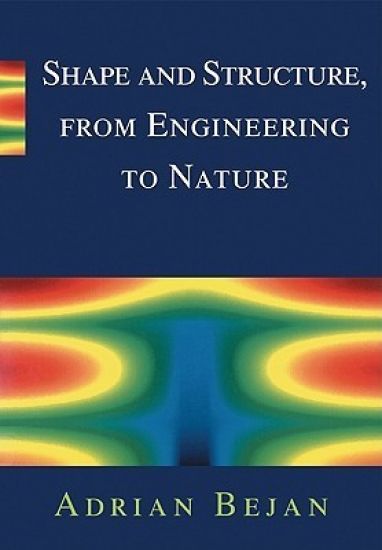
Shape and Structure, from Engineering to Nature

Shape and Structure, from Engineering to Nature

Adrian Bejan

Cambridge University Press
2000
sidottu
Seemingly universal geometric forms unite the flow systems of engineering and nature. For example, tree-shaped flows can be seen in computers, lungs, dendritic crystals, urban street patterns, and communication links. In this groundbreaking book, first published in 2000, Adrian Bejan considers the design and optimization of engineered systems and discovers a deterministic principle of the generation of geometric form in natural systems. Shape and structure spring from the struggle for better performance in both engineering and nature. This idea is the basis of the new constructal theory: the objective and constraints principle used in engineering is the same mechanism from which the geometry in natural flow systems emerges. From heat exchangers to river channels, the book draws many parallels between the engineered and the natural world. Among the topics covered are mechanical structure, thermal structure, heat trees, ducts and rivers, turbulent structure, and structure in transportation and economics. The numerous illustrations, examples, and homework problems in every chapter make this an ideal text for engineering design courses. Its provocative ideas will also appeal to a broad range of readers in engineering, natural sciences, economics, and business.
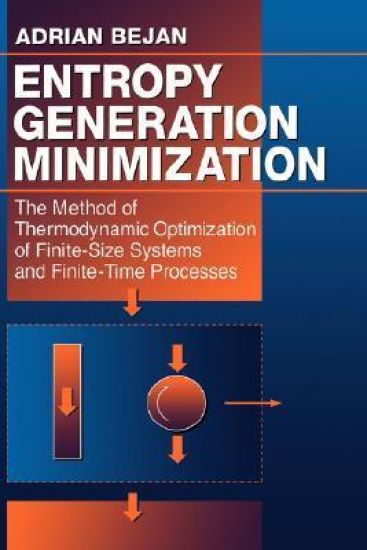
Entropy Generation Minimization

Entropy Generation Minimization

Adrian Bejan

CRC Press Inc
1995
sidottu
This book presents the diverse and rapidly expanding field of Entropy Generation Minimization (EGM), the method of thermodynamic optimization of real devices. The underlying principles of the EGM method - also referred to as "thermodynamic optimization," "thermodynamic design," and "finite time thermodynamics" - are thoroughly discussed, and the method's applications to real devices are clearly illustrated. The EGM field has experienced tremendous growth during the 1980s and 1990s. This book places EGM's growth in perspective by reviewing both sides of the field - engineering and physics. Special emphasis is given to chronology and to the relationship between the more recent work and the pioneering work that outlined the method and the field. Entropy Generation Minimization combines the fundamental principles of thermodynamics, heat transfer, and fluid mechanics. EGM applies these principles to the modeling and optimization of real systems and processes that are characterized by finite size and finite time constraints, and are limited by heat and mass transfer and fluid flow irreversibilities. Entropy Generation Minimization provides a straightforward presentation of the principles of the EGM method, and features examples that elucidate concepts and identify recent EGM advances in engineering and physics. Modern advances include the optimization of storage by melting and solidification; heat exchanger design; power from hot-dry-rock deposits; the on & off operation of defrosting refrigerators and power plants with fouled heat exchangers; the production of ice and other solids; the maximization of power output in simple power plant models with heat transfer irreversibilities; the minimization of refrigerator power input in simple models; and the optimal collection and use of solar energy.
Advanced Engineering Thermodynamics

Advanced Engineering Thermodynamics

Adrian Bejan

John Wiley Sons Inc
2016
sidottu
An advanced, practical approach to the first and second laws of thermodynamics Advanced Engineering Thermodynamics bridges the gap between engineering applications and the first and second laws of thermodynamics. Going beyond the basic coverage offered by most textbooks, this authoritative treatment delves into the advanced topics of energy and work as they relate to various engineering fields. This practical approach describes real-world applications of thermodynamics concepts, including solar energy, refrigeration, air conditioning, thermofluid design, chemical design, constructal design, and more. This new fourth edition has been updated and expanded to include current developments in energy storage, distributed energy systems, entropy minimization, and industrial applications, linking new technologies in sustainability to fundamental thermodynamics concepts. Worked problems have been added to help students follow the thought processes behind various applications, and additional homework problems give them the opportunity to gauge their knowledge. The growing demand for sustainability and energy efficiency has shined a spotlight on the real-world applications of thermodynamics. This book helps future engineers make the fundamental connections, and develop a clear understanding of this complex subject. Delve deeper into the engineering applications of thermodynamicsWork problems directly applicable to engineering fieldsIntegrate thermodynamics concepts into sustainability design and policyUnderstand the thermodynamics of emerging energy technologies Condensed introductory chapters allow students to quickly review the fundamentals before diving right into practical applications. Designed expressly for engineering students, this book offers a clear, targeted treatment of thermodynamics topics with detailed discussion and authoritative guidance toward even the most complex concepts. Advanced Engineering Thermodynamics is the definitive modern treatment of energy and work for today's newest engineers.
Heat Transfer

Heat Transfer

Adrian Bejan

Wiley-Blackwell
2022
sidottu
HEAT TRANSFER Provides authoritative coverage of the fundamentals of heat transfer, written by one of the most cited authors in all of Engineering Heat Transfer presents the fundamentals of the generation, use, conversion, and exchange of heat between physical systems. A pioneer in establishing heat transfer as a pillar of the modern thermal sciences, Professor Adrian Bejan presents the fundamental concepts and problem-solving methods of the discipline, predicts the evolution of heat transfer configurations, the principles of thermodynamics, and more. Building upon his classic 1993 book Heat Transfer, the author maintains his straightforward scientific approach to teaching essential developments such as Fourier conduction, fins, boundary layer theory, duct flow, scale analysis, and the structure of turbulence. In this new volume, Bejan explores topics and research developments that have emerged during the past decade, including the designing of convective flow and heat and mass transfer, the crucial relationship between configuration and performance, and new populations of configurations such as tapered ducts, plates with multi-scale features, and dendritic fins. Heat Transfer: Evolution, Design and Performance: Covers thermodynamics principles and establishes performance and evolution as fundamental concepts in thermal sciencesDemonstrates how principles of physics predict a future with economies of scale, multi-scale design, vascularization, and hierarchical distribution of many small featuresExplores new work on conduction architecture, convection with nanofluids, boiling and condensation on designed surfaces, and resonance of natural circulation in enclosuresIncludes numerous examples, problems with solutions, and access to a companion website Heat Transfer: Evolution, Design and Performance is essential reading for undergraduate and graduate students in mechanical and chemical engineering, and for all engineers, physicists, biologists, and earth scientists.
Freedom and Evolution

Freedom and Evolution

Adrian Bejan

Springer Nature Switzerland AG
2019
sidottu
The book begins with familiar designs found all around and inside us (such as the ‘trees’ of river basins, human lungs, blood and city traffic). It then shows how all flow systems are driven by power from natural engines everywhere, and how they are endlessly shaped because of freedom. Finally, Professor Bejan explains how people, like everything else that moves on earth, are driven by power derived from our “engines” that consume fuel and food, and that our movement dissipates the power completely and changes constantly for greater access, economies of scale, efficiency, innovation and life. Written for wide audiences of all ages, including readers interested in science, patterns in nature, similarity and non-uniformity, history and the future, and those just interested in having fun with ideas, the book shows how many “design change” concepts acquire a solid scientific footing and how they exist with the evolution of nature, society, technology and science.
Freedom and Evolution

Freedom and Evolution

Adrian Bejan

Springer Nature Switzerland AG
2020
nidottu
The book begins with familiar designs found all around and inside us (such as the ‘trees’ of river basins, human lungs, blood and city traffic). It then shows how all flow systems are driven by power from natural engines everywhere, and how they are endlessly shaped because of freedom. Finally, Professor Bejan explains how people, like everything else that moves on earth, are driven by power derived from our “engines” that consume fuel and food, and that our movement dissipates the power completely and changes constantly for greater access, economies of scale, efficiency, innovation and life. Written for wide audiences of all ages, including readers interested in science, patterns in nature, similarity and non-uniformity, history and the future, and those just interested in having fun with ideas, the book shows how many “design change” concepts acquire a solid scientific footing and how they exist with the evolution of nature, society, technology and science.
Time And Beauty: Why Time Flies And Beauty Never Dies

Time And Beauty: Why Time Flies And Beauty Never Dies

Adrian Bejan

WORLD SCIENTIFIC PUBLISHING CO PTE LTD
2022
sidottu
Time and beauty are two of our most visceral perceptions. Yet, their nature is seldom questioned. In this ground-breaking new work, Adrian Bejan — a true 'original' among physicists — explains, in a scholarly yet colorful style, the scientific basis for the perception of time and beauty.Organized into three main ideas, the book begins first with the perception of time. The author expounds on why we feel that time flies faster as we get older. Perceived time, also called 'mind time,' is different from clock time. In this context, time is another word for 'perceived change'. Next, readers will discover that beauty is appealing because beautifully-shaped images are scanned faster by two eyes. To observe our immediate surroundings and to understand them faster is highly advantageous to survival; hence, there is an underlying evolutionary advantage to our discernment for ideal ratios, shapes, and beauty at large. Finally, time and beauty are jointly understood to explain why the global pandemic had decelerated our mind time. This understanding arms us with techniques to slow down our mind time (which accelerates with age), and to create the conditions for living longer and more creatively.Scientists may have contemplated aspects of time and beauty separately. In contrast, the author submits an original and rewarding approach to understanding them together. In the process, key questions to our cognition are answered. Why does the mind 'try' to make sense of a new mental image? Why is there a natural tendency to organize a new input and mentally position it among past perceptions? Through physics, the book offers a general answer: to empower the individual with speed and clarity of thought, understanding, decision-making and movement. The same answer holds for the other disparate perceptions illustrated in this book, from time and beauty to ideas, message, shape, perspective, art, science, illusions, and dreams.
Time And Beauty: Why Time Flies And Beauty Never Dies

Time And Beauty: Why Time Flies And Beauty Never Dies

Adrian Bejan

WORLD SCIENTIFIC PUBLISHING CO PTE LTD
2022
nidottu
Time and beauty are two of our most visceral perceptions. Yet, their nature is seldom questioned. In this ground-breaking new work, Adrian Bejan — a true 'original' among physicists — explains, in a scholarly yet colorful style, the scientific basis for the perception of time and beauty.Organized into three main ideas, the book begins first with the perception of time. The author expounds on why we feel that time flies faster as we get older. Perceived time, also called 'mind time,' is different from clock time. In this context, time is another word for 'perceived change'. Next, readers will discover that beauty is appealing because beautifully-shaped images are scanned faster by two eyes. To observe our immediate surroundings and to understand them faster is highly advantageous to survival; hence, there is an underlying evolutionary advantage to our discernment for ideal ratios, shapes, and beauty at large. Finally, time and beauty are jointly understood to explain why the global pandemic had decelerated our mind time. This understanding arms us with techniques to slow down our mind time (which accelerates with age), and to create the conditions for living longer and more creatively.Scientists may have contemplated aspects of time and beauty separately. In contrast, the author submits an original and rewarding approach to understanding them together. In the process, key questions to our cognition are answered. Why does the mind 'try' to make sense of a new mental image? Why is there a natural tendency to organize a new input and mentally position it among past perceptions? Through physics, the book offers a general answer: to empower the individual with speed and clarity of thought, understanding, decision-making and movement. The same answer holds for the other disparate perceptions illustrated in this book, from time and beauty to ideas, message, shape, perspective, art, science, illusions, and dreams.