Kirjojen hintavertailu. Mukana 11 717 486 kirjaa ja 12 kauppaa.

Kirjahaku

Etsi kirjoja tekijän nimen, kirjan nimen tai ISBN:n perusteella.

15 kirjaa tekijältä Adrian Johnston

A New German Idealism

A New German Idealism

Adrian Johnston

Columbia University Press
2018
sidottu
In 2012, philosopher and public intellectual Slavoj Žižek published what arguably is his magnum opus, the one-thousand-page tome Less Than Nothing: Hegel and the Shadow of Dialectical Materialism. A sizable sequel appeared in 2014, Absolute Recoil: Towards a New Foundation of Dialectical Materialism. In these two books, Žižek returns to the German idealist G. W. F. Hegel in order to forge a new materialism for the twenty-first century. Žižek’s reinvention of Hegelian dialectics explores perennial and contemporary concerns: humanity’s relations with nature, the place of human freedom, the limits of rationality, the roles of spirituality and religion, and the prospects for radical sociopolitical change.In A New German Idealism, Adrian Johnston offers a first-of-its-kind sustained critical response to Less Than Nothing and Absolute Recoil. Johnston, a leading authority on and interlocutor of Žižek, assesses the recent return to Hegel against the backdrop of Kantian and post-Kantian German idealism. He also presents alternate reconstructions of Hegel’s positions that differ in important respects from Žižek’s version of dialectical materialism. In particular, Johnston criticizes Žižek’s deviations from the secular naturalism and Enlightenment optimism of his chosen sources of inspiration: not only Hegel, but Karl Marx and Sigmund Freud too. In response, Johnston develops what he calls transcendental materialism, an antireductive and leftist materialism capable of preserving and advancing the core legacies of the Hegelian, Marxian, and Freudian traditions central to Žižek.

A New German Idealism

A New German Idealism

Adrian Johnston

Columbia University Press
2019
pokkari
In 2012, philosopher and public intellectual Slavoj Žižek published what arguably is his magnum opus, the one-thousand-page tome Less Than Nothing: Hegel and the Shadow of Dialectical Materialism. A sizable sequel appeared in 2014, Absolute Recoil: Towards a New Foundation of Dialectical Materialism. In these two books, Žižek returns to the German idealist G. W. F. Hegel in order to forge a new materialism for the twenty-first century. Žižek’s reinvention of Hegelian dialectics explores perennial and contemporary concerns: humanity’s relations with nature, the place of human freedom, the limits of rationality, the roles of spirituality and religion, and the prospects for radical sociopolitical change.In A New German Idealism, Adrian Johnston offers a first-of-its-kind sustained critical response to Less Than Nothing and Absolute Recoil. Johnston, a leading authority on and interlocutor of Žižek, assesses the recent return to Hegel against the backdrop of Kantian and post-Kantian German idealism. He also presents alternate reconstructions of Hegel’s positions that differ in important respects from Žižek’s version of dialectical materialism. In particular, Johnston criticizes Žižek’s deviations from the secular naturalism and Enlightenment optimism of his chosen sources of inspiration: not only Hegel, but Karl Marx and Sigmund Freud too. In response, Johnston develops what he calls transcendental materialism, an antireductive and leftist materialism capable of preserving and advancing the core legacies of the Hegelian, Marxian, and Freudian traditions central to Žižek.
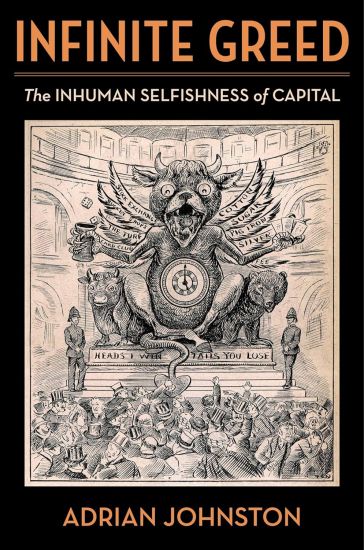
Infinite Greed

Infinite Greed

Adrian Johnston

Columbia University Press
2024
sidottu
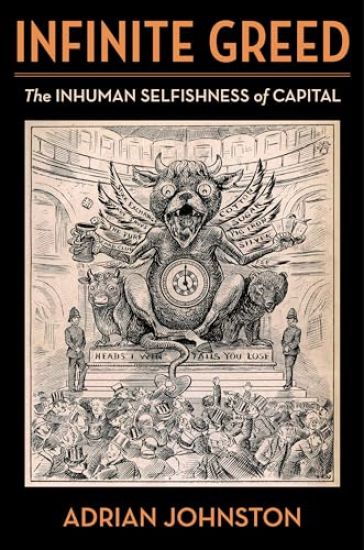
Selfishness is essential to capitalism—or so both advocates and opponents claim. In Infinite Greed, Adrian Johnston argues that this consensus is mistaken. Through a novel synthesis of Marxism and psychoanalysis, he reveals how the relentless pursuit of profits is not fundamentally animated by human acquisitiveness. Instead, capitalism’s strange “infinite greed” demands that individuals sacrifice their pleasures, their well-being, and even themselves to serve inhuman capital.Johnston traces the mechanisms that compel capitalist subjects to obey the cold imperative to accumulate in perpetuity and without limits—and also without regard for the consequences for everyone and everything else. Facing crises such as spiraling wealth inequality and the profit-driven prospect of a looming ecological apocalypse, the rational self-interest of the majority would seem to dictate putting a stop to capitalist accumulation. By bringing together the Marxian critique of political economy with psychoanalytic metapsychology, Johnston shows why and how capitalism, rather than being responsive to people’s rationally selfish interests, disregards and overrides them instead.Unlike previous syntheses of Marxism and psychoanalysis, Infinite Greed pairs Freudian and Lacanian concepts with the economic heart of Marx’s historical materialism. In so doing, Johnston brings to light the complex intertwining of political and libidinal economies keeping us invested and complicit in perpetuating capitalism and its ills.
Infinite Greed

Infinite Greed

Adrian Johnston

Columbia University Press
2024
pokkari
Selfishness is essential to capitalism—or so both advocates and opponents claim. In Infinite Greed, Adrian Johnston argues that this consensus is mistaken. Through a novel synthesis of Marxism and psychoanalysis, he reveals how the relentless pursuit of profits is not fundamentally animated by human acquisitiveness. Instead, capitalism’s strange “infinite greed” demands that individuals sacrifice their pleasures, their well-being, and even themselves to serve inhuman capital.Johnston traces the mechanisms that compel capitalist subjects to obey the cold imperative to accumulate in perpetuity and without limits—and also without regard for the consequences for everyone and everything else. Facing crises such as spiraling wealth inequality and the profit-driven prospect of a looming ecological apocalypse, the rational self-interest of the majority would seem to dictate putting a stop to capitalist accumulation. By bringing together the Marxian critique of political economy with psychoanalytic metapsychology, Johnston shows why and how capitalism, rather than being responsive to people’s rationally selfish interests, disregards and overrides them instead.Unlike previous syntheses of Marxism and psychoanalysis, Infinite Greed pairs Freudian and Lacanian concepts with the economic heart of Marx’s historical materialism. In so doing, Johnston brings to light the complex intertwining of political and libidinal economies keeping us invested and complicit in perpetuating capitalism and its ills.
Adventures in Transcendental Materialism

Adventures in Transcendental Materialism

Adrian Johnston

Edinburgh University Press
2014
sidottu
Adrian Johnston's transcendental materialism offers a new theoretical approach to the issues of science vs religion and mind vs body. Arming himself with resources provided by German idealism, Marxism, psychoanalysis, the life sciences and contemporary philosophical developments, Johnston formulates an account of subjectivity that, although being both materialist and naturalist, does full justice to human beings as irreducible to natural matter alone. At the same time he argues against relapses into idealisms, dualisms and spiritualisms. 'Adventures in Transcendental Materialism' elaborates Johnston's position through critical engagements with some of today's most important thinkers including Slavoj Zizek, Alain Badiou, Catherine Malabou, Jean-Claude Milner, Martin Hagglund, William Connolly and Jane Bennett.
Adventures in Transcendental Materialism

Adventures in Transcendental Materialism

Adrian Johnston

Edinburgh University Press
2014
nidottu
This book deals with a new materialist theory of subjectivity mobilising philosophy, psychoanalysis, politics and science. Armed with resources provided by German idealism, Marxism, psychoanalysis, the life sciences and contemporary philosophy, Johnston formulates an account of subjectivity that is both materialist and naturalist, and does full justice to human beings as irreducible to natural matter alone. At the same time, he argues against relapses into idealisms, dualisms and spiritualisms. It critically engages with some of today's most important thinkers, including Slavoj Zizek, Alain Badiou, Catherine Malabou, Jean-Claude Milner, Martin Hagglund, William Connolly and Jane Bennett. It is split into three parts: Zizek: Dossier of an Ongoing Debate; Psychoanalysis: The Unconscious between Philosophy, Science and Religion; and, Politics: True and False Utopias. It combines Continental-style philosophy with science.
Zizek's Ontology

Zizek's Ontology

Adrian Johnston

Northwestern University Press
2008
nidottu
Slavoj Zizek is one of the most interesting and important philosophers working today, known chiefly for his theoretical explorations of popular culture and contemporary politics. This book focuses on the generally neglected and often overshadowed philosophical core of Zizek's work - an essential component in any true appreciation of this unique thinker's accomplishment.His central concern, Zizek has proclaimed, is to use psychoanalysis (especially the teachings of Jacques Lacan) to redeploy the insights of late-modern German philosophy, in particular, the thought of Kant, Schelling, and Hegel. By taking this avowal seriously, Adrian Johnston finally clarifies the philosophical project underlying Zizek's efforts. His book charts the interlinked ontology and theory of subjectivity constructed by Zizek at the intersection of German idealism and Lacanian theory. Johnston also uses Zizek's combination of philosophy and psychoanalysis to address two perennial philosophical problems: the relationship of mind and body, and the nature of human freedom.By bringing together the past two centuries of European philosophy, psychoanalytic metapsychology, and cutting-edge work in the natural sciences, Johnston develops a transcendental materialist theory of subjectivity - in short, an account of how more-than-material forms of subjectivity can emerge from a corporeal being. His work shows how an engagement with Zizek's philosophy can produce compelling answers to today's most vexing and urgent questions as inherited from the history of ideas.
Badiou, Žižek, and Political Transformations

Badiou, Žižek, and Political Transformations

Adrian Johnston

Northwestern University Press
2009
sidottu
Alain Badiou and Slavoj Žižek together have emerged as two of Europe's most significant living philosophers. In a shared spirit of resistance to global capitalism, both are committed to bringing philosophical reflection to bear upon present-day political circumstances. These thinkers are especially interested in asking what consequences the supposed twentieth-century demise of communism entails for leftist political theory in the early twenty-first century. Badiou, Žižek, and Political Transformations examines Badiouian and Žižekian depictions of change, particularly as deployed at the intersection of philosophy and politics. The book details the origins of Badiou's concept of the event and Žižek's concept of the act as related theoretical visions of revolutionary happenings, delineating a number of difficulties arising from these similar concepts. Johnston finds that Badiou and Žižek tend to favor models of transformation that risk discouraging in advance precisely the efforts at changing the world of today that these uncompromising leftists so ardently desire. Badiou, Zizek, and Political Transformations will surely join Johnston's Zizek's Ontology as an instant classic in its field.
Badiou, Žižek, and Political Transformations

Badiou, Žižek, and Political Transformations

Adrian Johnston

Northwestern University Press
2009
nidottu
Alain Badiou and Slavoj Žižek together have emerged as two of Europe's most significant living philosophers. In a shared spirit of resistance to global capitalism, both are committed to bringing philosophical reflection to bear upon present-day political circumstances. These thinkers are especially interested in asking what consequences the supposed twentieth-century demise of communism entails for leftist political theory in the early twenty-first century. Badiou, Žižek, and Political Transformations examines Badiouian and Žižekian depictions of change, particularly as deployed at the intersection of philosophy and politics. The book details the origins of Badiou's concept of the event and Žižek's concept of the act as related theoretical visions of revolutionary happenings, delineating a number of difficulties arising from these similar concepts. Johnston finds that Badiou and Žižek tend to favor models of transformation that risk discouraging in advance precisely the efforts at changing the world of today that these uncompromising leftists so ardently desire. Badiou, Zizek, and Political Transformations will surely join Johnston's Zizek's Ontology as an instant classic in its field.
Prolegomena to Any Future Materialism

Prolegomena to Any Future Materialism

Adrian Johnston

Northwestern University Press
2013
nidottu
Adrian Johnston’s Prolegomena to Any Future Materialism, planned for three volumes, will lay the foundations for a new materialist theoretical apparatus, his “transcendental materialism.” In this first volume, Johnston clears an opening within contemporary philosophy and theory for his unique position. He engages closely with Lacan, Badiou, and Meillassoux, demonstrating how each of these philosophers can be seen as failing to forge an authentically atheistic materialism. Johnston builds a new materialism both profoundly influenced by these brilliant comrades of a shared cause as well as making up for the shortcomings of their own creative attempts to bring to realization the Lacanian vision of an Other-less, One-less ontology. The Outcome of Contemporary French Philosophy yields intellectual weapons suitable for deployment on multiple fronts simultaneously, effective against the mutually entangled spiritualist and scientistic foes of our post-Enlightenment, biopolitical era of nothing more than commodities and currencies.
Prolegomena to Any Future Materialism

Prolegomena to Any Future Materialism

Adrian Johnston

Northwestern University Press
2019
nidottu
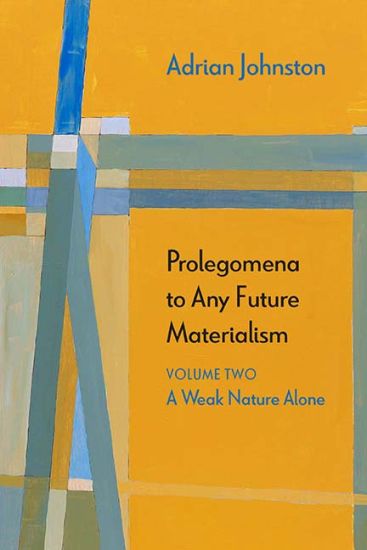
Adrian Johnston’s trilogy Prolegomena to Any Future Materialism aims to forge a thoroughly materialist yet antireductive theory of subjectivity. In this second volume, A Weak Nature Alone, Johnston focuses on the philosophy of nature required for such a theory. This volume is guided by a fundamental question: How must nature be rethought so that human minds and freedom do not appear to be either impossible or inexplicable within it? Asked differently: How must the natural world itself be structured such that sapient subjects in all their distinctive peculiarities emerged from and continue to exist within this world? In A Weak Nature Alone, Johnston develops his transcendental materialist account of nature through engaging with and weaving together five main sources of inspiration: Hegelian philosophy, Marxist materialism, Freudian-Lacanian metapsychology, Anglo-American analytic neo-Hegelianism, and evolutionary theory and neurobiology. Johnston argues that these seemingly (but not really) strange bedfellows should be brought together so as to construct a contemporary ontology of nature. Through this ontology, nonnatural human subjects can be seen to arise in an immanent, bottom-up fashion from nature itself.
Prolegomena to Any Future Materialism

Prolegomena to Any Future Materialism

Adrian Johnston

Northwestern University Press
2019
sidottu
Adrian Johnston’s trilogy Prolegomena to Any Future Materialism aims to forge a thoroughly materialist yet antireductive theory of subjectivity. In this second volume, A Weak Nature Alone, Johnston focuses on the philosophy of nature required for such a theory. This volume is guided by a fundamental question: How must nature be rethought so that human minds and freedom do not appear to be either impossible or inexplicable within it? Asked differently: How must the natural world itself be structured such that sapient subjects in all their distinctive peculiarities emerged from and continue to exist within this world? In A Weak Nature Alone, Johnston develops his transcendental materialist account of nature through engaging with and weaving together five main sources of inspiration: Hegelian philosophy, Marxist materialism, Freudian-Lacanian metapsychology, Anglo-American analytic neo-Hegelianism, and evolutionary theory and neurobiology. Johnston argues that these seemingly (but not really) strange bedfellows should be brought together so as to construct a contemporary ontology of nature. Through this ontology, nonnatural human subjects can be seen to arise in an immanent, bottom-up fashion from nature itself.
Irrepressible Truth

Irrepressible Truth

Adrian Johnston

Springer International Publishing AG
2017
sidottu
This book offers readers a uniquely detailed engagement with the ideas of legendary French psychoanalyst Jacques Lacan. The Freudian Thing is one of Lacan’s most important texts, wherein he explains the significance and stakes of his “return to Freud” as a passionate defence of Freud’s disturbing, epoch-making discovery of the unconscious, against misrepresentations and criticisms of it. However, Lacan is characteristically cryptic in The Freudian Thing. The combination of his writing style and vast range of references renders much of his thinking inaccessible to all but a narrow circle of scholarly specialists. Johnston’s Irrepressible Truth opens up the universe of Lacanian psychoanalysis to much wider audiences by furnishing a sentence-by-sentence interpretive unpacking of this pivotal 1955 essay. In so doing, Johnston reveals the precision, rigor, and soundness of Lacan’s teachings.
Irrepressible Truth

Irrepressible Truth

Adrian Johnston

Springer International Publishing AG
2018
nidottu
This book offers readers a uniquely detailed engagement with the ideas of legendary French psychoanalyst Jacques Lacan. The Freudian Thing is one of Lacan’s most important texts, wherein he explains the significance and stakes of his “return to Freud” as a passionate defence of Freud’s disturbing, epoch-making discovery of the unconscious, against misrepresentations and criticisms of it. However, Lacan is characteristically cryptic in The Freudian Thing. The combination of his writing style and vast range of references renders much of his thinking inaccessible to all but a narrow circle of scholarly specialists. Johnston’s Irrepressible Truth opens up the universe of Lacanian psychoanalysis to much wider audiences by furnishing a sentence-by-sentence interpretive unpacking of this pivotal 1955 essay. In so doing, Johnston reveals the precision, rigor, and soundness of Lacan’s teachings.
Zizek's Ontology

Zizek's Ontology

Adrian Johnston

Northwestern University Press
2008
sidottu
Slavoj Zizek is one of the most interesting and important philosophers working today, known chiefly for his theoretical explorations of popular culture and contemporary politics. This book focuses on the generally neglected and often overshadowed philosophical core of Zizek's work - an essential component in any true appreciation of this unique thinker's accomplishment.His central concern, Zizek has proclaimed, is to use psychoanalysis (especially the teachings of Jacques Lacan) to redeploy the insights of late-modern German philosophy, in particular, the thought of Kant, Schelling, and Hegel. By taking this avowal seriously, Adrian Johnston finally clarifies the philosophical project underlying Zizek's efforts. His book charts the interlinked ontology and theory of subjectivity constructed by Zizek at the intersection of German idealism and Lacanian theory. Johnston also uses Zizek's combination of philosophy and psychoanalysis to address two perennial philosophical problems: the relationship of mind and body, and the nature of human freedom.By bringing together the past two centuries of European philosophy, psychoanalytic metapsychology, and cutting-edge work in the natural sciences, Johnston develops a transcendental materialist theory of subjectivity - in short, an account of how more-than-material forms of subjectivity can emerge from a corporeal being. His work shows how an engagement with Zizek's philosophy can produce compelling answers to today's most vexing and urgent questions as inherited from the history of ideas.