
Kirjahaku
Etsi kirjoja tekijän nimen, kirjan nimen tai ISBN:n perusteella.
5 kirjaa tekijältä Adrien Albert

1. 1 What is Selectivity? purpose, and crop protective agent for the A biologically-active substance is said to be second, but there is no fundamental difference selective if it strongly affects certain cells with of principle in their mode of action. out causing any change in others, even when the Drug therapy has two, fundamentally two kinds of cells are close neighbours. In living opposed divisions. The first of these strives to organisms, there are many substances, often improve the action of one of the cell's natural quite small molecules, which have been chosen agents by modifying the molecule in order to for their specificity. This choice has been made localize or intensify its action. For instance, under the strong pressure of natural selection, the solubility can be decreased to make it form unhurried by any consideration of time. Such a deposit, or a change is made so that it becomes chemical compounds operate the metabolism a poorer fit on the naturally-occurring destruc of the cells and tissues, and ensure their health, tive enzyme. Both of these devices have proved survival, and reproduction. Important among useful in therapy, e. g. with steroid hormones. the smaller of these selective molecules are Such drugs, which seek to improve on Nature vitamins, coenzymes, hormones, neurotrans by performing more desirably, are called mitters, inorganic ions, nutritional fragments, agonists.
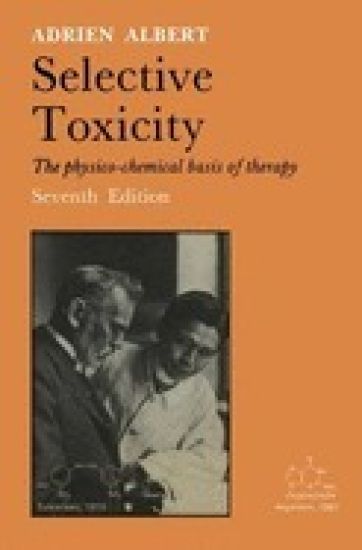
This book is about selectively toxic agents. That is to say, it is about those substances that affect certain cells without harming others, even when they are close neighbours. Toxicity need not be fatal. It can be made easily reversible, as is the case with general anaesthetics. Selective toxicity covers an immense field: most of the drugs used for treating illness in man and his economic animals, as well as all of the fungicides, insecticides, and weed killers that are used in agriculture. Essentially, this book is a discussion of the physical and chemical means which contribute to selectivity, and this is the basis of molecular pharmacology. _Selective Toxicity began as a course of lectures that Professor F. G. Young encouraged me to give in University College London, in 1948 and again in 1949. The first edition appeared in 1951, as a very small book because little was then known about the factors that provide selectivity. Since those early days, the subject has undergone tremendous development. At first, industry was un receptive to the word 'toxicity', however qualified! Yet the market was being supplied with biologically powerful substances of which several had the potential to cause harm. This aspect was brought to light by two events of the early 1960s. The first of these was the discovery that a sedative, thalidomide, administered to expectant mothers, after what was then considered to be adequate testing, had caused permanent deformities in about 10000 children.
This practical manual is devised for organic chemists and biochemists who, in the course of their researches and without previous experience, need to determine an ionization constant. We are gratified that earlier editions were much used for this purpose and that they also proved adequate for the in service training of technicians and technical officers to provide a Department with a pK service. The features of previous editions that gave this wide appeal have been retained, but the subject matter has been revised, extended, and brought up to date. We present two new chapters, one of which describes the determination of the stability constants of the complexes which organic ligands form with metal cations. The other describes the use of more recently introduced techniques for the determination of ionization constants, such as Raman and nuclear magnetic resonance spectroscopy, thermometric titrations, and paper electro phoresis. Chapter 1 gives enhanced help in choosing between alternative methods for determining ionization constants. The two chapters on potentiometric methods have been extensively revised in the light of newer understanding of electrode processes and of the present state of the art in instrumen tation.