Kirjojen hintavertailu. Mukana 12 390 323 kirjaa ja 12 kauppaa.

Kirjahaku

Etsi kirjoja tekijän nimen, kirjan nimen tai ISBN:n perusteella.

6 kirjaa tekijältä Alain Aspect, David Kaiser

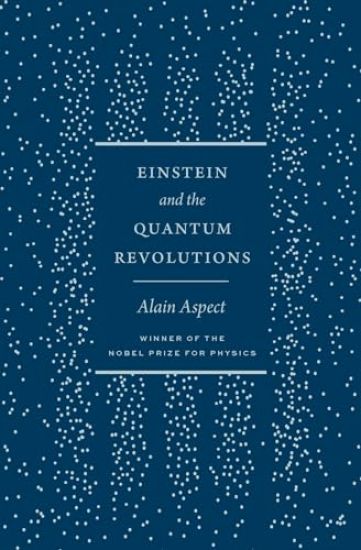
Einstein and the Quantum Revolutions

Einstein and the Quantum Revolutions

Alain Aspect; David Kaiser

THE UNIVERSITY OF CHICAGO PRESS
2024
sidottu
A Nobel laureate offers a brief lesson on physics’ biggest mystery, accessibly explaining the two quantum revolutions that changed our understanding of reality. At the start of the twentieth century, the first quantum revolution upset our vision of the world. New physics offered surprising realities, such as wave-particle duality, and led to major inventions: the transistor, the laser, and today’s computers. Less known is the second quantum revolution, arguably initiated in 1935 during a debate between giants Albert Einstein and Niels Bohr. This revolution is still unfolding. Its revolutionaries—including the author of this short accessible book, Nobel Prize–winning physicist Alain Aspect—explore the notion of entangled particles, able to interact at seemingly impossible distances. Aspect’s research has helped to show how entanglement may both upend existing technologies, like cryptography, and usher in entirely new ones, like quantum computing. Explaining this physics of the future, this work tells a story of how philosophical debates can shape new realities.

If Einstein had known / Et si Einstein avait su...
Alain Aspect wrote this book to share his fascination with the debate between two giants of physics, Niels Bohr and Albert Einstein, over the interpretation of quantum mechanics. Almost half a century after his own experiments, Aspect was awarded the Nobel Prize in Physics for demonstrating that it was necessary to abandon Einstein's vision of the quantum world. Aspect places this debate within the incredible history of quantum physics. Never hiding his admiration for Einstein, he shows us how the thinker's quasi-philosophical controversy with Bohr led to very real experiments, and to the invention of new quantum technologies. Recounting his career, Aspect explains with passion and clarity how he demonstrated one of the most extraordinary properties of quantum entanglement, and tries to imagine Einstein's reaction to his experimental results. "A major book."
Introduction to Quantum Optics

Introduction to Quantum Optics

Gilbert Grynberg; Alain Aspect; Claude Fabre; Claude Cohen-Tannoudji

Cambridge University Press
2010
sidottu
Covering a number of important subjects in quantum optics, this textbook is an excellent introduction for advanced undergraduate and beginning graduate students, familiarizing readers with the basic concepts and formalism as well as the most recent advances. The first part of the textbook covers the semi-classical approach where matter is quantized, but light is not. It describes significant phenomena in quantum optics, including the principles of lasers. The second part is devoted to the full quantum description of light and its interaction with matter, covering topics such as spontaneous emission, and classical and non-classical states of light. An overview of photon entanglement and applications to quantum information is also given. In the third part, non-linear optics and laser cooling of atoms are presented, where using both approaches allows for a comprehensive description. Each chapter describes basic concepts in detail, and more specific concepts and phenomena are presented in 'complements'.
Quantum Chance

Quantum Chance

Nicolas Gisin; Alain Aspect

Copernicus
2014
nidottu
Quantum physics, which offers an explanation of the world on the smallest scale, has fundamental implications that pose a serious challenge to ordinary logic. Particularly counterintuitive is the notion of entanglement, which has been explored for the past 30 years and posits an ubiquitous randomness capable of manifesting itself simultaneously in more than one place.This amazing 'non-locality' is more than just an abstract curiosity or paradox: it has entirely down-to-earth applications in cryptography, serving for example to protect financial information; it also has enabled the demonstration of 'quantum teleportation', whose infinite possibilities even science-fiction writers can scarcely imagine.This delightful and concise exposition does not avoid the deep logical difficulties of quantum physics, but gives the reader the insights needed to appreciate them. From 'Bell's Theorem' to experiments in quantum entanglement, the reader will gain a solid understanding of one of the most fascinating areas of contemporary physics.
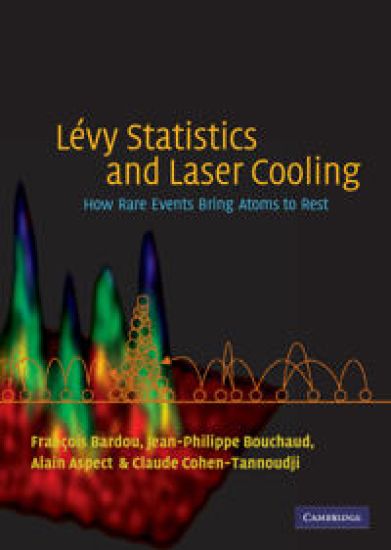
Lévy Statistics and Laser Cooling

Lévy Statistics and Laser Cooling

François Bardou; Jean-Philippe Bouchaud; Alain Aspect; Claude Cohen-Tannoudji

Cambridge University Press
2001
pokkari
Laser cooling of atoms provides an ideal case study for the application of Lévy statistics in a privileged situation where the statistical model can be derived from first principles. This book demonstrates how the most efficient laser cooling techniques can be simply and quantitatively understood in terms of non-ergodic random processes dominated by a few rare events. Lévy statistics are now recognised as the proper tool for analysing many different problems for which standard Gaussian statistics are inadequate. Laser cooling provides a simple example of how Lévy statistics can yield analytic predictions that can be compared to other theoretical approaches and experimental results. The authors of this book are world leaders in the fields of laser cooling and light-atom interactions, and are renowned for their clear presentation. This book will therefore hold much interest for graduate students and researchers in the fields of atomic physics, quantum optics, and statistical physics.
Lévy Statistics and Laser Cooling

Lévy Statistics and Laser Cooling

François Bardou; Jean-Philippe Bouchaud; Alain Aspect; Claude Cohen-Tannoudji

Cambridge University Press
2001
sidottu
Laser cooling of atoms provides an ideal case study for the application of Lévy statistics in a privileged situation where the statistical model can be derived from first principles. This book demonstrates how the most efficient laser cooling techniques can be simply and quantitatively understood in terms of non-ergodic random processes dominated by a few rare events. Lévy statistics are now recognised as the proper tool for analysing many different problems for which standard Gaussian statistics are inadequate. Laser cooling provides a simple example of how Lévy statistics can yield analytic predictions that can be compared to other theoretical approaches and experimental results. The authors of this book are world leaders in the fields of laser cooling and light-atom interactions, and are renowned for their clear presentation. This book will therefore hold much interest for graduate students and researchers in the fields of atomic physics, quantum optics, and statistical physics.