Kirjojen hintavertailu. Mukana 11 244 527 kirjaa ja 12 kauppaa.

Kirjahaku

Etsi kirjoja tekijän nimen, kirjan nimen tai ISBN:n perusteella.

8 kirjaa tekijältä Alan Baddeley

Working Memory, Thought, and Action

Working Memory, Thought, and Action

Alan Baddeley

Oxford University Press
2007
sidottu
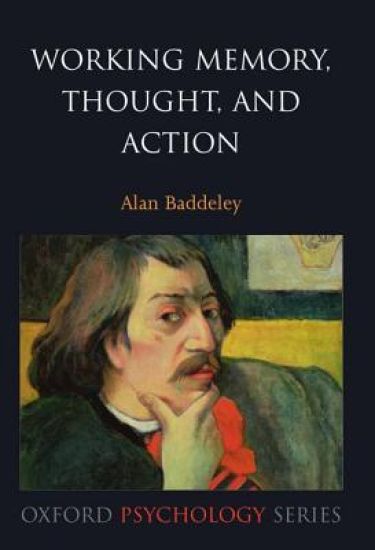
'Working Memory, Thought, and Action' is the magnum opus of one of the most influential cognitive psychologists of the past 50 years. This new volume on the model he created (with Graham Hitch) discusses the developments that have occurred within the model in the past twenty years, and places it within a broader context. Working memory is a temporary storage system that underpins our capacity for coherent thought. Some 30 years ago, Baddeley and Hitch proposed a way of thinking about working memory that has proved to be both valuable and influential in its application to practical problems. This book updates the theory, discussing both the evidence in its favour, and alternative approaches. In addition, it discusses the implications of the model for understanding social and emotional behaviour, concluding with an attempt to place working memory in a broader biological and philosophical context. Inside are chapters on the phonological loop, the visuo-spatial sketchpad, the central executive and the episodic buffer. There are also chapters on the relevance to working memory of studies of the recency effect, of work based on individual differences, and of neuroimaging research. The broader implications of the concept of working memory are discussed in the chapters on social psychology, anxiety, depression, consciousness and on the control of action. Finally, Baddeley discusses the relevance of a concept of working memory to the classic problems of consciousness and free will. This new volume from one of the pioneers in memory research will doubtless emulate the success of its predecessor, and be a major publication within the psychological literature.
Working Memory, Thought, and Action

Working Memory, Thought, and Action

Alan Baddeley

Oxford University Press
2007
nidottu
'Working Memory, Thought, and Action' is the magnum opus of one of the most influential cognitive psychologists of the past 50 years. This new volume on the model he created (with Graham Hitch) discusses the developments that have occurred within the model in the past twenty years, and places it within a broader context. Working memory is a temporary storage system that underpins our capacity for coherent thought. Some 30 years ago, Baddeley and Hitch proposed a way of thinking about working memory that has proved to be both valuable and influential in its application to practical problems. This book updates the theory, discussing both the evidence in its favour, and alternative approaches. In addition, it discusses the implications of the model for understanding social and emotional behaviour, concluding with an attempt to place working memory in a broader biological and philosophical context. Inside are chapters on the phonological loop, the visuo-spatial sketchpad, the central executive and the episodic buffer. There are also chapters on the relevance to working memory of studies of the recency effect, of work based on individual differences, and of neuroimaging research. The broader implications of the concept of working memory are discussed in the chapters on social psychology, anxiety, depression, consciousness and on the control of action. Finally, Baddeley discusses the relevance of a concept of working memory to the classic problems of consciousness and free will. This new volume from one of the pioneers in memory research will doubtless emulate the success of its predecessor, and be a major publication within the psychological literature.
Exploring Working Memory

Exploring Working Memory

Alan Baddeley

Routledge
2020
nidottu
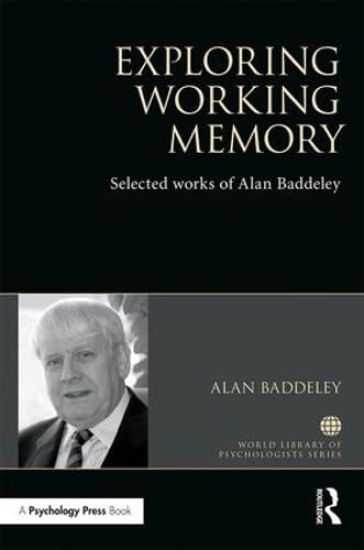
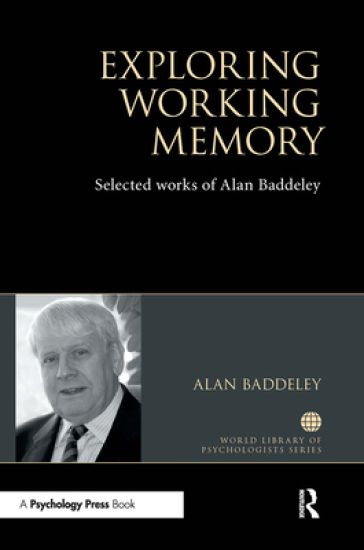
In the World Library of Psychologists series, international experts present themselves career-long collections of what they judge to be their finest pieces - extracts from books, key articles, salient research findings, and their major theoretical and practical contributions.Alan Baddeley has an international reputation as an eminent scholar and pioneer in the field of human memory, and is principally known for the theory of working memory, devised with Graham Hitch. This model continues to be valuable today in recognising the functions of short-term memory. This volume includes a specially written introduction by Alan Baddeley which gives an overview of the start of his career and his entry into the field of Psychology. Throughout the book he also provides introductions to the selection of works included and contextualises them in relation to changes in the field during this time. Exploring Working Memory includes the author’s most influential publications on topics including short-term memory, the distinctions between short and long-term memory, the theory of working memory, the phonological loop, the concept of the central executive, and the episodic buffer. This exceptional selection concludes with an article giving a broad overview of the author’s current views on working memory and its relation to other theories in the field.Through his outstanding work Alan Baddeley has become known as a world-leading expert on human memory. Exploring Working Memory is a unique collection which will be of great interest to both students and researchers interested in human memory from psychology backgrounds.
Exploring Working Memory

Exploring Working Memory

Alan Baddeley

Routledge
2017
sidottu
In the World Library of Psychologists series, international experts present themselves career-long collections of what they judge to be their finest pieces - extracts from books, key articles, salient research findings, and their major theoretical and practical contributions.Alan Baddeley has an international reputation as an eminent scholar and pioneer in the field of human memory, and is principally known for the theory of working memory, devised with Graham Hitch. This model continues to be valuable today in recognising the functions of short-term memory. This volume includes a specially written introduction by Alan Baddeley which gives an overview of the start of his career and his entry into the field of Psychology. Throughout the book he also provides introductions to the selection of works included and contextualises them in relation to changes in the field during this time. Exploring Working Memory includes the author’s most influential publications on topics including short-term memory, the distinctions between short and long-term memory, the theory of working memory, the phonological loop, the concept of the central executive, and the episodic buffer. This exceptional selection concludes with an article giving a broad overview of the author’s current views on working memory and its relation to other theories in the field.Through his outstanding work Alan Baddeley has become known as a world-leading expert on human memory. Exploring Working Memory is a unique collection which will be of great interest to both students and researchers interested in human memory from psychology backgrounds.
Working Memories

Working Memories

Alan Baddeley

Routledge
2018
sidottu
Technological developments during the Second World War led to an approach that linked ideas from computer science to neuroscience, linguistics, philosophy and psychology, known today as the Cognitive Revolution. Leaving behind traditional behaviourist approaches popular at the time, psychology began to utilise artificial intelligence and computer science to develop testable theories and design groundbreaking new experiments. The Cognitive Revolution dramatically changed the way that psychological research and studies were conducted and proposed a new way of thinking about the mind. In Working Memories, Alan Baddeley, one of the world's leading authorities on Human Memory, draws on his own personal experience of this time, recounting the radical development of a pioneering science in parallel with his own transatlantic, vibrant and distinguished career. Detailing the excitement and sometimes frustration experienced in taking psychology into the world beyond the laboratory, Working Memories presents unique insights into the mind and psychological achievements of one of the most influential psychologists of our time.
Working Memories

Working Memories

Alan Baddeley

Routledge
2018
nidottu
Technological developments during the Second World War led to an approach that linked ideas from computer science to neuroscience, linguistics, philosophy and psychology, known today as the Cognitive Revolution. Leaving behind traditional behaviourist approaches popular at the time, psychology began to utilise artificial intelligence and computer science to develop testable theories and design groundbreaking new experiments. The Cognitive Revolution dramatically changed the way that psychological research and studies were conducted and proposed a new way of thinking about the mind. In Working Memories, Alan Baddeley, one of the world's leading authorities on Human Memory, draws on his own personal experience of this time, recounting the radical development of a pioneering science in parallel with his own transatlantic, vibrant and distinguished career. Detailing the excitement and sometimes frustration experienced in taking psychology into the world beyond the laboratory, Working Memories presents unique insights into the mind and psychological achievements of one of the most influential psychologists of our time.
Essentials of Human Memory (Classic Edition)

Essentials of Human Memory (Classic Edition)

Alan Baddeley

Psychology Press Ltd
2013
sidottu
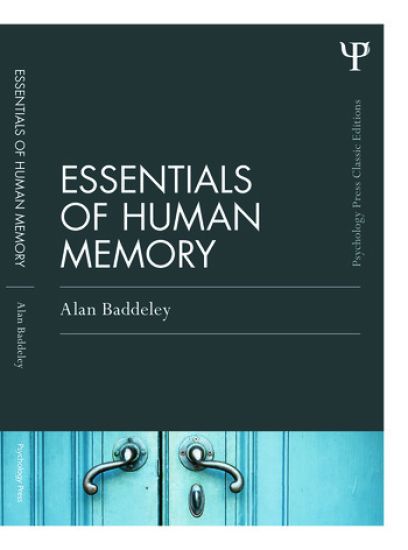
This Classic Edition of the best-selling textbook offers an in-depth overview of approaches to the study of memory. With empirical research from both the real world and the neuropsychological clinic, the book explains the fundamental workings of human memory in a clear and accessible style. This edition contains a new introduction and concluding chapter in which the author reflects on how the book is organized, and also on how the field of memory has developed since it was first published.Essentials of Human Memory evolved from a belief that, although the amount we know about memory has increased enormously in recent years, it is still possible to explain it in a way that would be fully understood by the general reader. After a broad overview of approaches to the study of memory, short-term and working memory are discussed, followed by learning, the role of organizing in remembering and factors influencing forgetting, including emotional variables and claims for the role of repression in what has become known as the false memory syndrome. The way in which knowledge of the world is stored is discussed next, followed by an account of the processes underlying retrieval, and their application to the practical issues of eyewitness testimony. The breakdown of memory in the amnesic syndrome is discussed next, followed by discussion of the way in which memory develops in children, and declines in the elderly. After a section concerned with mnemonic techniques and memory improvement, the book ends with an overview of recent developments in the field of human memory.Written by the leading expert in human memory, recently awarded the British Psychological Society Research Board Lifetime Achievement Award, Essentials of Human Memory will be of interest to students of Cognitive Psychology, Neuropsychology, and anyone with an interest in the workings of memory.
Essentials of Human Memory (Classic Edition)

Essentials of Human Memory (Classic Edition)

Alan Baddeley

Psychology Press Ltd
2013
nidottu
This Classic Edition of the best-selling textbook offers an in-depth overview of approaches to the study of memory. With empirical research from both the real world and the neuropsychological clinic, the book explains the fundamental workings of human memory in a clear and accessible style. This edition contains a new introduction and concluding chapter in which the author reflects on how the book is organized, and also on how the field of memory has developed since it was first published.Essentials of Human Memory evolved from a belief that, although the amount we know about memory has increased enormously in recent years, it is still possible to explain it in a way that would be fully understood by the general reader. After a broad overview of approaches to the study of memory, short-term and working memory are discussed, followed by learning, the role of organizing in remembering and factors influencing forgetting, including emotional variables and claims for the role of repression in what has become known as the false memory syndrome. The way in which knowledge of the world is stored is discussed next, followed by an account of the processes underlying retrieval, and their application to the practical issues of eyewitness testimony. The breakdown of memory in the amnesic syndrome is discussed next, followed by discussion of the way in which memory develops in children, and declines in the elderly. After a section concerned with mnemonic techniques and memory improvement, the book ends with an overview of recent developments in the field of human memory.Written by the leading expert in human memory, recently awarded the British Psychological Society Research Board Lifetime Achievement Award, Essentials of Human Memory will be of interest to students of Cognitive Psychology, Neuropsychology, and anyone with an interest in the workings of memory.