Kirjojen hintavertailu. Mukana 11 699 587 kirjaa ja 12 kauppaa.

Kirjahaku

Etsi kirjoja tekijän nimen, kirjan nimen tai ISBN:n perusteella.

12 kirjaa tekijältä Alan Clark

Alan Clark: A Life in his Own Words

Alan Clark: A Life in his Own Words

Alan Clark

Weidenfeld Nicolson
2010
pokkari
Some of the most talked about books of recent years, Alan Clark's diaries provide a witty and irreverant insider's account of political life in Britain. Now in one volume.'From the moment the first scabrous and brilliant volume was published, people wanted more. Now they have it and they will not be disappointed... These diaries are not wonderful simply because they show a politician unafraid to say what he thinks, and refusing to suck up to those whom he represents. They are great because they show all sides of a man who was, within his complex personality, arrogant, sensitive, loyal, unfaithful, patriotic, selfish, selfless, and - at all times - completely Technicolour' Simon Heffner, DAILY MAIL
Barbarossa

Barbarossa

Alan Clark

Orion Publishing Co
2001
pokkari
The classic account of the war on the Eastern Front between the Russians and the Germans - the greatest clash of arms the world has ever seen - written by the eminent military historian, diarist and politician Alan Clark.
Barbarossa: The Russian-German Conflict, 1941-45

Barbarossa: The Russian-German Conflict, 1941-45

Alan Clark

William Morrow Company
1985
nidottu
On June 22, 1941, before dawn, German tanks and guns began firing across the Russian border. It was the beginning of Hitler's Operation Barbarossa, one of the most brutal campaigns in the history of warfare. Four years later, the victorious Red Army has suffered a loss of seven million lives. Alan Clark's incisive analysis succeeds in explaining how a fighting force that in one two-month period lost two million men was nevertheless able to rally to defeat the Wehrmacht. The Barbarossa campaign included some of the greatest episodes in military history: the futile attack on Moscow in the winter of 1941-42, the siege of Stalingrad, the great Russian offensive beginning in 1944 that would lead the Red Army to the historic meeting with the Americans at the Elbe and on to victory in Berlin. Barbarossa is a classic of miltary history. This paperback edition contains a new preface by the author.
The Donkeys

The Donkeys

Alan Clark

Pimlico
1991
pokkari
The landmark exposé of incompetent leadership on the Western Front - why the British troops were lions led by donkeys On 26 September 1915, twelve British battalions – a strength of almost 10,000 men – were ordered to attack German positions in France. In the three-and-a-half hours of the battle, they sustained 8,246 casualties. The Germans suffered no casualties at all. Why did the British Army fail so spectacularly? What can be said of the leadership of generals? And most importantly, could it have all been prevented? In The Donkeys, eminent military historian Alan Clark scrutinises the major battles of that fateful year and casts a steady and revealing light on those in High Command - French, Rawlinson, Watson and Haig among them - whose orders resulted in the virtual destruction of the old professional British Army. Clark paints a vivid and convincing picture of how brave soldiers, the lions, were essentially sent to their deaths by incompetent and indifferent officers – the donkeys. ‘An eloquent and painful book... Clark leaves the impression that vanity and stupidity were the main ingredients of the massacres of 1915. He writes searingly and unforgettably’ Evening Standard
Backfire

Backfire

Alan Clark

Weidenfeld Nicolson
2002
pokkari
Alan Clark's passion for cars - that he bought, drove and wrote about over 50 yearsAlan Clark was passionate about cars from an early age. He bought his first car - a secondhand 6.5 litre Bentley - while still a schoolboy at Eton and without a driving licence. By the time he was 24 he had been banned from driving three times, not only for speeding but in one instance for driving an open Buick Roadster with a girl on his lap. He dealt in 'classic' and vintage cars and soon built up an impressive stable of his own. One of his first published pieces of journalism appeared in the US magazine, Road and Track, for which he was briefly UK correspondent. BACK FIRE, the title of a column he wrote in Thoroughbred and Classic Cars magazine, ran for three years until his death in September 1999. Alan Clark's elder son, James Clark - who has inherited his father's motoring enthusiasms - provides a Prologue; Alan Clark's widow Jane writes a moving Afterword.
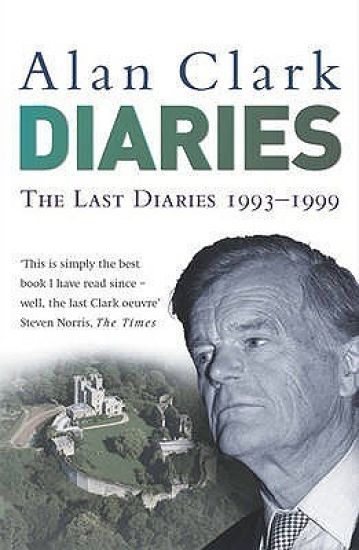
The Last Diaries

The Last Diaries

Alan Clark

Weidenfeld Nicolson
2003
pokkari
'With his Diaries, he has written himself into the life of our times with a panache and candour that ranks him next to Boswell or Pepys' The TimesThe first two volumes of Alan Clark's were irresistible, irreverent, infamous, outrageous. This last volume is a fitting finale to the work of a man who has been described as 'the best diarist of his century'. The third volume begins in 1991 with Alan Clark contemplating quitting as an MP. Life at Saltwood Castle, his home, hangs heavy; then comes the Scott inquiry and the Matrix Churchill affair. Publication of the first volume of the Diaries leads 'the coven', a family of former girlfriends, to sell their story to the NEWS OF THE WORLD. This volume follows his attempts to return to Westminster, an affair that threatens his marriage, and closes with the tragedy of his final months when he is diagnosed with a brain tumour, but keeps his diary until he can no longer focus on the page.
Temporary Friends

Temporary Friends

Alan Clark

Lulu.com
2008
nidottu
Against the backdrop of Nashville, Tennessee, local author Alan Clark depicts the lives of four strangers who become friends during a period of challenge in each of their lives. Will their new friendships help each other through their personal turmoil?
Aces High

Aces High

Alan Clark

Bloomsbury Reader
2012
pokkari
Aces High is the vivid chronicle of aerial warfare over the Western Front in World War One and the personalities that characterised the era. These were the airmen who became legends in their own lifetimes: Albert Ball, Manfred von Richthofen (also known as the Red Baron), Mick Mannock, René Fonck and Georges Guynemer. The key to maintaining military superiority was by perfecting the aeroplane, which meant many of these pilots were flying dangerous, untested machines. From the birth of powered flight for reconnaissance purposes to the development of strategic bombing and the creation of the Royal Air Force in 1918, this was as much a war of technological advances as it was of skill and endurance.