Kirjojen hintavertailu. Mukana 12 097 514 kirjaa ja 12 kauppaa.

Kirjahaku

Etsi kirjoja tekijän nimen, kirjan nimen tai ISBN:n perusteella.

2 kirjaa tekijältä Alan J. Ross

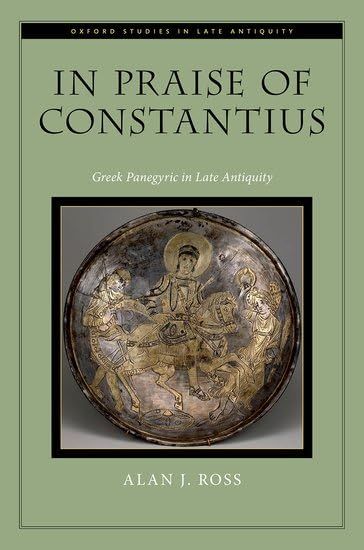
In Praise of Constantius

In Praise of Constantius

Alan J. Ross

OXFORD UNIVERSITY PRESS INC
2026
sidottu
In Praise of Constantius offers historical and literary analysis of eight Greek panegyrics composed by Libanius, Themistius, and Julian in the 340s and 350s CE, and addressed to Constantius II and his wife, the empress Eusebia. Its central concerns are the role that the composition, performance, and dissemination of imperial panegyric played in establishing the careers of the three most prominent Greek pagans of the fourth century; and their development of Greek epideictic literature in an era beyond the Second Sophistic. The book deftly exposes the rich intertextual dynamics between these eight speeches, other contemporary works, and canonical works of Greek political literature. It revises standard interpretations of panegyric's communicative function, and treats the orator less as a vector for others' messaging and instead as an active agent in political discourse in pursuit of his own ends. The volume substantially re-writes the early careers of each of its subjects, emphasizing their precarity and the utilization of performed paideia in managing moments of personal and political upheaval.
Ammianus' Julian

Ammianus' Julian

Alan J. Ross

Oxford University Press
2016
sidottu
Ammianus Marcellinus' Res Gestae holds a prominent position in modern studies of the emperor Julian as the fullest extant narrative of the reign of the last 'pagan' emperor. Ammianus' Julian: Narrative and Genre in the Res Gestae offers a major reinterpretation of the work, which is one of the main narrative sources for the political history of the later Roman Empire, and argues for a re-examination of Ammianus' agenda and methods in narrating the reign of Julian. Building on recent developments in the application of literary approaches and critical theories to historical texts, Ammianus' presentation of Julian is evaluated by considering the Res Gestae within three interrelated contexts: as a work of Latin historiography, which consciously sets itself within a classical and classicizing generic tradition; in a more immediate literary and political context, as the final contribution by a member of an 'eyewitness' generation to a quarter century of intense debate over Julian's legacy by several authors who had lived through his reign and had been in varying degrees of proximity to Julian himself; and as a narrative text, in which narratorial authority is closely associated with the persona of the narrator, both as an external narrating agent and an occasional participant in the events he relates. This is complemented by a literary survey and a re-analysis of Ammianus' depiction of several key moments in Julian's reign, such as his appointment as Caesar, the battle of Strasbourg in 357AD, his acclamation as Augustus, and the disastrous invasion of Persia in 363AD. It suggests that the Res Gestae presents a Latin-speaking, western audience with an idiosyncratic and 'Romanized' depiction of the philhellene emperor and that, consciously exploiting his position as a Greek writing in Latin and as a contemporary of Julian, Ammianus wished his work to be considered a culminating and definitive account of the man and his life.