Kirjojen hintavertailu. Mukana 11 342 296 kirjaa ja 12 kauppaa.

Kirjahaku

Etsi kirjoja tekijän nimen, kirjan nimen tai ISBN:n perusteella.

4 kirjaa tekijältä Alan M. Polansky

Introduction to Statistical Limit Theory
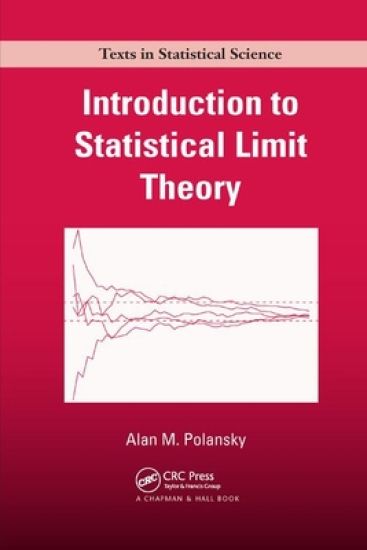
Helping students develop a good understanding of asymptotic theory, Introduction to Statistical Limit Theory provides a thorough yet accessible treatment of common modes of convergence and their related tools used in statistics. It also discusses how the results can be applied to several common areas in the field.The author explains as much of the background material as possible and offers a comprehensive account of the modes of convergence of random variables, distributions, and moments, establishing a firm foundation for the applications that appear later in the book. The text includes detailed proofs that follow a logical progression of the central inferences of each result. It also presents in-depth explanations of the results and identifies important tools and techniques. Through numerous illustrative examples, the book shows how asymptotic theory offers deep insight into statistical problems, such as confidence intervals, hypothesis tests, and estimation. With an array of exercises and experiments in each chapter, this classroom-tested book gives students the mathematical foundation needed to understand asymptotic theory. It covers the necessary introductory material as well as modern statistical applications, exploring how the underlying mathematical and statistical theories work together.
Observed Confidence Levels

Observed Confidence Levels

Alan M. Polansky

CRC Press
2019
nidottu
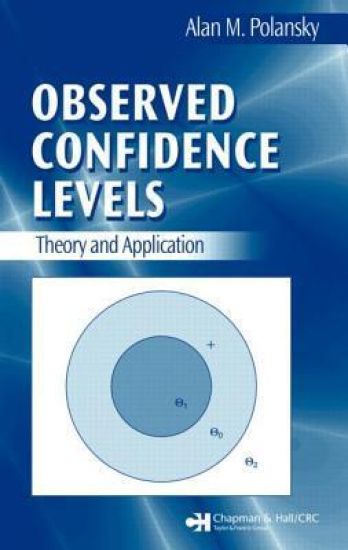
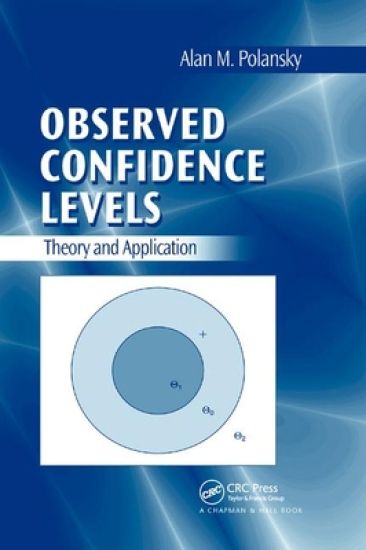
Illustrating a simple, novel method for solving an array of statistical problems, Observed Confidence Levels: Theory and Application describes the basic development of observed confidence levels, a methodology that can be applied to a variety of common multiple testing problems in statistical inference. It focuses on the modern nonparametric framework of bootstrap-based estimates, allowing for substantial theoretical development and for relatively simple solutions to numerous interesting problems.After an introduction, the book develops the theory and application of observed confidence levels for general scalar parameters, vector parameters, and linear models. It then examines nonparametric problems often associated with smoothing methods, including nonparametric density estimation and regression. The author also describes applications in generalized linear models, classical nonparametric statistics, multivariate analysis, and survival analysis as well as compares the method of observed confidence levels to hypothesis testing, multiple comparisons, and Bayesian posterior probabilities. In addition, the appendix presents some background material on the asymptotic expansion theory used in the book. Helping you choose the most reliable method for a variety of problems, this book shows how observed confidence levels provide useful information on the relative truth of hypotheses in multiple testing problems.
Introduction to Statistical Limit Theory

Introduction to Statistical Limit Theory

Alan M. Polansky

Chapman Hall/CRC
2011
sidottu
Helping students develop a good understanding of asymptotic theory, Introduction to Statistical Limit Theory provides a thorough yet accessible treatment of common modes of convergence and their related tools used in statistics. It also discusses how the results can be applied to several common areas in the field.The author explains as much of the background material as possible and offers a comprehensive account of the modes of convergence of random variables, distributions, and moments, establishing a firm foundation for the applications that appear later in the book. The text includes detailed proofs that follow a logical progression of the central inferences of each result. It also presents in-depth explanations of the results and identifies important tools and techniques. Through numerous illustrative examples, the book shows how asymptotic theory offers deep insight into statistical problems, such as confidence intervals, hypothesis tests, and estimation. With an array of exercises and experiments in each chapter, this classroom-tested book gives students the mathematical foundation needed to understand asymptotic theory. It covers the necessary introductory material as well as modern statistical applications, exploring how the underlying mathematical and statistical theories work together.
Observed Confidence Levels

Observed Confidence Levels

Alan M. Polansky

Chapman Hall/CRC
2007
sidottu
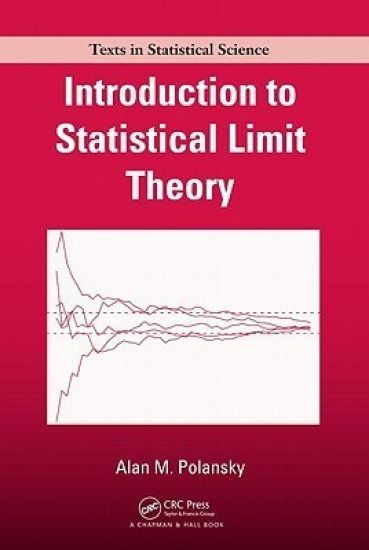
Illustrating a simple, novel method for solving an array of statistical problems, Observed Confidence Levels: Theory and Application describes the basic development of observed confidence levels, a methodology that can be applied to a variety of common multiple testing problems in statistical inference. It focuses on the modern nonparametric framework of bootstrap-based estimates, allowing for substantial theoretical development and for relatively simple solutions to numerous interesting problems.After an introduction, the book develops the theory and application of observed confidence levels for general scalar parameters, vector parameters, and linear models. It then examines nonparametric problems often associated with smoothing methods, including nonparametric density estimation and regression. The author also describes applications in generalized linear models, classical nonparametric statistics, multivariate analysis, and survival analysis as well as compares the method of observed confidence levels to hypothesis testing, multiple comparisons, and Bayesian posterior probabilities. In addition, the appendix presents some background material on the asymptotic expansion theory used in the book. Helping you choose the most reliable method for a variety of problems, this book shows how observed confidence levels provide useful information on the relative truth of hypotheses in multiple testing problems.