Kirjojen hintavertailu. Mukana 12 016 292 kirjaa ja 12 kauppaa.

Kirjahaku

Etsi kirjoja tekijän nimen, kirjan nimen tai ISBN:n perusteella.

8 kirjaa tekijältä Alan R. H. Baker

Geography and History

Geography and History

Alan R. H. Baker

Cambridge University Press
2003
sidottu
Geography and History is the first book for more than a century to examine comprehensively the interdependence of the two disciplines. Alan Baker, an internationally honoured historical geographer, focuses upon the work of North American, British and French historians and geographers but takes a global and interdisciplinary perspective upon the theory and practice of historical geography and geographical history. He analyses the views of historians on the relationship of their discipline to geography, and geographers on the relationship of theirs to history. He considers in turn locational geographies and spatial histories, environmental geographies and histories, landscape geographies and histories, and regional geographies and histories. Seeking to bridge the 'Great Divide' between history and geography, Dr Baker identifies some basic principles relating historical geography not only to history but also to geography, a reworking which signifies a 'new beginning' for this scholarly hybrid.

Fraternity among the French Peasantry

Fraternity among the French Peasantry

Alan R. H. Baker

Cambridge University Press
2004
pokkari
The individualism of the French peasantry during the nineteenth century has frequently been asserted as one of its most striking characteristics. Alan Baker challenges this orthodox view and demonstrates the extent to which peasants continued with traditional, and developed new, forms of collective action. He examines representations of the peasantry and discusses the discourse of fraternity in nineteenth-century France in general before considering specifically the historical development, geographical diffusion and changing functions of fraternal voluntary associations in Loir-et-Cher between 1815 and 1914. Alan Baker focuses principally upon associations aimed at reducing risk and uncertainty and upon associations intended to provide agricultural protection. A wide range of new voluntary associations were established in Loir-et-Cher - and indeed throughout rural France - during the nineteenth century. Their historical geography throws new light upon the sociability, upon the changing mentalités, of French peasants, and upon the role of fraternal associations in their struggle for survival.
Fraternity among the French Peasantry

Fraternity among the French Peasantry

Alan R. H. Baker

Cambridge University Press
1999
sidottu
The individualism of the French peasantry during the nineteenth century has frequently been asserted as one of its most striking characteristics. Alan Baker challenges this orthodox view and demonstrates the extent to which peasants continued with traditional, and developed new, forms of collective action. He examines representations of the peasantry and discusses the discourse of fraternity in nineteenth-century France in general before considering specifically the historical development, geographical diffusion and changing functions of fraternal voluntary associations in Loir-et-Cher between 1815 and 1914. Alan Baker focuses principally upon associations aimed at reducing risk and uncertainty and upon associations intended to provide agricultural protection. A wide range of new voluntary associations were established in Loir-et-Cher - and indeed throughout rural France - during the nineteenth century. Their historical geography throws new light upon the sociability, upon the changing mentalités, of French peasants, and upon the role of fraternal associations in their struggle for survival.
The Personality of Paris

The Personality of Paris

Alan R. H. Baker

BLOOMSBURY PUBLISHING PLC
2023
nidottu
What was the personality of 19th-century Paris? To answer that question, this book eschews the conventional narrative and chronological route taken by most histories of Paris. Instead, it thematically analyses the complex personality traits of Paris from the onset of the Revolution of 1789 to the beginning of the Great War. Starting with the topographical and cultural legacies that late 18th-century Paris inherited from its foundation in pre-Roman and Roman times and from its medieval infancy and early-modern adolescence, The Personality of Paris unpacks the social and material complexity of the 19th-century city. It considers the role of immigration in the making of Parisians and in the city's growth from half a million in 1801 to almost three million in 1911. It examines the making of its distinctive landscape through the construction of monuments and architectural icons, through its massive re-modelling by Napoléon III and Baron Haussmann, through its five world exhibitions, through its emphasis on food, fashion and leisure, and through the ways in which Parisians sought rural release from urban pressure. Finally, the book considers the self-harm done to the person of 19th-century Paris by revolutions and wars and the damage inflicted on it by 20th-century hubristic politicians and architects.
The Personality of Paris

The Personality of Paris

Alan R. H. Baker

Bloomsbury Academic
2022
sidottu
What was the personality of 19th-century Paris? To answer that question, this book eschews the conventional narrative and chronological route taken by most histories of Paris. Instead, it thematically analyses the complex personality traits of Paris from the onset of the Revolution of 1789 to the beginning of the Great War. Starting with the topographical and cultural legacies that late 18th-century Paris inherited from its foundation in pre-Roman and Roman times and from its medieval infancy and early-modern adolescence, The Personality of Paris unpacks the social and material complexity of the 19th-century city. It considers the role of immigration in the making of Parisians and in the city's growth from half a million in 1801 to almost three million in 1911. It examines the making of its distinctive landscape through the construction of monuments and architectural icons, through its massive re-modelling by Napoléon III and Baron Haussmann, through its five world exhibitions, through its emphasis on food, fashion and leisure, and through the ways in which Parisians sought rural release from urban pressure. Finally, the book considers the self-harm done to the person of 19th-century Paris by revolutions and wars and the damage inflicted on it by 20th-century hubristic politicians and architects.
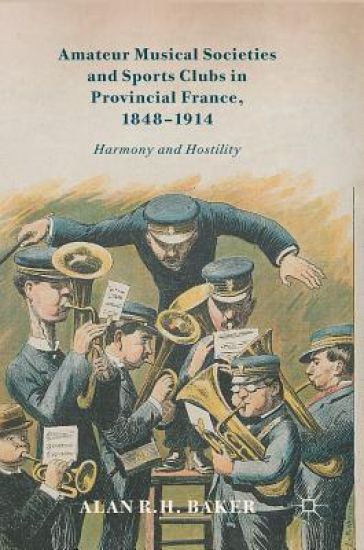
Amateur Musical Societies and Sports Clubs in Provincial France, 1848-1914

Amateur Musical Societies and Sports Clubs in Provincial France, 1848-1914

Alan R. H. Baker

Springer International Publishing AG
2017
sidottu
This book explores leisure-related voluntary associations in France during the nineteenth century as practical expressions of the Revolutionary concept of fraternité. Using a mass of unpublished sources in provincial and national archives, it analyses the history, geography and cultural significance of amateur musical societies and sports clubs in eleven départements of France between 1848 and 1914. It demonstrates that, although these voluntary associations drew upon and extended the traditional concept of cooperation and community, and the Revolutionary concept of fraternity, they also incorporated the fundamental characteristics of competition and conflict. Although intended to produce social harmony, in practice they reflected the ideological hostilities and cultural tensions that permeated French society in the nineteenth century.
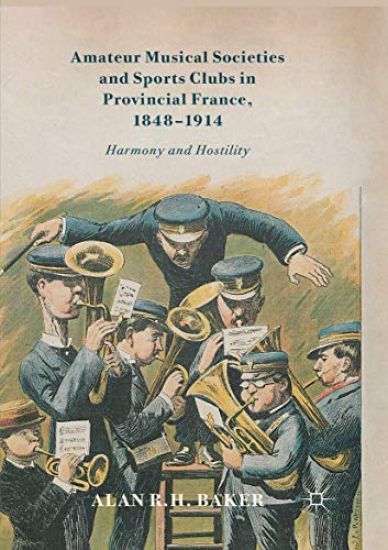
Amateur Musical Societies and Sports Clubs in Provincial France, 1848-1914

Amateur Musical Societies and Sports Clubs in Provincial France, 1848-1914

Alan R. H. Baker

Springer International Publishing AG
2018
nidottu
This book explores leisure-related voluntary associations in France during the nineteenth century as practical expressions of the Revolutionary concept of fraternité. Using a mass of unpublished sources in provincial and national archives, it analyses the history, geography and cultural significance of amateur musical societies and sports clubs in eleven départements of France between 1848 and 1914. It demonstrates that, although these voluntary associations drew upon and extended the traditional concept of cooperation and community, and the Revolutionary concept of fraternity, they also incorporated the fundamental characteristics of competition and conflict. Although intended to produce social harmony, in practice they reflected the ideological hostilities and cultural tensions that permeated French society in the nineteenth century.