

Kirjahaku
Etsi kirjoja tekijän nimen, kirjan nimen tai ISBN:n perusteella.
26 kirjaa tekijältä Alan Watson

One of the world's foremost scholars of Roman and comparative law here describes the nature of legal traditions and develops a general and coherent view of legal change.

In The Evolution of Western Private Law, renowned legal scholar Alan Watson presents a comprehensive overview of legal change in the Western world. Watson explains why and how such change occurs in mature systems, in underdeveloped systems, and when legal systems of different levels of sophistication and from different societal roots-such as those of the Romans and of Germanic tribes-come into contact. Originally intended as a second edition of the author's widely acclaimed The Evolution of Law (1985), this expanded edition has been completely restructured with more than double the number of examples. The result is a work that incorporates all the ideas that Watson has put forward during his twenty-five years studying comparative law and the development of legal systems, combining a remarkable range of sources with superb insight.

Sources of Law, Legal Change, and Ambiguity
Alan Watson
University of Pennsylvania Press
1997
pokkari
Why is the law notoriously unclear, arcane, slow to change in the face of changing circumstances? In this sweeping comparative analysis of the lawmaking process from ancient Rome to the present day, Alan Watson argues that the answer has largely to do with the mixed ancestry of modern law, the confusion of sources-custom, legislation, scholarly writing, and judicial precedent-from which it derives.
To understand how law develops and how legal rules and structures relate to society, one must examine the issues both comparatively and historically, Alan Watson asserts. And in the Western world, he adds, in order to understand law comparatively, one must have knowledge of Roman law.As his title suggests, Watson has divided the book into two related but independent parts. The first part, a revised and enlarged version of his 1970 volume The Law of the Ancient Romans, provides a comprehensive description of the system of Roman law. Watson begins with a discussion of law and the Roman mind and proceeds to such topics as slavery, property, contracts, delicts, and succession. In part two he argues that comparative law--an area of study still in its infancy--can help us "to identify the circumstances in which law changes, thereby uncovering the causes of legal development."Guided by this purpose, Watson examines the ways in which Roman law influenced later legal systems and how comparative law explains the role of law in society. He ties his explication throughout to individual issues. These include the structure of European legal systems, tort law in the French civil code, the structure of Blackstone's Commentaries on the Law of England, differences between contract law in France and Germany, the parameters of judicial reasoning, lessons to be drawn from feudal law, and the interests of governments in making and communicating law. He takes care to discriminate between law created by legislatures and law conceived by scholarly jurists or judges.

In Legal Transplants, one of the world's foremost authorities on legal history and comparative law puts forth a clear and concise statement of his controversial thesis on the way that law has developed throughout history.When it was first published in 1974, Legal Transplants sparked both praise and outrage. Alan Watson's argument challenges the long-prevailing notion that a close connection exists between the law and the society in which it operates. His main thesis is that a society's laws do not usually develop as a logical outgrowth of its own experience. Instead, he contends, the laws of one society are primarily borrowed from other societies; therefore, most law operates in a society very different from the one for which it was originally created. Utilizing a wealth of primary sources, Watson illustrates his argument with examples ranging from the ancient Near East, ancient Rome, early modern Europe, Puritan New England, and modern New Zealand. The resulting picture of the law's surprising longevity and acceptance in foreign conditions carries important implications for legal historians and sociologists. The law cannot be used as a tool to understand society, Watson believes, without a careful consideration of legal transplants.For this edition, Watson has written a new afterword in which he places his original study in the context of more recent scholarship and offers some new reflections on legal borrowings, law, and society.
This book is not about the rules or concepts of Roman law, says Alan Watson, but about the values and approaches, explicit and implicit, of those who made the law. The scope of Watson's concerns encompasses the period from the Twelve Tables, around 451 B.C., to the end of the so-called classical period, around A.D. 235. As he discusses the issues and problems that faced the Roman legal intelligentsia, Watson also holds up Roman law as a clear, although admittedly extreme, example of law's enormous impact on society in light of society's limited input into law.Roman private law has been the most admired and imitated system of private law in the world, but it evolved, Watson argues, as a hobby of gentlemen, albeit a hobby that carried social status. The jurists, the private individuals most responsible for legal development, were first and foremost politicians and (in the Empire) bureaucrats; their engagement with the law was primarily to win the esteem of their peers. The exclusively patrician College of Pontiffs was given a monopoly on interpretation of private law in the mid fifth century B.C. Though the College would lose its exclusivity and monopoly, interpretation of law remained one mark of a Roman gentleman. But only interpretation of the law, not conceptualization or systematization or reform, gave prestige, says Watson. Further, the jurists limited themselves to particular modes of reasoning: no arguments to a ruling could be based on morality, justice, economic welfare, or what was approved elsewhere. No praetor (one of the elected officials who controlled the courts) is famous for introducing reforms, Watson points out, and, in contrast with a nonjurist like Cicero, no jurist theorized about the nature of law. A strong characteristic of Roman law is its relative autonomy, and isolation from the rest of life. Paradoxically, this very autonomy was a key factor in the Reception of Roman Law—the assimilation of the learned Roman law as taught at the universities into the law of the individual territories of Western Europe.
In Ancient Law and Modern Understanding Alan Watson proposes that ancient law is relevant and important for understanding history, theology, sociology, and literature. "Law, though technical," he writes, "is not remote from scholarship on other matters, and law is a central element in society."From Homeric Greece to present-day Armenia, Watson examines law's influence. Without a sensitivity to technical legal language, scholars of literature or history miss much: the use of puns in Plautus, Sulla's claim that Julius Caesar was descended from a slave, the relationship between the Synoptic Gospels. Legal history is an essential tool for understanding society, Watson argues, but it must be applied with knowledge of how law moves from one society to the next, legal reliance on authority, juristic concern with apparent trivia, and the impact on legal growth.

Law and society are closely related, though the relationship between the two is both complicated and understudied. In a world of rapidly changing people, places, and ideas, law is frequently taken out of context, often with surprising and unnecessary consequences. As societies and their structures, religious doctrines, and economies change, laws previously established often remain unchanged. Dominant nations frequently impose their own laws on weaker nations, whether or not their cultures are similar. Conquered nations, after regaining freedom, often keep their conquerors' laws by default. Law is often misrepresented in literature, and legal scholars, citizens, and businesspeople alike ignore large portions of the legislation under which they live and work. Even the American system of legal education frequently proves itself irrelevant to a proper understanding of today's laws. Alan Watson studies examples from the ancient laws of Rome and Byzantium, laws within the Christian Gospels, and policies of legal education in the modern United States to demonstrate the need for a new approach to both law and legal education. Law Out of Context illustrates that only by understanding comparative legal history and by paying more attention to changes in our society can we hope to devise consistently fair and respected laws.
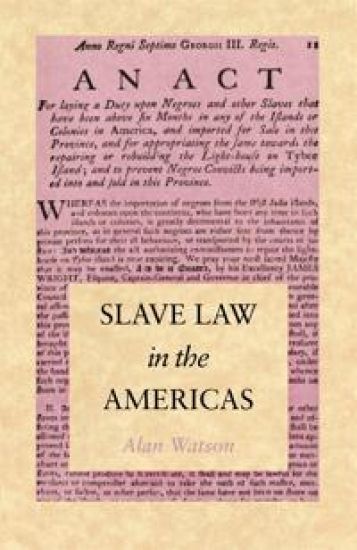
In this book, Alan Watson argues that the slave laws of North and South America—the written codes defining the relationship of masters to slaves—reflect not so much the culture and society of the various colonies but the legal traditions of England, Europe, and ancient Rome.A pathbreaking study concerned as much with the nature of comparative law as the specific subject of the law of slavery, Slave Law in the Americas posits an essential distance in the Western legal tradition between the tenets of law and the values of the society they govern. Laws, Watson shows, often are made not by governments or rulers but by jurists as in ancient Rome, law professors as in medieval and continental Europe, and judges as in common law England. Bodies of law, often created without reference to particular social and political ideals, are also often transferred whole cloth from one society to another. Tracing the effects of the reception of Roman law throughout Europe (excluding England) and the Americas, Watson reveals the enormous impact of this legal tradition on subsequent lawmakers operating under utterly dissimilar social and political conditions in the New World.Slave law in the colonies, Watson demonstrates, had much to do with the mother country's relations to Roman law. Spain, Portugal, France, and the United Dutch Provinces, all within the Roman legal tradition, imposed on their colonies slave laws that were private and nonracist in character, laws that interfered little in master-slave relations and provided for the relative ease of manumission and the grant of citizenship to freed slaves. England, however, did not ascribe to Roman law and colonists created rather than received slave law. Public and racist, slave law in the English colonies uniquely reflected local concerns, involving every citizen in the protection and perpetuation of slavery, strictly regulating education, manumission, and citizenship status."Comparative legal history," Watson writes, "is in its infancy." Presenting the laws of slavery in ancient Rome and in the slaveholding colonies of America, Watson demonstrates how comparative law can elucidate the relationship of law, legal rules, and institutions to the society in which they operate. Investigating not the dynamics of slavery but of slave law, he reveals the working of a legal culture and its peculiar history.

Written by one of our most respected legal historians, this book analyzes the interaction of law and religion in ancient Rome. As such, it offers a major new perspective on the nature and development of Roman law in the early republic and empire before Christianity was recognized and encouraged by Constantine.At the heart of the book is the apparent paradox that Roman private law is remarkably secular even though, until the late second century B.C., the Romans were regarded (and regarded themselves) as the most religious people in the world. Adding to the paradox was the fact that the interpretation of private law, which dealt with relations between private citizens, lay in the hands of the College of Pontiffs, an advisory body of priests.Alan Watson traces the roots of the paradox—and the way in which Roman law ultimately developed—to the conflict between patricians and plebeians that occurred in the mid-fifth century B.C. When the plebeians demanded equality of all citizens before the law, the patricians prepared in response the Twelve Tables, a law code that included only matters considered appropriate for plebeians. Public law, which dealt with public officials and the governance of the state, was totally excluded form the code, thus preserving gross inequalities between the classes of Roman citizens. Religious law, deemed to be the preserve of patrician priests, was also excluded. As Watson notes, giving a monopoly of legal interpretation to the College of Pontiffs was a shrewd move to maintain patrician advantages; however, a fundamental consequence was that modes of legal reasoning appropriate for judgments in sacred law were carried over to private law, where they were often less appropriate. Such reasoning, Watson contends, persists even in modern legal systems.After sketching the tenets of Roman religion and the content of the Twelve Tables, Watson proceeds to such matters as formalism in religion and law, religion and property, and state religion versus alien religion. In his concluding chapter, he compares the law that emerged after the adoption of the Twelve Tables with the law that reportedly existed under the early Roman kings.

Joseph Story and the Comity of Errors examines the decisions of Supreme Court justice and Harvard law professor Joseph Story (1779–1845). According to Alan Watson, Story erred in his interpretation of Dutchman Ulrich Huber’s theory of comity—the respect accorded by one sovereignty to another sovereignty’s laws. Watson suggests that it is because of Story’s misinterpretation that the Dred Scott case went before the United States Supreme Court, whose notorious ruling against Scott fed directly into heated sectional conflict that culminated in the Civil War. Demonstrating the odd twists and turns that legal development sometimes takes, the book is also a fascinating case study that reveals much about the relationship of law to society.

In Jesus and the Jews, Alan Watson reveals and substantiates a central yet previously unrecognized source for the composition of the Gospel of John. Strikingly antithetical to John’s basic message, this source originated from an anti-Christian tradition promulgated by the Pharisees, the powerful and dogmatic teachers of Jewish law. The aims of this Pharisaic tradition, argues Watson, included discrediting Jesus as the Messiah, minimizing his historical importance, and justifying the Jewish authorities’ role in his death. Jesus and the Jews joins three other works by Watson—The Trial of Jesus, Jesus and the Law, and Jesus: A Profile—to examine the early dynamism of western religion through refocused attention on biblical texts and other historical sources.

In The Trial of Jesus Alan Watson argues that by virtue of Jesus’s conviction and crucifixion at the hands of the Romans he failed to fulfill the prophecy of his messiahship in the manner he had intended. Jesus’s destiny, as he saw it, was to be condemned by the Jewish authorities to death by stoning. This is just one of the provoking insights in Watson’s fresh interpretation of the arrest, trial, and conviction of Jesus. Drawing on the four Gospels, writings from the period, and Jewish and Roman laws and customs, Watson adds substantially to what we know about Jesus himself, his prophesies, the justness of the charges against him, his degree of guilt, and the powers, prerogatives, and motivations of his accusers. The Trial of Jesus joins three other works by Watson—Jesus and the Jews, Jesus and the Law, and Jesus: A Profile (all Georgia)—to examine the early dynamism of western religion through refocused attention on biblical texts and other historical sources.

In Jesus and the Law, Alan Watson measures the success of Jesus’s ministry by explaining his attitude toward, and knowledge of, certain laws and legal customs. Watson argues that Jesus engendered harsh responses from his fellow Jews by his apparently contemptuous or insensitive behavior that stemmed from a lack of knowledge or concern about legal and rabbinic strictures. Informed by Watson’s knowledge of Jewish and Roman law and ancient history, and his skillful relation of Mishnaic and Talmudic materials to the time of Jesus, this book is more than a vivid retelling of the events of the Gospels. Jesus and the Law joins three other works by Watson—The Trial of Jesus, Jesus and the Jews, and Jesus: A Profile—to examine the early dynamism of western religion through refocused attention on biblical texts and other historical sources.

In The Trial of Stephen Alan Watson studies the first Christian martyr, who was stoned to death by a mob outside of Jerusalem around A.D. 36 during his trial by the supreme rabbinic court for blasphemy against the Jewish faith. Watson focuses on Stephen’s enthralling defense speech, as found solely in the Acts of Apostles, which is both the pivotal and, until now, least understood part of the fatal proceedings. Watson locates the speech in the well-known genre of criminal trial defenses, which shows that the conduct of the accused was either justified or needs no justification and that the prosecutors themselves are the real wrongdoers. Noting Stephen’s departure from mainstream early Christian thought and the enmity he brought down upon all Christians, Watson suggests that Stephen was perhaps not only Christianity’s first martyr, but also its first heretic.

Alan Watson argues that a close examination of the Gospels in their historic and religious context reveals St. Mark’s text as the most plausible account of how Jesus saw himself and how he was perceived by his contemporaries. In the gospel of Mark, Watson says that we see a Jesus who felt he was beyond the law—a man who was basically apolitical, hostile to dogma, and deliberately incomprehensible to his followers and enemies. Watson concludes that Jesus was essentially a cult leader—a charismatic individual who demanded personal faith from his followers with little regard to consistency or content of his message. Jesus: A Profile joins three other works by Watson—The Trial of Jesus, Jesus and the Law, and Jesus and the Jews—to examine the early dynamism of western religion through refocused attention on biblical texts and other historical sources.


Upon his release from a prison in the South of France, Marlon Crappy, a daunting and fierce behemoth of a man, unexpectedly discovers he's now a wealthy heir, courtesy of his late brother's estate. This sudden fortune, including a luxury yacht, only fuels his thirst for revenge. He's convinced that the affluent owners of a grand chateau are responsible for his brother's tragic end. However, the chateau's proprietors are not to be trifled with. Comprising an ex-US Navy Seal, a formidable Dutch Judo Champion, and the enigmatic Eva, a former French Secret Service agent, they are a force to be reckoned with. When tragedy strikes the chateau's youngest members, and with Parisian politicians entangled in the fray and an unknown thief plundering Crappy's newfound riches, the trio must delve deep into their formidable pasts to face this escalating threat. The battle lines are drawn, and in this high-stakes game, every move could be their last.

Upon his release from a prison in the South of France, Marlon Crappy, a daunting and fierce behemoth of a man, unexpectedly discovers he's now a wealthy heir, courtesy of his late brother's estate. This sudden fortune, including a luxury yacht, only fuels his thirst for revenge. He's convinced that the affluent owners of a grand chateau are responsible for his brother's tragic end. However, the chateau's proprietors are not to be trifled with. Comprising an ex-US Navy Seal, a formidable Dutch Judo Champion, and the enigmatic Eva, a former French Secret Service agent, they are a force to be reckoned with. When tragedy strikes the chateau's youngest members, and with Parisian politicians entangled in the fray and an unknown thief plundering Crappy's newfound riches, the trio must delve deep into their formidable pasts to face this escalating threat. The battle lines are drawn, and in this high-stakes game, every move could be their last.