Kirjojen hintavertailu. Mukana 12 286 362 kirjaa ja 12 kauppaa.

Kirjahaku

Etsi kirjoja tekijän nimen, kirjan nimen tai ISBN:n perusteella.

17 kirjaa tekijältä Alan Wolfe

The Politics of Petulance

The Politics of Petulance

Alan Wolfe

University of Chicago Press
2018
sidottu
How did we get into this mess? Every morning, many Americans ask this as, with a cringe, they pick up their phones and look to see what terrible thing President Trump has just said or done. Regardless of what he’s complaining about or whom he’s attacking, a second question comes hard on the heels of the first: How on earth do we get out of this? Alan Wolfe has an answer. In The Politics of Petulance he argues that the core of our problem isn’t Trump himself—it’s that we are mired in an age of political immaturity. That immaturity is not grounded in any one ideology, nor is it a function of age or education. It’s in an abdication of valuing the character of would-be leaders; it’s in a failure to acknowledge, even welcome the complexity of government and society; and it’s in a loss of the ability to be skeptical without being suspicious. In 2016, many Americans were offered tantalizingly simple answers to complicated problems, and, like children being offered a lunch of Pop Rocks and Coke, they reflexively—and mindlessly—accepted. The good news, such as it is, is that we’ve been here before. Wolfe reminds us that we know how to grow up and face down Trump and other demagogues. Wolfe reinvigorates the tradition of public engagement exemplified by midcentury intellectuals such as Richard Hofstadter, Reinhold Niebuhr, and Lionel Trilling—and he draws lessons from their battles with McCarthyism and conspiratorial paranoia. Wolfe mounts a powerful case that we can learn from them to forge a new path for political intervention today. Wolfe has been thinking and writing about American life and politics for decades. He sees this moment as one of real risk. But he’s not throwing up his hands; he’s bracing us. We’ve faced demagogues before. We can find the intellectual maturity to fight back. Yes we can.
The Politics of Petulance

The Politics of Petulance

Alan Wolfe

University of Chicago Press
2019
pokkari
How did we get into this mess? Every morning, many Americans ask this as, with a cringe, they pick up their phones and look to see what terrible thing President Trump has just said or done. Regardless of what he's complaining about or whom he's attacking, a second question comes hard on the heels of the first: How on earth do we get out of this? Alan Wolfe has an answer. In The Politics of Petulance he argues that the core of our problem isn't Trump himself--it's that we are mired in an age of political immaturity. That immaturity is not grounded in any one ideology, nor is it a function of age or education. It's in an abdication of valuing the character of would-be leaders; it's in a failure to acknowledge, even welcome the complexity of government and society; and it's in a loss of the ability to be skeptical without being suspicious. In 2016, many Americans were offered tantalizingly simple answers to complicated problems, and, like children being offered a lunch of Pop Rocks and Coke, they reflexively--and mindlessly--accepted. The good news, such as it is, is that we've been here before. Wolfe reminds us that we know how to grow up and face down Trump and other demagogues. Wolfe reinvigorates the tradition of public engagement exemplified by midcentury intellectuals such as Richard Hofstadter, Reinhold Niebuhr, and Lionel Trilling--and he draws lessons from their battles with McCarthyism and conspiratorial paranoia. Wolfe mounts a powerful case that we can learn from them to forge a new path for political intervention today. Wolfe has been thinking and writing about American life and politics for decades. He sees this moment as one of real risk. But he's not throwing up his hands; he's bracing us. We've faced demagogues before. We can find the intellectual maturity to fight back. Yes we can.

Marginalized in the Middle

Marginalized in the Middle

Alan Wolfe

University of Chicago Press
1996
sidottu
In this text Alan Wolfe moves from the "golden age" of social criticism of the 1940s and 1950s to the social sciences of today, all in an effort to understand how and why social criticism should be done at all. Addressing volatile social issues such as gender, pornography, race, welfare, immigration, and schooling, the author examines the ills of American society in the 1990s.
Marginalized in the Middle

Marginalized in the Middle

Alan Wolfe

University of Chicago Press
1998
nidottu
Addressing volatile social issues such as gender, pornography, race, welfare, immigration, and schooling, Alan Wolfe examines the ills of American society in the 1990s. He shows that it is possible to be critical and fair at the same time, and concludes that social criticism does not lie within the boundaries of either left-wing or right-wing ideas, but rather is connected to a broad understanding of liberalism. This immensely readable book illustrates the power of social criticism to enlarge discussion of issues at the heart of democracy today."In applying a realist approach to controversies over immigration, pornography, race relations, and the apparent communications gap between the genders, Wolfe seeks to demonstrate the advantages of combining the insights of criticism and the tools of social science."—Library Journal"A plea for a return to liberal thinking, an insistence on the value of 'social criticism beyond politics.' "—Washington Post Book World"[Wolfe] surveys contemporary public discourse on racial and sexual relations, welfare policy, immigration, pornography, education and cultural politics . . . he manages to bring some fresh thinking to most of these stale debates."—T. J. Jackson Lears, New York Times Book Review
The Transformation of American Religion

The Transformation of American Religion

Alan Wolfe

University of Chicago Press
2005
nidottu
A sociological study of religion in America challenges conceptions that the United States is the most religious western nation, citing a rise in religious sentiments and institutions in recent history while identifying key differences in current and traditional belief systems. Reprint.
Does American Democracy Still Work?

Does American Democracy Still Work?

Alan Wolfe

Yale University Press
2007
pokkari
Why Americans should be concerned about recent changes in their democracy The past few decades have brought a shift in the nature of American democracy—an alarming shift that threatens such liberal democratic values as respect for pluralism, acceptance of the separation of powers, and recognition of the rights of opposition parties. In this insightful book, political scientist Alan Wolfe identifies the current political conditions that endanger the quality of our democracy. He describes how politics has changed, and he calls for a democracy protection movement designed to preserve our political traditions not unlike the environmental protection movement’s efforts to safeguard the natural world. Voters who know little about issues, leaders who bend rules with little fear of reprisal, and political parties that are losing the ability to mobilize citizens have all contributed to a worrisome new politics of democracy, Wolfe argues. He offers a brilliant analysis of how religion and morality have replaced political and economic self-interest as guiding principles, and how a dangerous populism promotes a radical form of elitism. Without laying blame on one party or ideology and without claiming that matters will improve with one party or the other in office, Wolfe instead suggests that Americans need to understand the danger their own indifference poses and take political matters more seriously.
Moral Freedom

Moral Freedom

Alan Wolfe

WW Norton Co
2002
nidottu
What is the difference between right and wrong? What does it mean to lead a good life? How binding is the marriage vow? What are your obligations to an employer? To your friends? To yourself? Is it always immoral to tell a lie? "[A]n alert and knowledgeable social critic," Alan Wolfe asked Americans around the country such questions in "his intriguing exploration of our collective character, testing prevailing notions of the culture war" (New York Times Book Review). Focusing on the traditional virtues of loyalty, honesty, self-restraint, and forgiveness, Wolfe "strips away ulterior agendas to give us a look at the raw material of the American conscience" (New York Observer) and discovers that "Americans...have not so much left traditional morality behind as they have redefined it in ways that suit their individual tastes, purposes, and situations" (Washington Post). "Wolfe is right that [the search for moral freedom] is a revolution...a very American revolution."—Newsweek
An Intellectual in Public

An Intellectual in Public

Alan Wolfe

The University of Michigan Press
2004
nidottu
A new collection of essays from one of the most courageous and honest thinkers writing today"The question of the public intellectual is very much in the air again," writes Alan Wolfe. As one of our eminent social commentators, Wolfe should know; he's been writing, with fierce intellectual independence, about American public and private life since the 1960s.In this new collection of essays spanning seven years of contributions to The New Republic, The New Yorker, Atlantic Monthly, and other prominent publications, Wolfe displays the courage necessary to write honestly—yet free of ideology, cant, and piety—about the things Americans take very seriously.Wolfe thinks big; indeed, the essays in An Intellectual in Public confront many of the most controversial issues of our time: country, God, race, sex, material consumption, and left and right. Beginning and ending the book are original essays describing the public intellectual's role, and how Wolfe believes that role ought to be filled.An Intellectual in Public is not only a demonstration of Wolfe's pointed analytical skills but a testament to his belief that "severely ideological thinking" is inappropriate for some of our most difficult problems, and that "neither the right nor the left can speak for all of America."Alan Wolfe is the director of the Boisi Center for Religion and American Public Life and also Professor of Political Science at Boston College. He is the author of over a dozen books, including One Nation After All: What Middle Class Americans Really Think About: God, Country, Family, Racism, Welfare, Immigration, Homosexuality, Work, the Right, the Left and Each Other.
The Human Difference

The Human Difference

Alan Wolfe

University of California Press
1994
pokkari
"An eloquent and exquisitely reasoned plea for a social science based on what is distinctively human about human beings - their capacity to create meaning by the forms of interpretation that make human culture possible. This book is a lively attack on the growing anti humanism of so much contemporary social science, and it deserves a wide audience." (Jerome Bruner, New York University). "Wolfe's style of argument is of enormous scope, virtuosity, clarity, and grace. In The Human Difference he will force both his sympathizers and his detractors to reflect profoundly upon the proper meaning and purpose of the social sciences." (Neil J. Smelser, University of California). "There is much to be learned from his cognitive map which locates sociology in its relations to the other social sciences, literary theory, and the biological and physical sciences." (Robert Merton, Columbia University). "Argued with the intensity and skill of a defense attorney for the human species, Wolfe takes on sociobiology, artificial intelligence research, ecology and post-modernism ...[This book) will generate discussion. The analyses of contemporary theoretical thought are accessible and well-documented." (Diane Miller, The Great Plains Sociologist). "Wolfe calls for a return to the works of Ourkheim, Weber, Mead, and Marx as a means of resurrecting a sociology capable of responding to human difference and reflecting the ambiguity and ambivalence that arises from it...Compelling and provocative." (Choice).
Whose Keeper?

Whose Keeper?

Alan Wolfe

University of California Press
2022
pokkari
Whose Keeper? is a profound and creative treatise on modernity and its challenge to social science. Alan Wolfe argues that modern liberal democracies, such as the United States and Scandinavia, have broken with traditional sources of mortality and instead have relied upon economic and political frameworks to define their obligations to one another. Wolfe calls for reinvigorating a sense of community and thus a sense of obligation to the larger society. This title is part of UC Press's Voices Revived program, which commemorates University of California Press’s mission to seek out and cultivate the brightest minds and give them voice, reach, and impact. Drawing on a backlist dating to 1893, Voices Revived makes high-quality, peer-reviewed scholarship accessible once again using print-on-demand technology. This title was originally published in 1989.
Whose Keeper?

Whose Keeper?

Alan Wolfe

University of California Press
2022
sidottu
Whose Keeper? is a profound and creative treatise on modernity and its challenge to social science. Alan Wolfe argues that modern liberal democracies, such as the United States and Scandinavia, have broken with traditional sources of mortality and instead have relied upon economic and political frameworks to define their obligations to one another. Wolfe calls for reinvigorating a sense of community and thus a sense of obligation to the larger society. This title is part of UC Press's Voices Revived program, which commemorates University of California Press’s mission to seek out and cultivate the brightest minds and give them voice, reach, and impact. Drawing on a backlist dating to 1893, Voices Revived makes high-quality, peer-reviewed scholarship accessible once again using print-on-demand technology. This title was originally published in 1989.
Return to Greatness

Return to Greatness

Alan Wolfe

Princeton University Press
2005
sidottu
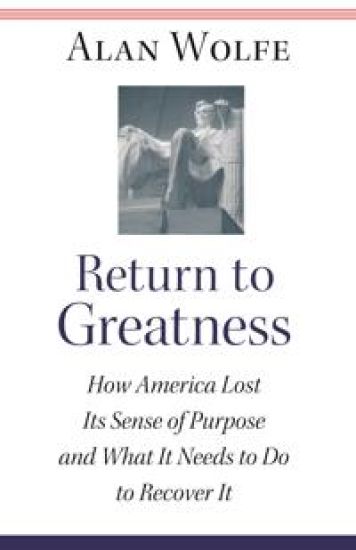
Has America, in its quest for goodness, sacrificed its sense of greatness? In this sharp-witted, historically informed book, veteran political observer Alan Wolfe argues that most Americans show greater concern with saving the country's soul than with making the nation great. Wolfe castigates both conservatives and liberals for opting for small-mindedness over greatness. Liberals, who at their best insisted on policies of national solidarity, have convinced themselves that small is beautiful, prefer multiculturalism to one nation, and are mistrustful of executive political power. Conservatives, who once embraced strong, active central government and an ideal of national citizenship, now support huge tax cuts that undermine America's future ability to undertake any ambitious, long-term project at home or abroad. No great society, in Wolfe's view, has ever been built on the cheap. Wolfe notes that neither the conservatives' call for small-scale faith-based initiatives nor the recent embrace on the left of a grassroots "civil society" can provide health care to tens of millions of uninsured Americans or ensure national security in an age of terrorism. To find better solutions, Wolfe looks back at specific moments in our national experience, when, in the face of sharp resistance, aspirations for the idea of national greatness shaped American history. He demonstrates how a bold and ambitious political agenda, championed at various times by Alexander Hamilton, John Marshall, Abraham Lincoln, and the two Roosevelts, steered the country toward periods of national strength and unity. Steeped in a colorful, panoramic reading of history, Return to Greatness offers a fresh take on American national identity and purpose. A call to action for a renewed embrace of the ideal of an activist federal government and bold policy agendas, it is sure to become a centerpiece of national debate.
At Home in Exile

At Home in Exile

Alan Wolfe

Beacon Press
2015
pokkari
An eloquent, controversial argument that says, for the first time in their long history, Jews are free to live in a Jewish state or lead secure and productive lives outside it Since the beginnings of Zionism in the twentieth century, many Jewish thinkers have considered it close to heresy to validate life in the Diaspora. Jews in Europe and America faced a life of pointless struggle and futile suffering, of ambivalence, confusion, and eternal impotence, as one early Zionist philosopher wrote, echoing a widespread and vehement disdain for Jews living outside Israel. This thinking, in a more understated but still pernicious form, continues to the present: the Holocaust tried to kill all of us, many Jews believe, and only statehood offers safety. But what if the Diaspora is a blessing in disguise? In "At Home in Exile," renowned scholar and public intellectual Alan Wolfe, writing for the first time about his Jewish heritage, makes an impassioned, eloquent, and controversial argument that Jews should take pride in their Diasporic tradition. It is true that Jews have experienced more than their fair share of discrimination and destruction in exile, and there can be no doubt that anti-Semitism persists throughout the world and often rears its ugly head. Yet for the first time in history, Wolfe shows, it is possible for Jews to lead vibrant, successful, and, above all else, secure lives in states in which they are a minority. Drawing on centuries of Jewish thinking and writing, from Maimonides to Philip Roth, David Ben Gurion to Hannah Arendt, Wolfe makes a compelling case that life in the Diaspora can be good for the Jews no matter where they live, Israel very much included as well as for the non-Jews with whom they live, Israel once again included. Not only can the Diaspora offer Jews the opportunity to reach a deep appreciation of pluralism and a commitment to fighting prejudice, but in an era of rising inequalities and global instability, the whole world can benefit from Jews passion for justice and human dignity. Wolfe moves beyond the usual polemical arguments and celebrates a universalistic Judaism that is desperately needed if Israel is to survive. Turning our attention away from the Jewish state, where half of world Jewry lives, toward the pluralistic and vibrant places the other half have made their home, "At Home in Exile" is an inspiring call for a Judaism that isn t defensive and insecure but is instead open and inquiring."
Is There a Culture War?

Is There a Culture War?

James Davison Hunter; Alan Wolfe

Brookings Institution
2006
nidottu
"In the wake of a bitter presidential campaign and in the face of numerous divisive policy questions, many Americans wonder if their country has split in two. People are passionately choosing sides on contentious issues such as the invasion of Iraq, gay marriage, stem-cell research, and the right to die, and the battle over abortion continues unabated. Social and political splits fascinate the media: we hear of Red States against Blue States and the ""Religious Right"" against ""Secular America""; Fox News and Air America; NASCAR dads and soccer moms. Is America, in fact, divided so clearly? Does a moderate middle still exist? Is the national fabric fraying? To the extent that these divisions exist, are they simply the healthy and unavoidable products of a diverse, democratic nation? In Is There a Culture War? two of America's leading authorities on political culture lead a provocative and thoughtful investigation of this question and its ramifications. James Davison Hunter and Alan Wolfe debate these questions with verve, insight, and a deep knowledge rooted in years of study and reflection. Long before most scholars and pundits addressed the issue, Hunter and Wolfe were identifying the fault lines in the debate. Hunter's 1992 book Culture Wars put the term in popular circulation, arguing that America was in the midst of a ""culture war"" over ""our most fundamental and cherished assumptions about how to order our lives."" Six years later, in One Nation After All, Wolfe challenged the idea of a culture war and argued that a majority of Americans were seeking a middle way, a blend of the traditional and the modern. For the first time, these two distinguished scholars join in dialogue to clarify their differences, update their arguments, and search for the truth about America's cultural condition. "
The Power Elite

The Power Elite

C. Wright Mills; Alan Wolfe

Oxford University Press Inc
1999
nidottu
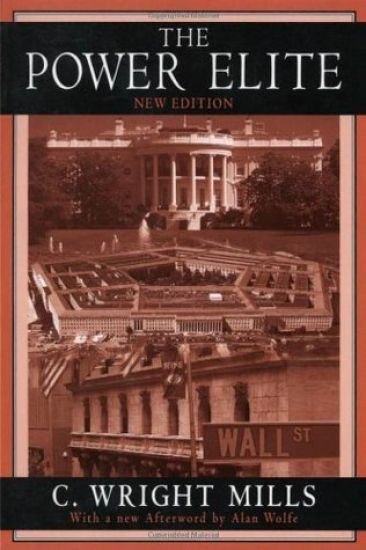
First published in 1956, The Power Elite stands as a contemporary classic of social science and social criticism. C. Wright Mills examines and critiques the organization of power in the United States, calling attention to three firmly interlocked prongs of power: the military, corporate, and political elite. The Power Elite can be read as a good account of what was taking place in America at the time it was written, but its underlying question of whether America is as democratic in practice as it is in theory continues to matter very much today. What The Power Elite informed readers of in 1956 was how much the organization of power in America had changed during their lifetimes, and Alan Wolfe's astute afterword to this new edition brings us up to date, illustrating how much more has changed since then. Wolfe sorts out what is helpful in Mills book and which of his predictions have not come to bear, laying out the radical changes in American capitalism, from intense global competition and the collapse of communism to rapid technological transformations and ever changing consumer tastes. The Power Elite has stimulated generations of readers to think about the kind of society they have and the kind of society they might want, and deserves to be read by every new generation.
Om den amerikanska idén

Om den amerikanska idén

Peter Baldwin; Peter Beinart; Kathleenn Burk; James Carroll; David Ellwood; Godfrey Hodgson; Daniel Walker Howe; Oliver Kamm; Deepak Lal; Anatol Lieven; Edward Luce; Pauline Maier; Douglas Murray; Jong-Yil Ra; David Reynolds; Philippe Roger; Göran Rosenberg; robert J Shapiro; Anders Stephanson; Reinhold Wagnleitner; Alan Wolfe

Bokförlaget Atlantis
2010
sidottu
Hur uppstod idén om Amerika, hur har den omformats genom historien, vart är den på väg? Kring dessa och liknande frågor kretsade Engelsbergsseminariet 2009. Vilka är komponenterna i den amerikanska idén? Hur förvaltas de i dagens USA? Hur reagerar resten av världen på dem? Sker idag en övergång till en post-amerikansk värld? Vem kommer i så fall att ta över USA:s ledande ställning? Indien? Kina? Och vad skulle det innebära? Vilka tankefigurer skulle då komma att prägla världen? Eller har USA chansen att bli kvar som herre på täppan? Bevittnar vi början på slutet för idén om Amerika eller befinner vi oss bara i början av en amerikansk era?Bland bidragsgivarna märks Anatol Lieven, Deepak Lal, Jong-Yil Ra, Edward Luce och Alan Wolfe.