Kirjojen hintavertailu. Mukana 11 244 527 kirjaa ja 12 kauppaa.

Kirjahaku

Etsi kirjoja tekijän nimen, kirjan nimen tai ISBN:n perusteella.

29 kirjaa tekijältä Alasdair MacIntyre

Against the Self-Images of the Age

Against the Self-Images of the Age

Alasdair MacIntyre

University of Notre Dame Press
2018
sidottu
Alasdair MacIntyre is one of the few professional philosophers whose writings span both technical analytical philosophy and those general moral or intellectual questions that laymen often suppose to be the province of philosophy but that are seldom discussed within its bounds. The unity of this book—made up both of original and previously published pieces—lies in its attempt to expose this dichotomy and to link beliefs and moral theories with philosophical criticism. The author successively criticizes Christianity, Marxism, and psychoanalysis for their failure to express the forms of thought and action that constitute our contemporary social life, and argues that a greater understanding of our complex world will require a more thorough inquiry into the philosophy of the social sciences.
Against the Self-Images of the Age

Against the Self-Images of the Age

Alasdair MacIntyre

University of Notre Dame Press
1989
nidottu
Alasdair MacIntyre is one of the few professional philosophers whose writings span both technical analytical philosophy and those general moral or intellectual questions that laymen often suppose to be the province of philosophy but that are seldom discussed within its bounds. The unity of this book—made up both of original and previously published pieces—lies in its attempt to expose this dichotomy and to link beliefs and moral theories with philosophical criticism. The author successively criticizes Christianity, Marxism, and psychoanalysis for their failure to express the forms of thought and action that constitute our contemporary social life, and argues that a greater understanding of our complex world will require a more thorough inquiry into the philosophy of the social sciences.
Marxism and Christianity

Marxism and Christianity

Alasdair MacIntyre

University of Notre Dame Press
1984
nidottu
Contending that Marxism achieved its unique position in part by adopting the content and functions of Christianity, MacIntyre details the religious attitudes and modes of belief that appear in Marxist doctrine as it developed historically from the philosophies of Hegel and Feuerbach, and as it has been carried on by latter-day interpreters from Rosa Luxemburg and Trotsky to Kautsky and Lukacs. The result is a lucid exposition of Marxism and an incisive account of its persistence and continuing importance.
A Short History of Ethics

A Short History of Ethics

Alasdair MacIntyre

University of Notre Dame Press
2000
nidottu
A Short History of Ethics is a significant contribution written by one of the most important living philosophers. For the second edition Alasdair MacIntyre has included a new preface in which he examines his book "thirty years on" and considers its impact. It remains an important work, ideal for all students interested in ethics and morality.
Three Rival Versions of Moral Enquiry

Three Rival Versions of Moral Enquiry

Alasdair MacIntyre

University of Notre Dame Press
1994
sidottu
Alasdair MacIntyre—whom Newsweek has called "one of the foremost moral philosophers in the English-speaking world"—here presents his 1988 Gifford Lectures as an expansion of his earlier work Whose Justice? Which Rationality? He begins by considering the cultural and philosophical distance dividing Lord Gifford's late nineteenth-century world from our own. The outlook of that earlier world, MacIntyre claims, was definitively articulated in the Ninth Edition of the Encyclopaedia Brittanica, which conceived of moral enquiry as both providing insight into and continuing the rational progress of mankind into ever greater enlightenment. MacIntyre compares that conception of moral enquiry to two rival conceptions also formulated in the late nineteenth century: that of Nietzsche's Zur Genealogie der Moral and that expressed in the encyclical letter of Pope Leo XIII Aeterni Patris. The lectures focus on Aquinas's integration of Augustinian and Aristotelian modes of enquiry, the inability of the encyclopaedists' standpoint to withstand Thomistic or genealogical criticism, and the problems confronting the contemporary post-Nietzschean genealogist. MacIntyre concludes by considering the implications for education in universities and colleges.
Three Rival Versions of Moral Enquiry

Three Rival Versions of Moral Enquiry

Alasdair MacIntyre

University of Notre Dame Press
1994
nidottu
Alasdair MacIntyre—whom Newsweek has called "one of the foremost moral philosophers in the English-speaking world"—here presents his 1988 Gifford Lectures as an expansion of his earlier work Whose Justice? Which Rationality? He begins by considering the cultural and philosophical distance dividing Lord Gifford's late nineteenth-century world from our own. The outlook of that earlier world, MacIntyre claims, was definitively articulated in the Ninth Edition of the Encyclopaedia Brittanica, which conceived of moral enquiry as both providing insight into and continuing the rational progress of mankind into ever greater enlightenment. MacIntyre compares that conception of moral enquiry to two rival conceptions also formulated in the late nineteenth century: that of Nietzsche's Zur Genealogie der Moral and that expressed in the encyclical letter of Pope Leo XIII Aeterni Patris. The lectures focus on Aquinas's integration of Augustinian and Aristotelian modes of enquiry, the inability of the encyclopaedists' standpoint to withstand Thomistic or genealogical criticism, and the problems confronting the contemporary post-Nietzschean genealogist. MacIntyre concludes by considering the implications for education in universities and colleges.
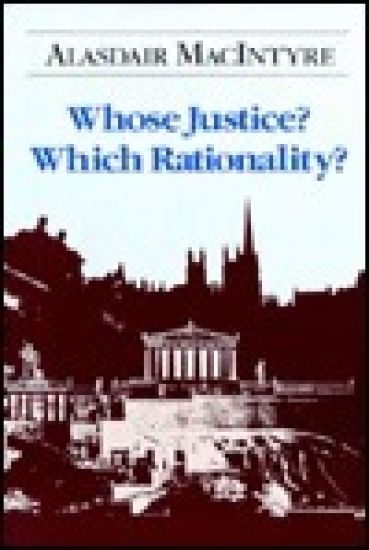
Whose Justice? Which Rationality?

Whose Justice? Which Rationality?

Alasdair MacIntyre

University of Notre Dame Press
1988
sidottu
Whose Justice? Which Rationality?, the sequel to After Virtue, is a persuasive argument of there not being rationality that is not the rationality of some tradition. MacIntyre examines the problems presented by the existence of rival traditions of inquiry in the cases of four major philosophers: Aristotle, Augustine, Aquinas, and Hume.
Whose Justice? Which Rationality?

Whose Justice? Which Rationality?

Alasdair MacIntyre

University of Notre Dame Press
1988
nidottu
Whose Justice? Which Rationality?, the sequel to After Virtue, is a persuasive argument of there not being rationality that is not the rationality of some tradition. MacIntyre examines the problems presented by the existence of rival traditions of inquiry in the cases of four major philosophers: Aristotle, Augustine, Aquinas, and Hume.
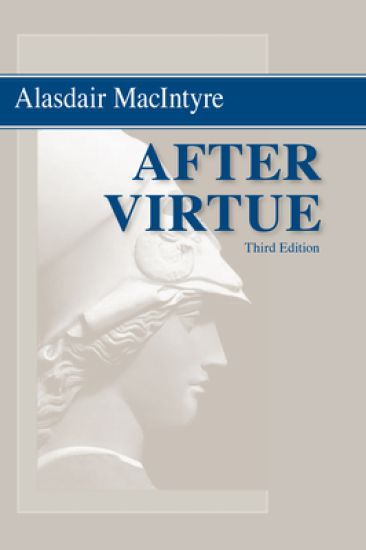
After Virtue

After Virtue

Alasdair MacIntyre

University of Notre Dame Press
2007
nidottu
When After Virtue first appeared in 1981, it was recognized as a significant and potentially controversial critique of contemporary moral philosophy. Newsweek called it "a stunning new study of ethics by one of the foremost moral philosophers in the English-speaking world." Since that time, the book has been translated into more than fifteen foreign languages and has sold over one hundred thousand copies. Now, twenty-five years later, the University of Notre Dame Press is pleased to release the third edition of After Virtue, which includes a new prologue "After Virtue after a Quarter of a Century." In this classic work, Alasdair MacIntyre examines the historical and conceptual roots of the idea of virtue, diagnoses the reasons for its absence in personal and public life, and offers a tentative proposal for its recovery. While the individual chapters are wide-ranging, once pieced together they comprise a penetrating and focused argument about the price of modernity. In the Third Edition prologue, MacIntyre revisits the central theses of the book and concludes that although he has learned a great deal and has supplemented and refined his theses and arguments in other works, he has "as yet found no reason for abandoning the major contentions" of this book. While he recognizes that his conception of human beings as virtuous or vicious needed not only a metaphysical but also a biological grounding, ultimately he remains "committed to the thesis that it is only from the standpoint of a very different tradition, one whose beliefs and presuppositions were articulated in their classical form by Aristotle, that we can understand both the genesis and the predicament of moral modernity."
A Short History of Ethics

A Short History of Ethics

Alasdair MacIntyre

UNIVERSITY OF NOTRE DAME PRESS
2022
sidottu
A Short History of Ethics is a significant contribution written by one of the most important living philosophers. For the second edition Alasdair MacIntyre has included a new preface in which he examines his book "thirty years on" and considers its impact. It remains an important work, ideal for all students interested in ethics and morality.
After Virtue

After Virtue

Alasdair MacIntyre

UNIVERSITY OF NOTRE DAME PRESS
2022
sidottu
When After Virtue first appeared in 1981, it was recognized as a significant and potentially controversial critique of contemporary moral philosophy. Newsweek called it "a stunning new study of ethics by one of the foremost moral philosophers in the English-speaking world." Since that time, the book has been translated into more than fifteen foreign languages and has sold over one hundred thousand copies. Now, twenty-five years later, the University of Notre Dame Press is pleased to release the third edition of After Virtue, which includes a new prologue "After Virtue after a Quarter of a Century." In this classic work, Alasdair MacIntyre examines the historical and conceptual roots of the idea of virtue, diagnoses the reasons for its absence in personal and public life, and offers a tentative proposal for its recovery. While the individual chapters are wide-ranging, once pieced together they comprise a penetrating and focused argument about the price of modernity. In the Third Edition prologue, MacIntyre revisits the central theses of the book and concludes that although he has learned a great deal and has supplemented and refined his theses and arguments in other works, he has "as yet found no reason for abandoning the major contentions" of this book. While he recognizes that his conception of human beings as virtuous or vicious needed not only a metaphysical but also a biological grounding, ultimately he remains "committed to the thesis that it is only from the standpoint of a very different tradition, one whose beliefs and presuppositions were articulated in their classical form by Aristotle, that we can understand both the genesis and the predicament of moral modernity."

A Short History of Ethics

A Short History of Ethics

Alasdair MacIntyre

Routledge
2002
sidottu
A Short History of Ethics has over the past thirty years become a key philosophical contribution to studies on morality and ethics. Alasdair MacIntyre writes a new preface for this second edition which looks at the book 'thirty years on' and considers its impact. A Short History of Ethics guides the reader through the history of moral philosophy from the Greeks to contemporary times. MacIntyre emphasises the importance of a historical context to moral concepts and ideas showing the relevance of philosophical queries on moral concepts and the importance of a historical account of ethics.A Short History of Ethics is an important contribution written by one of the most important living philosophers. Ideal for all philosophy students interested in ethics and morality.
A Short History of Ethics

A Short History of Ethics

Alasdair MacIntyre

Routledge
2002
nidottu
A Short History of Ethics has over the past thirty years become a key philosophical contribution to studies on morality and ethics. Alasdair MacIntyre writes a new preface for this second edition which looks at the book 'thirty years on' and considers its impact. A Short History of Ethics guides the reader through the history of moral philosophy from the Greeks to contemporary times. MacIntyre emphasises the importance of a historical context to moral concepts and ideas showing the relevance of philosophical queries on moral concepts and the importance of a historical account of ethics.A Short History of Ethics is an important contribution written by one of the most important living philosophers. Ideal for all philosophy students interested in ethics and morality.
The Tasks of Philosophy: Volume 1

The Tasks of Philosophy: Volume 1

Alasdair MacIntyre

Cambridge University Press
2006
pokkari
How should we respond when some of our basic beliefs are put into question? What makes a human body distinctively human? Why is truth an important good? These are among the questions explored in this 2006 collection of essays by Alasdair MacIntyre, one of the most creative and influential philosophers working today. Ten of MacIntyre's most influential essays written over almost thirty years are collected together here for the first time. They range over such topics as the issues raised by different types of relativism, what it is about human beings that cannot be understood by the natural sciences, the relationship between the ends of life and the ends of philosophical writing, and the relationship of moral philosophy to contemporary social practice. They will appeal to a wide range of readers across philosophy and especially in moral philosophy, political philosophy, and theology.
Ethics and Politics: Volume 2

Ethics and Politics: Volume 2

Alasdair MacIntyre

Cambridge University Press
2006
pokkari
Alasdair MacIntyre is one of the most creative and important philosophers working today. This volume presents a selection of his classic essays on ethics and politics collected together for the first time, focussing particularly on the themes of moral disagreement, moral dilemmas, and truthfulness and its importance. The essays range widely in scope, from Aristotle and Aquinas and what we need to learn from them, to our contemporary economic and social structures and the threat which they pose to the realization of the forms of ethical life. They will appeal to a wide range of readers across philosophy and especially in moral philosophy, political philosophy, and theology.
The Tasks of Philosophy: Volume 1

The Tasks of Philosophy: Volume 1

Alasdair MacIntyre

Cambridge University Press
2006
sidottu
How should we respond when some of our basic beliefs are put into question? What makes a human body distinctively human? Why is truth an important good? These are among the questions explored in this 2006 collection of essays by Alasdair MacIntyre, one of the most creative and influential philosophers working today. Ten of MacIntyre's most influential essays written over almost thirty years are collected together here for the first time. They range over such topics as the issues raised by different types of relativism, what it is about human beings that cannot be understood by the natural sciences, the relationship between the ends of life and the ends of philosophical writing, and the relationship of moral philosophy to contemporary social practice. They will appeal to a wide range of readers across philosophy and especially in moral philosophy, political philosophy, and theology.
Three Rival Versions of Moral Enquiry

Three Rival Versions of Moral Enquiry

Alasdair MacIntyre

Gerald Duckworth Co Ltd
1990
nidottu
MacIntyre's project, here as elsewhere, is to put up a fight against philosophical relativism. . . . The current form is the 'incommensurability, ' so-called, of differing standpoints or conceptual schemes. Mr. MacIntyre claims that different schools of philosophy must differ fundamentally about what counts as a rational way to settle intellectual differences. Reading between the lines, one can see that he has in mind nationalities as well as thinkers, and literary criticism as well as academic philosophy. More explicitly, he labels and discusses three significantly different standpoints: the encyclopedic, the genealogical and the traditional. . . . [T]he chapters on the development of Christian philosophy between Augustine and Duns Scotus are very interesting indeed. . . . [MacIntyre] must be the past, present, future, and all-time philosophical historians' historian of philosophy. -The New York Times Book Revie
Marxism and Christianity

Marxism and Christianity

Alasdair MacIntyre

Gerald Duckworth Co Ltd
1995
pokkari
This volume explores the common ground between Marxism and Christianity. It argues that Marxism shares in good measure both the content and functions of Christianity and does so because it inherits it from Christianity. It details the religious attitudes and modes of belief that appear in Marxism as it developed historically from the philosophies of Hegel and Feuerbach, and as it has been carried on by its latter-day interpreters from Rosa Luxemberg and Trotsky to Kautsky and Lukacs. It sets out to show that Marxism, no less than Christianity, is subject to the historical relativity that affects all ideologies. This new edition has been updated to take account of the collapse of Communism in the former Eastern bloc and whether Marxism, in particular, is still relevant to those who seek a changed social order today.
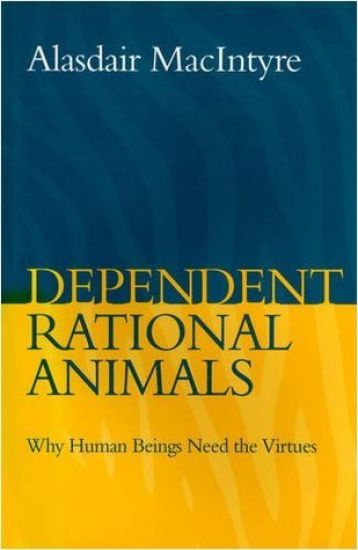
Dependent Rational Animals

Dependent Rational Animals

Alasdair MacIntyre

Gerald Duckworth Co Ltd
2009
pokkari
Where should an account of the virtues begin? In "Dependent Rational Animals", Alasdair MacIntyre argues that we should begin with those facts of vulnerability and disability, and of consequent dependence on others, to which moral philosophers have generally given insufficient attention, and with the animal nature of human beings - that which exhibits their kinship to members of other intelligent species. He argues that it is by reference to these that we become able to understand the part played in our lives both by the virtues of independent practical reasoning and by the virtues of an acknowledged dependence on others.