Kirjojen hintavertailu. Mukana 11 244 527 kirjaa ja 12 kauppaa.

Kirjahaku

Etsi kirjoja tekijän nimen, kirjan nimen tai ISBN:n perusteella.

10 kirjaa tekijältä Alastair Fowler

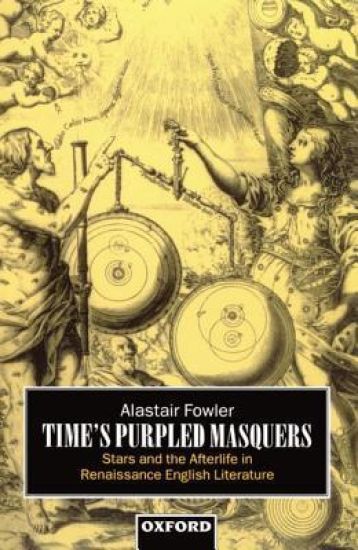
Time's Purpled Masquers

Time's Purpled Masquers

Alastair Fowler

Clarendon Press
1996
sidottu
Alastair Fowler's fascinating study explores the extraordinary prominence of astronomical imagery in Renaissance literature. Although the stars were important astrologically, this is at best a partial explanation for the popularity of such imagery, and the impact of astronomical discoveries (particularly their implications for stellification, or translation to the stars) is also an important factor. Seventeenth-century culture was both religious and materialistic and the literature of the period shows a great variety of negotiated reconciliations of the two.
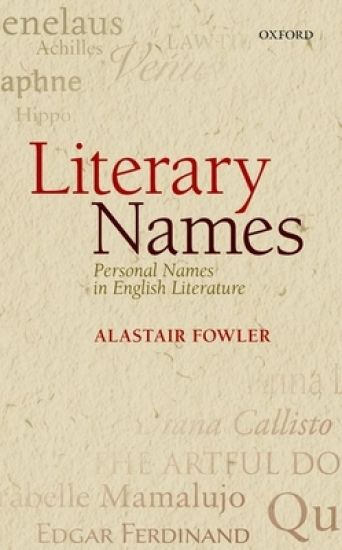
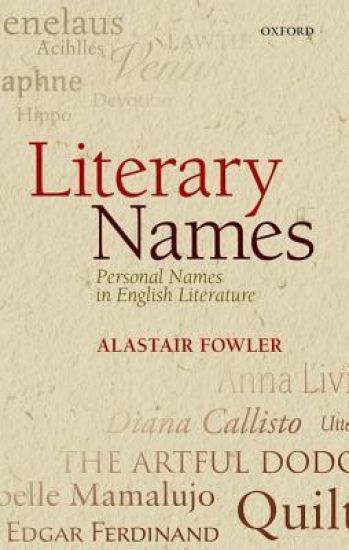
Literary Names

Literary Names

Alastair Fowler

Oxford University Press
2014
nidottu
Why do authors use pseudonyms and pen-names, or ingeniously hide names in their work with acrostics and anagrams? How has the range of permissible given names changed and how is this reflected in literature? Why do some characters remain mysteriously nameless? In this rich and learned book, Alastair Fowler explores the use of names in literature of all periods - primarily English but also Latin, Greek, French, and Italian - casting an unusual and rewarding light on the work of literature itself. He traces the history of names through Homer, Spenser, Shakespeare, Milton, Thackeray, Dickens, Joyce, and Nabokov, showing how names often turn out to be the thematic focus. Fowler shows that the associations of names, at first limited, become increasingly salient and sophisticated as literature itself develops.
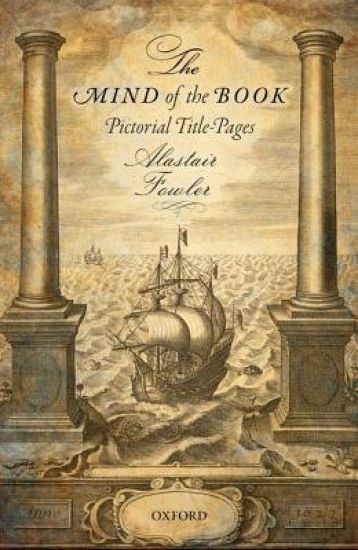
The Mind of the Book

The Mind of the Book

Alastair Fowler

Oxford University Press
2017
sidottu
Alastair Fowler presents a fascinating study of title-pages printed in England from the early modern period to the nineteenth century. He examines pictorial title-pages in the context of the History of the Book for the first time. The first part of The Mind of the Book explores the forerunner of the frontispiece in late antiquity; the use of frames and borders in title-pages; portraits; printers' devices; emblematic title-pages of the sixteenth and seventeenth centuries, especially attending to explanatory verses and arcane features such as chronograms; title-pages as 'memory prompts'; and eighteenth and nineteenth-century title-pages, tracing 'the rejection of emblematic and symbolic features and the introduction of unadorned, unpictorial, title-pages'. The second part of the book presents illustrations of sixteen significant title-pages with commentaries, ranging from Chaucer's Works in 1532 through Bacon's Instauratio Magna in 1620, Dicken's The Mystery of Edwin Drood in 1870, and arriving back at Chaucer with Edward Burnes-Jones's illustrated title-page for the Works of 1896.
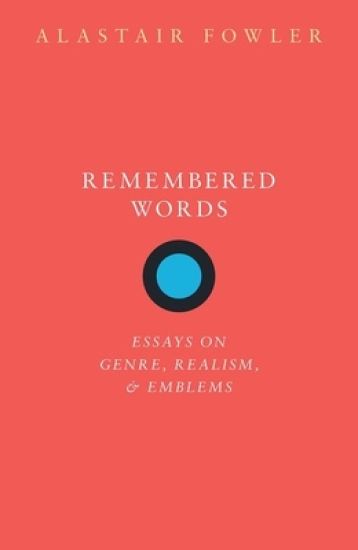
Remembered Words

Remembered Words

Alastair Fowler

Oxford University Press
2021
sidottu
Remembered Words is a selection of Alastair Fowler's essays on genre, realism, and the emblem (three interrelated subjects), published over six decades. It offers readers a way to arrive at a sense of how approaches to these subjects have changed over that period. Specifically, it shows how genre has come to be understood in terms of family resemblance theory. Remembered Words argues that realism can be seen as altering historically, so that Renaissance realism, for example, differs from those of later periods. Similar changes are traced in the emblem, which Fowler shows to be not only a particular genre, but an element of various kinds of realism. Famous passages in ancient literature are remembered in the familiar emblems of the Renaissance; and Renaissance emblems form the basis of metaphors in later literature. Meanwhile, the general approach of the critic and the reader has been altering over the years--as becomes evident when one takes into account the time-scale of sixty years (an unusually long working life for a critic). Modern theoretical approaches--which are often casually regarded as self-evident--may appear less inevitable and more arbitrary. This is not to say that they are necessarily wrong, just that they need to be argued for. Remembered Words is intended for senior undergraduates and for graduate students, who may use it to form ideas of Fowler's approach and that of his contemporaries and predecessors over the last half century.
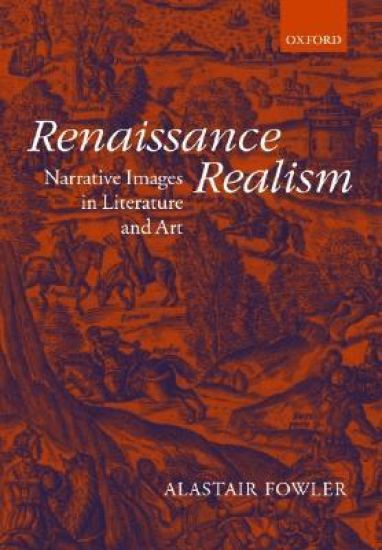
Renaissance Realism

Renaissance Realism

Alastair Fowler

Oxford University Press
2003
sidottu
This book questions the assumption of a single realism, the continuous realism of novels. Many suppose that narrative before the novel either looked forward to it or was medieval and allegorical, and compare the introduction of single-point perspective with the rise of the novel. But continuous realism did not arise as soon as perspective was discovered. In actuality, a distinctive sort of Renaissance realism, with its own conventions, was practised from the late Middle Ages to the seventeenth century. Renaissance Realism surveys the history of perspective, showing that it only gradually came to dominate the western imagination and to become the default assumption for portrayal in the visual arts. Looked at in this way, correlates between literature and art emerge in the depiction of objects and events. Treatment of spatial arrangement and time sequences, for example, closely parallel 'simultaneous narration' in the visual arts.
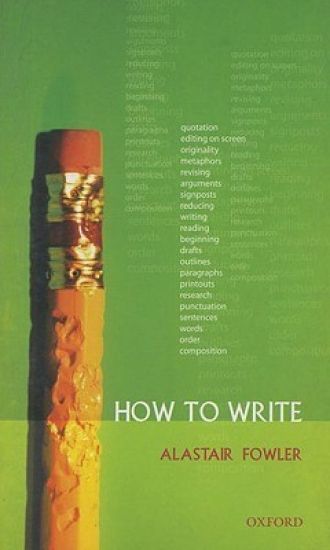
How to Write

How to Write

Alastair Fowler

Oxford University Press
2006
nidottu
How to Write is an introductory guide to writing, aimed at people who think they can't write, or for whom writing is an ordeal. Broken down into short topic-based chapters on everything from beginning to revising, it demystifies the writing process by taking the reader through each stage necessary to bring a piece of writing to a decent finish. The book also offers a wealth of invaluable practical considerations, including when and where to write, when to printout and when to edit onscreen, what type of pen works well for revisions, and the hazards of the paperclip. The author is a seasoned writer whose encouraging but uncompromising guidance will delight as well as instruct. Offering practical advice in a lucid, no-nonsense style, How to Write will be ideal for both students and professional people who need to write during the course of their work.
Literary Names

Literary Names

Alastair Fowler

Oxford University Press
2012
sidottu
Why do authors use pseudonyms and pen-names, or ingeniously hide names in their work with acrostics and anagrams? How has the range of permissible given names changed and how is this reflected in literature? Why do some characters remain mysteriously nameless? In this rich and learned book, Alastair Fowler explores the use of names in literature of all periods - primarily English but also Latin, Greek, French, and Italian - casting an unusual and rewarding light on the work of literature itself. He traces the history of names through Homer, Spenser, Shakespeare, Milton, Thackeray, Dickens, Joyce, and Nabokov, showing how names often turn out to be the thematic focus. Fowler shows that the associations of names, at first limited, become increasingly salient and sophisticated as literature itself develops.
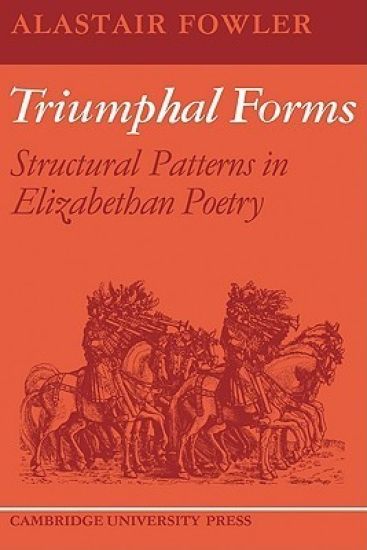
Triumphal Forms

Triumphal Forms

Alastair Fowler

Cambridge University Press
2010
pokkari
A study of numerology in Elizabethan poetry, with some background studies which base the subject in classical learning, the works of Dante and Petrarch, and the esoteric traditions of the humanists. The central assumption of numerological criticism is that there exist works written in this tradition which show a correspondence between structure and meaning on a numerical plane; that is, one in which the number of the constituent parts (lines, stanzas, sonnets in a sequence) expresses a major aspect of the meaning. For instance parts of the whole can be arranged to represent months of the year and so on. Such structures of time and the triumphal form, in which the most important 'sovereign' element is placed at the centre, are the two main numerological patterns discussed by Dr Fowler. Critics have tended to regard numerology as an isolated phenomenon, rare after the Middle Ages but Dr Fowler demonstrates its persistence in the works of Spenser, Sidney, Chapman, Shakespeare, Donne, Jonson, Dryden and others.
Edmund Spenser

Edmund Spenser

Alastair Fowler

NORTHCOTE HOUSE PUBLISHERS LTD
1978
nidottu
Edmund Spenser (c.1552-1599) was an English writer best known for his epic poem The Faerie Queene (1590). In this 1977 study, Alastair Fowler argues that Spenser’s work shows ‘an astonishing capacity to speak to’ the twentieth century.