Kirjojen hintavertailu. Mukana 12 016 292 kirjaa ja 12 kauppaa.

Kirjahaku

Etsi kirjoja tekijän nimen, kirjan nimen tai ISBN:n perusteella.

176 kirjaa tekijältä Albert Einstein

The Collected Papers of Albert Einstein, Volume 5 (English)

The Collected Papers of Albert Einstein, Volume 5 (English)

Albert Einstein

Princeton University Press
1995
pokkari
Every document in The Collected Papers of Albert Einstein appears in the language in which it was written, and supplementary paperback volumes present the English translations if all non-English materials. For those desiring a supplement to Volume 5, for instance, this paperback includes translations of correspondence that give a much richer picture of Einstein in his twenties and thirties than we ever had. In addition to illuminating the personal aspects of his life, the letters document his scientific activity: his concentration for years on the unfathomable problems of quanta and radiation, his extensive knowledge of experimental physics, his many fruitful interactions with experimentalists, and finally his long struggle to generalize the 1905 theory of relativity to include gravitation and accelerated frames of reference. This paperback translation does not include notes or annotation of the documentary volume and is not intended for use without the original language documentary edition, which provides the extensive editorial commentary necessary for a full historical and scientific understanding of the documents.
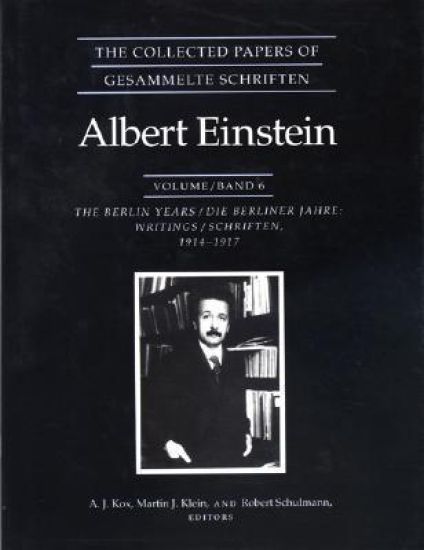
The Collected Papers of Albert Einstein, Volume 6

The Collected Papers of Albert Einstein, Volume 6

Albert Einstein

Princeton University Press
1996
sidottu
Presented in this volume are Albert Einstein's writings from his arrival in Berlin in the spring of 1914 to take up his new position at the Prussian Academy of Sciences through the end of 1917. During these years he completed the general theory of relativity--the relativistic theory of gravitation--and this was surely the high point of his scientific life. His writings on relativity in this volume range from general treatments of the theory to detailed calculations of specific consequences and his first attempt at a relativistic account of cosmology. They also include his popular exposition of the special and general theories, first published in 1917 and still a valuable account for the general reader. As soon as the difficulties on the path to general relativity had been overcome, Einstein returned to the riddles of the quantum theory. His major clarification of the quantum theory of radiation appears here along with his lesser known contribution to the formulation of quantum conditions. This volume also contains the papers describing Einstein's only experimental investigation, a study of Ampere's molecular currents, which he carried out with the Dutch physicist W. J. de Haas. Before the beginning of World War I, Einstein had never expressed his views on nonscientific subjects. Yet one of his first reactions to this previously unthinkable general war was to sign an "Appeal to Europeans" urging an immediate end to hostilities. Every document in The Collected Papers of Albert Einstein appears in the language in which it was written.
The Collected Papers of Albert Einstein, Volume 6 (English)

The Collected Papers of Albert Einstein, Volume 6 (English)

Albert Einstein

Princeton University Press
1997
pokkari
Every document in The Collected Papers of Albert Einstein appears in the language in which it was written, and this supplementary paperback volume presents the English translations of all non-English materials. This translation does not include notes or annotation of the documentary volume and is not intended for use without the original language documentary edition which provides the extensive editorial commentary necessary for a full historical and scientific understanding of the documents.
The Collected Papers of Albert Einstein, Volume 4 (English)

The Collected Papers of Albert Einstein, Volume 4 (English)

Albert Einstein

Princeton University Press
1996
pokkari
This volume presents Einstein's writings from the final period of his work in Switzerland. Most of the material in Volume 4 documents Einstein's search for a relativistic theory of gravitation, a search that ended in Berlin in the fall of 1915 with the completion of the general theory of relativity. Three scientific manuscripts, printed here for the first time, provide insight into Einstein's efforts to generalize his original relativity theory into a theory of gravitation. The first is a review article on the special theory of relativity. The second consists of notes that document Einstein's research on gravitation. The third manuscript contains calculations on the problem of the motion of the perihelion of Mercury. The explanation of the observed anomaly of this motion was to become one of the classical tests of general relativity. The existence of such a manuscript has not been known before now. All three of these manuscripts, along with other material in this volume, add significantly to our understanding of the creation of general relativity. This supplementary paperback volue presents only the English translations of non-English materials and is not intended for use without the original-language documentary edition.
The Collected Papers of Albert Einstein, Volume 5

The Collected Papers of Albert Einstein, Volume 5

Albert Einstein

Princeton University Press
1993
sidottu
This volume, the first in the series to be devoted to Einstein's correspondence, begins in June 1902, when he went to work at the Swiss Patent Office. It closes in March 1914, as Einstein left Switzerland to take up his appointment as a member of the Prussian Academy of Sciences in Berlin. The great majority of the more than 500 letters from and to Einstein presented here have not been published before, and some of them will be new even to most Einstein scholars. They give us a much richer picture of Einstein in his twenties and early thirties than we have ever had. We see him through his correspondence with his mother, his wife Mileva, and, from 1912 on, his cousin Elsa, who would later become his second wife. He maintains close ties with old friends, but his circle widens, particularly after 1906, to include a number of his contemporaries in physics such as Max Laue and Paul Ehrenfest. He also develops important relationships with older theorists--Max Planck, Arnold Sommerfeld, and especially H. A. Lorentz. The letters in this volume clarify the development of his academic career once he leaves the Patent Office in 1909, and bring out the important parts played by such staunch supporters of Einstein as Alfred Kleiner, Fritz Haber, and, above all, Walther Nernst. Most significant, however, is the way the letters document crucial aspects of Einstein's scientific activity: his concentration for years on the unfathomable problems of quanta and radiation, his extensive knowledge of experimental physics, his many fruitful interactions with experimentalists, and finally his long struggle to generalize the 1905 theory of relativity to include gravitation and accelerated frames of reference.
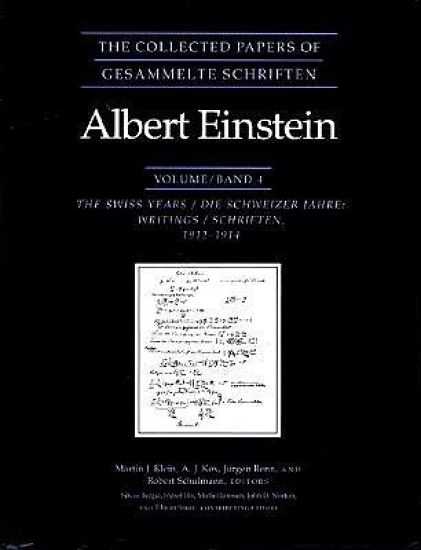
The Collected Papers of Albert Einstein, Volume 4

The Collected Papers of Albert Einstein, Volume 4

Albert Einstein

Princeton University Press
1995
sidottu
This volume presents Einstein's writings from the final period of his work in Switzerland. Most of the material in Volume 4 documents Einstein's search for a relativistic theory of gravitation, a search that ended in Berlin in the fall of 1915 with the completion of the general theory of relativity. Three scientific manuscripts, printed here for the first time, provide insights into Einstein's efforts to generalize his original relativity theory into a theory of gravitation. The first is a review article on the special theory of relativity. The second consists of notes that document Einstein's research on gravitation. The third manuscript contains calculations on the problem of the motion of the perihelion of Mercury. The explanation of the observed anomaly of this motion was to become one of the classical tests of general relativity. The existence of such a manuscript has not been known before now. All three of these manuscripts, along with other material in this volume, add significantly to our understanding of the creation of general relativity.
The Collected Papers of Albert Einstein, Volume 8 (English)

The Collected Papers of Albert Einstein, Volume 8 (English)

Albert Einstein

Princeton University Press
1998
pokkari
This volume opens in spring 1914 when Einstein takes up a research professorship at the Prussian Academy of Sciences in Berlin and closes with the collapse of the German Empire four and one-half years later. A good portion of the documentation, which comprises more than 675 letters, has only recently been discovered by the editors. The letters touch on all aspects of Einstein's activities and shed new light on his inner life, while enriching our understanding of his published papers, presented in volumes 6 and 7 of this series. The breakup of Einstein's first marriage and the divorce are presented here for the first time in all their complexity. New material shows Einstein maintaining a strong sense of moral urgency throughout the war. The scientific correspondence documents Einstein's struggle to find satisfactory field equations for his new gravitational theory--the general theory of relativity--and his continued discussion with leading physicists and mathematicians about the implications and further development of the theory.
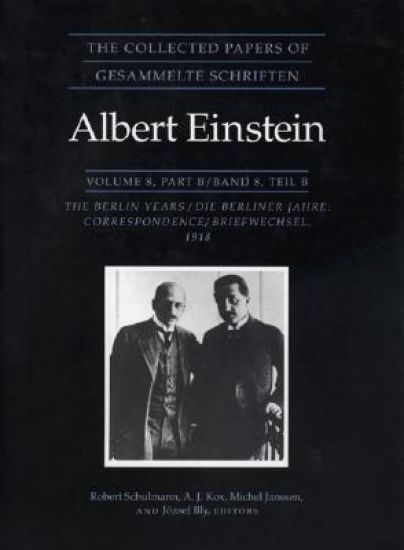
The Collected Papers of Albert Einstein, Volume 8

The Collected Papers of Albert Einstein, Volume 8

Albert Einstein

Princeton University Press
1998
sidottu
This volume opens in spring 1914 when Einstein takes up a research professorship at the Prussian Academy of Sciences in Berlin and closes with the collapse of the German Empire four and one-half years later. A good portion of the documentation, which comprises more than 675 letters, has only recently been discovered by the editors. The letters touch on all aspects of Einstein's activities and shed new light on his inner life, while enriching our understanding of his published papers, presented in volumes 6 and 7 of this series. The breakup of Einstein's first marriage and the divorce are presented here for the first time in all their complexity. New material shows Einstein maintaining a strong sense of moral urgency throughout the war. The scientific correspondence documents Einstein's struggle to find satisfactory field equations for his new gravitational theory--the general theory of relativity--and his continued discussion with leading physicists and mathematicians about the implications and further development of the theory.
Collected Papers of Albert Einstein

Collected Papers of Albert Einstein

Albert Einstein

Princeton University Press
2002
sidottu
In the spring of 1919, two British solar eclipse expeditions confirmed the correctness of general relativity theory and propelled Albert Einstein to instant celebrity. Before this major turning point, the majority of Einstein's writings published in this volume dealt with the clarification of general relativistic problems, such as the status of the metric field, the character of gravitational waves, the problem of energy-momentum conservation, and questions of cosmology, such as the nature and size of the universe and the distribution of matter within it. After his rise to international fame, Einstein's publications changed markedly. He faced an increasing demand for popular articles and lectures on relativity, its development and meaning. He also felt compelled to respond to a host of commentators, ranging from skeptical physicists to philosophers trying to reconcile his revolutionary theory with their views. For the first time, he also responded in print to outspoken anti-relativists, some of them fueled by cultural conservatism and, frequently, anti-Semitism. Einstein used his newly won fame to lend prestige to political causes, especially to the reconciliation among European nations and to Zionism. In the early years of Weimar Germany, Einstein spoke out vigorously for the young republic, emphasizing the rights of the individual. He agonized over the misery of the Central Europeans in the grip of starvation and economic collapse, praised the support of individuals and groups such as the Quakers, and championed the cause of Eastern European Jews. His rejection of assimilation, combined with a fierce defense of the right of Jews to higher education, led Einstein to campaign for the establishment of a university in Palestine, the land which he conceived of as a cultural center for all Jews.
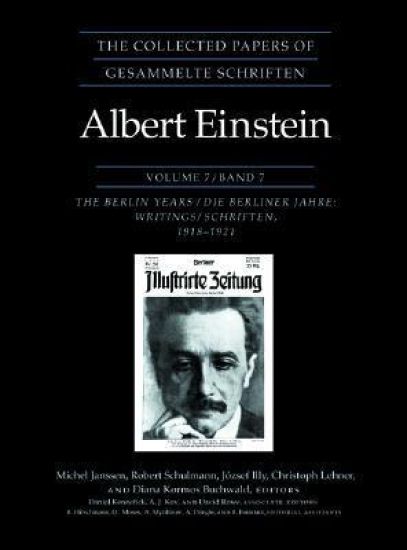
The Collected Papers of Albert Einstein, Volume 7 (English)

The Collected Papers of Albert Einstein, Volume 7 (English)

Albert Einstein

Princeton University Press
2002
pokkari
In the spring of 1919, two British solar eclipse expeditions confirmed the correctness of general relativity theory and propelled Albert Einstein to instant celebrity. Before this major turning point, the majority of Einstein's writings published in this volume dealt with the clarification of general relativistic problems, such as the status of the metric field, the character of gravitational waves, the problem of energy-momentum conservation, and questions of cosmology, such as the nature and size of the universe and the distribution of matter within it. After his rise to international fame, Einstein's publications changed markedly. He faced an increasing demand for popular articles and lectures on relativity, its development and meaning. He also felt compelled to respond to a host of commentators, ranging from skeptical physicists to philosophers trying to reconcile his revolutionary theory with their views. For the first time, he also responded in print to outspoken anti-relativists, some of them fueled by cultural conservatism and, frequently, anti-Semitism. Einstein used his newly won fame to lend prestige to political causes, especially to the reconciliation among European nations and to Zionism. In the early years of Weimar Germany, Einstein spoke out vigorously for the young republic, emphasizing the rights of the individual. He agonized over the misery of the Central Europeans in the grip of starvation and economic collapse, praised the support of individuals and groups such as the Quakers, and championed the cause of Eastern European Jews. His rejection of assimilation, combined with a fierce defense of the right of Jews to higher education, led Einstein to campaign for the establishment of a university in Palestine, the land which he conceived of as a cultural center for all Jews. Since this supplementary paperback includes only select portions of Volume 7, it is not recommended for purchase without the main volume.
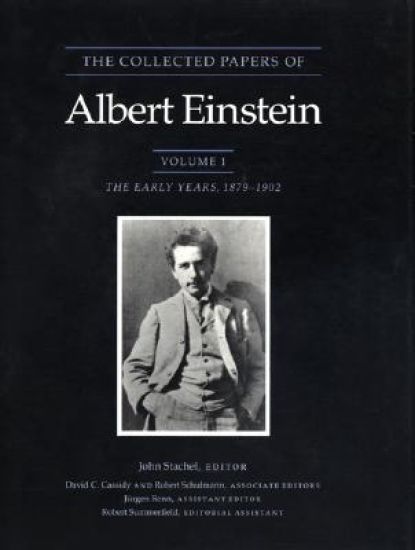
The Collected Papers of Albert Einstein, Volume 1

The Collected Papers of Albert Einstein, Volume 1

Albert Einstein

Princeton University Press
1987
sidottu
Volume 1 presents important new material on the young Einstein. Over half the documents made available here were discovered by the editors, including a significant group of over fifty letters that Einstein exchanged with Mileva Maric, his fellow student and future wife. These letters, together with other previously unpublished documents, provide an entirely new view of Einstein's youth. The documents in the volume also foreshadow the emergence of his extraordinary creative power. In them is manifested his intense commitment to scientific work and his interest in certain themes that proved to be central to his thinking during the next decade. We can follow, for example, the beginnings of his preoccupation with the electrodynamics of moving bodies that was to lead to the development of this special theory of relativity. For the first time it can be seen how closely he followed such contemporary developments in physics as Planck's work on radiation theory and Drude's work on the electron theory of metals. In addition to all of Einstein's known correspondence and other writings from this period, the volume includes the relevant portions of all third-party letters and other contemporary documents that provide additional information about his secondary schooling at the Aargau Cantonal School; his four years at the Swiss Federal Plytechnical School, or the ETH; and his search for a job after graduation. Included in the volume are those sections of an unpublished biography by Einstein's sister, Maja Winteler-Einstein, which deal with his early years; his extensive notes on a physics course he took at the ETH; and previously unpublished photographs of the young Einstein and his teachers and friends. Documents in Volume 1 portray Einstein's experiences during the two stressful years after his graduation from the ETH in Zurich. Denied a position as an Assistant at the ETH, he lived a hand-to-mouth existence while he looked for a post at other universities; then he attempted to find a secondary-school post, and finally sought a nonacademic job. Tension with his parents over his plans to marry Mileva Maric is evident throughout this period. With the help of a friend, he finally found work at the Swiss Patent Office, the haven where he would spend the next seven years. Freed from his financial worries, he entered on one of the most productive periods of his life, as the next volume, Writings (1901-1910), will document.
The Collected Papers of Albert Einstein, Volume 1 (English)

The Collected Papers of Albert Einstein, Volume 1 (English)

Albert Einstein

Princeton University Press
1987
pokkari
Volume 1 presents important new material on the young Einstein. Over half the documents made available here were discovered by the editors, including a significant group of over fifty letters that Einstein exchanged with Mileva Maric, his fellow student and future wife. These letters, together with other previously unpublished documents, provide an entirely new view of Einstein's youth. The documents in the volume also foreshadow the emergence of his extraordinary creative power. In them is manifested his intense commitment to scientific work and his interest in certain themes that proved to be central to his thinking during the next decade. We can follow, for example, the beginnings of his preoccupation with the electrodynamics of moving bodies that was to lead to the development of this special theory of relativity. For the first time it can be seen how closely he followed such contemporary developments in physics as Planck's work on radiation theory and Drude's work on the electron theory of metals. In addition to all of Einstein's known correspondence and other writings from this period, the volume includes the relevant portions of all third-party letters and other contemporary documents that provide additional information about his secondary schooling at the Aargau Cantonal School; his four years at the Swiss Federal Plytechnical School, or the ETH; and his search for a job after graduation. Included in the volume are those sections of an unpublished biography by Einstein's sister, Maja Winteler-Einstein, which deal with his early years; his extensive notes on a physics course he took at the ETH; and previously unpublished photographs of the young Einstein and his teachers and friends. Documents in Volume 1 portray Einstein's experiences during the two stressful years after his graduation from the ETH in Zurich. Denied a position as an Assistant at the ETH, he lived a hand-to-mouth existence while he looked for a post at other universities; then he attempted to find a secondary-school post, and finally sought a nonacademic job. Tension with his parents over his plans to marry Mileva Maric is evident throughout this period. With the help of a friend, he finally found work at the Swiss Patent Office, the haven where he would spend the next seven years. Freed from his financial worries, he entered on one of the most productive periods of his life, as the next volume, Writings (1901-1910), will document.
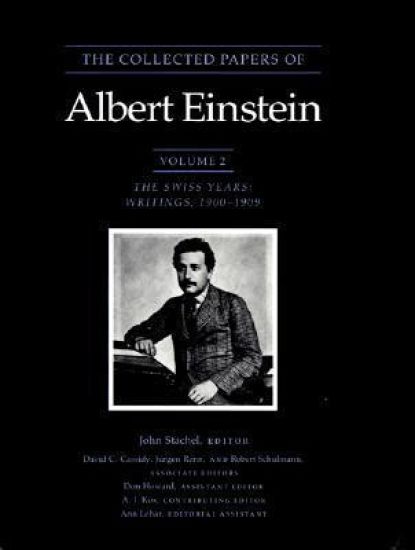
The Collected Papers of Albert Einstein, Volume 2

The Collected Papers of Albert Einstein, Volume 2

Albert Einstein

Princeton University Press
1990
sidottu
This volume of The Collected Papers of Albert Einstein contains the scientific work Einstein published during the first decade of his career, and includes some of the most significant achievements of twentieth-century physics. The first paper was written in 1900 by the twenty-one-year-old Einstein, newly graduated from the Swiss Federal Polytechnical School, or ETH, in Zurich and still searching in vain for a job. The last paper in this volume is the text of an invited lecture given in 1909 to a major scientific meeting by Einstein after he was appointed to his first academic post at the University of Zurich. He had already been recognized as an important theoretical physicist on the basis of the work reprinted here, particularly the three masterpieces that appeared in quick succession during 1905, Einstein's year of miracles. In one of these papers Einstein showed how one could finally confirm the ancient view that matter is composed of discrete atoms, and even measure the numbers and masses of these atoms. In a second paper, which even he referred to as "very revolutionary," he argued that the observed properties of thermal radiation suggest that it consists not of waves, but rather of localized particles of energy which he called energy quanta. The third and most famous paper set forth the special theory of relativity, solving some long-standing difficulties, but requiring a significant change in our understanding of those basic concepts, space and time.
The Collected Papers of Albert Einstein, Volume 2 (English)

The Collected Papers of Albert Einstein, Volume 2 (English)

Albert Einstein

Princeton University Press
1989
pokkari
Every document in The Collected Papers of Albert Einstein appears in the language in which it was written, and this supplementary paperback volume presents the English translations of all non-English materials. This translation does not include notes or annotation of the documentary volume and is not intended for use without the original language documentary edition which provides the extensive editorial commentary necessary for a full historical and scientific understanding of the documents.
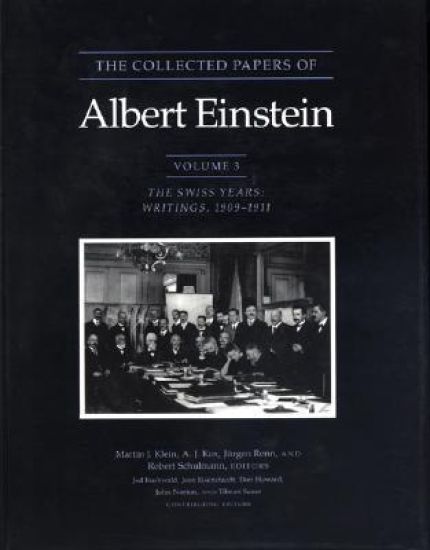
The Collected Papers of Albert Einstein, Volume 3

The Collected Papers of Albert Einstein, Volume 3

Albert Einstein

Princeton University Press
1994
sidottu
This volume of The Collected Papers of Albert Einstein presents Einstein's writings for the two-year period starting in October 1909. The initial date marks Einstein's departure from the Swiss Patent Office at Bern, which had been his professional home for seven years, and the beginning of his first academic appointment, at the University of Zurich. The volume concludes with the masterful report that Einstein, by then a full professor at the German-language university in Prague, gave to the original Solvay Congress, the first international meeting devoted to the problems of radiation and the quantum theory. Most of Einstein's efforts during these years went into his struggle with these ever more perplexing problems of quanta, on which he made discouragingly little progress. Einstein's new academic career naturally required him to teach, and almost half of this volume consists of the previously unpublished notes he wrote in preparation for his lectures on mechanics, on electricity and magnetism, and on kinetic theory and statistical mechanics. The last of these is particularly interesting in reflecting some of his research interests. Several papers here are concerned with aspects of the special theory of relativity, but it is Einstein's article of June 1911 that is a harbinger of things to come: it contains his calculation of the bending of light in a gravitational field on the basis of his equivalence principle. Martin J. Klein is Bass Professor of the History of Science and Professor of Physics at Yale University and Senior Editor of The Collected Papers of Albert Einstein. A. J. Kox teaches history of science at the University of Amsterdam, Jurgen Renn is Assistant Professor of Philosophy and Physics at Boston University, and Robert Schulmann is Assistant Professor of History at Boston University.
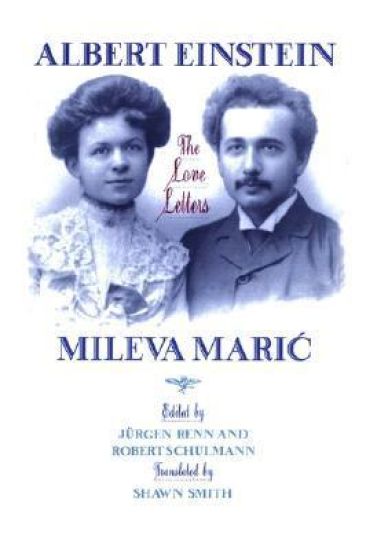
Albert Einstein, Mileva Maric

Albert Einstein, Mileva Maric

Albert Einstein

Princeton University Press
2000
pokkari
In 1903, despite the vehement objections of his parents, Albert Einstein married Mileva Maric, the companion, colleague, and confidante whose influence on his most creative years has given rise to much speculation. Beginning in 1897, after Einstein and Maric met as students at the Swiss Federal Polytechnic, and ending shortly after their marriage, these fifty-four love letters offer a rare glimpse into Einstein's relationship with his first wife while shedding light on his intellectual development in the period before the annus mirabilis of 1905. Unlike the picture of Einstein the lone, isolated thinker of Princeton, he appears here both as the burgeoning enfant terrible of science and as an amorous young man beset, along with his fiance, by financial and personal struggles--among them the illegitimate birth of their daughter, whose existence is known only by these letters. Describing his conflicts with professors and other scientists, his arguments with his mother over Maric, and his difficulty obtaining an academic position after graduation, the letters enable us to reconstruct the youthful Einstein with an unprecedented immediacy. His love for Maric, whom he describes as "a creature who is my equal, and who is as strong and independent as I am," brings forth his serious as well as playful, often theatrical nature. After their marriage, however, Maric becomes less his intellectual companion, and, failing to acquire a teaching certificate, she subordinates her professional goals to his. In the final letters Einstein has obtained a position at the Swiss Patent Office and mentions their daughter one last time to his wife in Hungary, where she is assumed to have placed the girl in the care of relatives. Informative, entertaining, and often very moving, this collection of letters captures for scientists and general readers alike a little known yet crucial period in Einstein's life.
The Collected Papers of Albert Einstein, Volume 3 (English)

The Collected Papers of Albert Einstein, Volume 3 (English)

Albert Einstein

Princeton University Press
1994
pokkari
This volume of The Collected Papers of Albert Einstein presents Einstein's writings for the two-year period starting in October 1909. The initial date marks Einstein's departure from the Swiss Patent Office at Bern, which had been his professional home for seven years, and the beginning of his first academic appointment, at the University of Zurich. The volume concludes with the masterful report that Einstein, by then a full professor at the German-language university in Prague, gave to the original Solvay Congress, the first international meeting devoted to the problems of radiation and the quantum theory. Most of Einstein's efforts during these years went into his struggle with these ever more perplexing problems of quanta, on which he made discouragingly little progress. Einstein's new academic career naturally required him to teach, and almost half of this volume consists of the previously unpublished notes he wrote in preparation for his lectures on mechanics, on electricity and magnetism, and on kinetic theory and statistical mechanics. The last of these are particularly interesting in reflecting some of his research interests. Several papers here are concerned with aspects of the special theory of relativity, but it is Einstein's article of June 1911 that is a harbinger of things to come: it contains his calculation of the bending of light in a gravitational field on the basis of his equivalence principle. Martin J. Klein is Bass Professor of the History of Science and Professor of Physics at Yale University and Senior Editor of The Collected Papers of Albert Einstein. A. J. Kox teaches history of science at the University of Amsterdam, Jurgen Renn is Assistant Professor of Philosophy and Physics at Boston University, and Robert Schulmann is Assistant Professor of History at Boston University.
The Collected Papers of Albert Einstein, Volume 9

The Collected Papers of Albert Einstein, Volume 9

Albert Einstein

Princeton University Press
2004
sidottu
The present volume, set in the turbulent post-World War I period, finds Einstein awaiting news of the 1919 British eclipse expedition to test the general relativistic prediction of the deflection of starlight by the sun. With the expedition's success, he becomes the first science celebrity of our age. Deeply interested in the other, stellar redshift test of his theory, Einstein supports astronomers engaged in experimental work on the issue. Piqued by early suggestions of a unified field theory, he ponders how to unify gravitation and electromagnetic field theory and also works to resolve contradictions between the new quantum physics and relativity. His open-minded exchanges with colleagues may challenge his later image as the stubborn critic of quantum mechanics. We see Einstein deeply engaged in discussing social and political issues, participating in humanitarian efforts, and intervening on behalf of intellectuals condemned to death after the fall of the Bavarian Soviet republic. He faced anti-Semitic outbursts, reflected increasingly on his own identity as a Jew and assisted in efforts toward the establishment of the Hebrew University. As an internationalist opponent of war, and a German-speaking Swiss citizen whose renown was sealed by the Englishman Eddington's confirmation of relativity, Einstein mitigated postwar hostility toward German scholars. Correspondence with family and friends documents his divorce, remarriage to his cousin, and his closeness to his two sons. Notwithstanding evidence in newly uncovered material concerning efforts to lure Einstein back to Switzerland, and also to the Netherlands, Einstein, entertaining high hopes for the young Weimar Republic, remained in Berlin. This volume reveals new facets of Einstein as he constructively participated in German and European scientific, academic, and cultural life.
The Collected Papers of Albert Einstein, Volume 9. (English)

The Collected Papers of Albert Einstein, Volume 9. (English)

Albert Einstein

Princeton University Press
2004
pokkari
The present volume, set in the turbulent post-World War I period, finds Einstein awaiting news of the 1919 British eclipse expedition to test the general relativistic prediction of the deflection of starlight by the sun. With the expedition's success, he becomes the first science celebrity of our age. Deeply interested in the other, stellar redshift test of his theory, Einstein supports astronomers engaged in experimental work on the issue. Piqued by early suggestions of a unified field theory, he ponders how to unify gravitation and electromagnetic field theory and also works to resolve contradictions between the new quantum physics and relativity. His open-minded exchanges with colleagues may challenge his later image as the stubborn critic of quantum mechanics. We see Einstein deeply engaged in discussing social and political issues, participating in humanitarian efforts, and intervening on behalf of intellectuals condemned to death after the fall of the Bavarian Soviet republic. He faced anti-Semitic outbursts, reflected increasingly on his own identity as a Jew and assisted in efforts toward the establishment of the Hebrew University. As an internationalist opponent of war, and a German-speaking Swiss citizen whose renown was sealed by the Englishman Eddington's confirmation of relativity, Einstein mitigated postwar hostility toward German scholars. Correspondence with family and friends documents his divorce, remarriage to his cousin, and his closeness to his two sons. Notwithstanding evidence in newly uncovered material concerning efforts to lure Einstein back to Switzerland, and also to the Netherlands, Einstein, entertaining high hopes for the young Weimar Republic, remained in Berlin. This volume reveals new facets of Einstein as he constructively participated in German and European scientific, academic, and cultural life. Since this translation includes only select portions of Volume 9, it is not recommended for purchase without the main volume.
The Collected Papers of Albert Einstein, Volume 10

The Collected Papers of Albert Einstein, Volume 10

Albert Einstein

Princeton University Press
2006
sidottu
The first half of this volume presents a substantial amount of heretofore unavailable correspondence. From among family letters closed for twenty years after the death of Margot Einstein, who donated them to the Albert Einstein Archives in Jerusalem, the volume presents, for the first time, letters written by Einstein's sons, the adolescent Hans Albert and little Eduard, and numerous letters written by Einstein to his cousin and future second wife Elsa Einstein. Combined with newly available correspondence with his close friend Heinrich Zangger, this supplementary correspondence provides vivid and intimate details of Einstein's private life. It documents the emotional bonds to his family and friends; the severe deprivations caused by the war to family members in Berlin and Zurich; the fragile health of Mileva Einstein-Maric during these years of separation and divorce; the worries and joys of caring for the sons; and Einstein's views on German and international politics during this turbulent period. The second half finds Einstein full of optimism about Germany's new democracy. He vigorously promotes general relativity and the endeavors of other scientists toward its further confirmation. He responds to the rising interest in his work among philosophers, as attested by correspondence with M. Schlick, H. Reichenbach, R. Carnap, E. Cassirer, and H. Vaihinger. And yet he is embroiled in vociferous, politically tinged, public attacks on his theory of relativity. He considers leaving Berlin, which would have deprived the Weimar Republic of its most famous scientist. In many letters, colleagues, friends, and unknown admirers offer support. Einstein travels to Leyden, where he is appointed a visiting professor and where, in the circle of friends such as P. Ehrenfest, H. A. Lorentz, and H. Kamerlingh Onnes, he is involved in lively debates on issues related to quantum physics. He visits Oslo and Copenhagen, where he meets with N. Bohr, and receives invitations to the United States, anticipating his first visit to the New World in 1921. ENGLISH TRANSLATION: A translation of selected non-English texts included in Volume 10 is available in paperback, http://www.pupress.princeton.edu/titles/8332.html. Since this supplementary paperback includes only select portions of Volume 10, it is not recommended for purchase without the main volume.