Kirjojen hintavertailu. Mukana 11 244 527 kirjaa ja 12 kauppaa.

Kirjahaku

Etsi kirjoja tekijän nimen, kirjan nimen tai ISBN:n perusteella.

6 kirjaa tekijältä Alberto Isidori

Nonlinear Control Systems II

Nonlinear Control Systems II

Alberto Isidori

Springer London Ltd
2012
nidottu
The purpose of this book is to present a self-contained and coordinated de­ scription of several design methods for nonlinear control systems, with special emphasis on the problem of achieving stability, globally or on arbitrarily large domains, in the presence of model uncertainties. The book is intended to be a continuation of my earlier book Nonlinear Control Systems, dealing with the fundamentals of the theory of nonlinear control systems, whose third edition was published in 1995. In this respect, it is written in the form of a "second volume" of a single work, and uses a numbering system that continues the one adopted in the earlier book, with which the overlap is essentially insignificant. The book is intended as a graduate text as well as a reference to scientists and engineers interested in the design of feedback laws for nonlinear control systems. In the last decade, methods for global stabilization of nonlinear systems have experienced a vigorous growth.

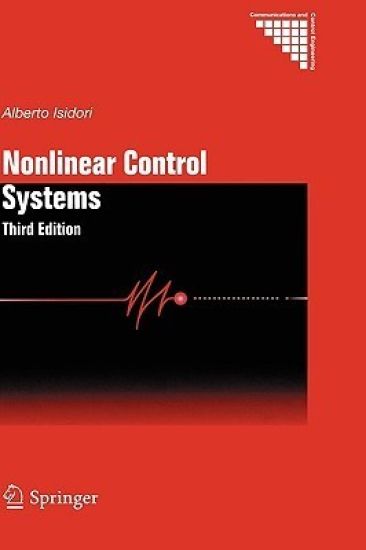
Nonlinear Control Systems

Nonlinear Control Systems

Alberto Isidori

Springer London Ltd
2013
nidottu
The purpose of this book is to present a self-contained description of the fun­ damentals of the theory of nonlinear control systems, with special emphasis on the differential geometric approach. The book is intended as a graduate text as weil as a reference to scientists and engineers involved in the analysis and design of feedback systems. The first version of this book was written in 1983, while I was teach­ ing at the Department of Systems Science and Mathematics at Washington University in St. Louis. This new edition integrates my subsequent teaching experience gained at the University of Illinois in Urbana-Champaign in 1987, at the Carl-Cranz Gesellschaft in Oberpfaffenhofen in 1987, at the University of California in Berkeley in 1988. In addition to a major rearrangement of the last two Chapters of the first version, this new edition incorporates two additional Chapters at a more elementary level and an exposition of some relevant research findings which have occurred since 1985.
Nonlinear Control Systems II

Nonlinear Control Systems II

Alberto Isidori

Springer London Ltd
1999
sidottu
The purpose of this book is to present a self-contained and coordinated de­ scription of several design methods for nonlinear control systems, with special emphasis on the problem of achieving stability, globally or on arbitrarily large domains, in the presence of model uncertainties. The book is intended to be a continuation of my earlier book Nonlinear Control Systems, dealing with the fundamentals of the theory of nonlinear control systems, whose third edition was published in 1995. In this respect, it is written in the form of a "second volume" of a single work, and uses a numbering system that continues the one adopted in the earlier book, with which the overlap is essentially insignificant. The book is intended as a graduate text as well as a reference to scientists and engineers interested in the design of feedback laws for nonlinear control systems. In the last decade, methods for global stabilization of nonlinear systems have experienced a vigorous growth.
Lectures in Feedback Design for Multivariable Systems

Lectures in Feedback Design for Multivariable Systems

Alberto Isidori

Springer International Publishing AG
2016
sidottu
This book focuses on methods that relate, in one form or another, to the “small-gain theorem”. It is aimed at readers who are interested in learning methods for the design of feedback laws for linear and nonlinear multivariable systems in the presence of model uncertainties. With worked examples throughout, it includes both introductory material and more advanced topics.Divided into two parts, the first covers relevant aspects of linear-systems theory, the second, nonlinear theory. In order to deepen readers’ understanding, simpler single-input–single-output systems generally precede treatment of more complex multi-input–multi-output (MIMO) systems and linear systems precede nonlinear systems. This approach is used throughout, including in the final chapters, which explain the latest advanced ideas governing the stabilization, regulation, and tracking of nonlinear MIMO systems. Two major design problems are considered, both in the presence of model uncertainties: asymptotic stabilization with a “guaranteed region of attraction” of a given equilibrium point and asymptotic rejection of the effect of exogenous (disturbance) inputs on selected regulated outputs.Much of the introductory instructional material in this book has been developed for teaching students, while the final coverage of nonlinear MIMO systems offers readers a first coordinated treatment of completely novel results. The worked examples presented provide the instructor with ready-to-use material to help students to understand the mathematical theory.Readers should be familiar with the fundamentals of linear-systems and control theory. This book is a valuable resource for students following postgraduate programs in systems and control, as well as engineers working on the control of robotic, mechatronic and power systems.
Lectures in Feedback Design for Multivariable Systems

Lectures in Feedback Design for Multivariable Systems

Alberto Isidori

Springer International Publishing AG
2018
nidottu
This book focuses on methods that relate, in one form or another, to the “small-gain theorem”. It is aimed at readers who are interested in learning methods for the design of feedback laws for linear and nonlinear multivariable systems in the presence of model uncertainties. With worked examples throughout, it includes both introductory material and more advanced topics.Divided into two parts, the first covers relevant aspects of linear-systems theory, the second, nonlinear theory. In order to deepen readers’ understanding, simpler single-input–single-output systems generally precede treatment of more complex multi-input–multi-output (MIMO) systems and linear systems precede nonlinear systems. This approach is used throughout, including in the final chapters, which explain the latest advanced ideas governing the stabilization, regulation, and tracking of nonlinear MIMO systems. Two major design problems are considered, both in the presence of model uncertainties: asymptotic stabilization with a “guaranteed region of attraction” of a given equilibrium point and asymptotic rejection of the effect of exogenous (disturbance) inputs on selected regulated outputs.Much of the introductory instructional material in this book has been developed for teaching students, while the final coverage of nonlinear MIMO systems offers readers a first coordinated treatment of completely novel results. The worked examples presented provide the instructor with ready-to-use material to help students to understand the mathematical theory.Readers should be familiar with the fundamentals of linear-systems and control theory. This book is a valuable resource for students following postgraduate programs in systems and control, as well as engineers working on the control of robotic, mechatronic and power systems.
Nonlinear Control Systems

Nonlinear Control Systems

Alberto Isidori

Springer-Verlag Berlin and Heidelberg GmbH Co. K
1995
sidottu
The purpose of this book is to present a self-contained description of the fun­ damentals of the theory of nonlinear control systems, with special emphasis on the differential geometric approach. The book is intended as a graduate text as weil as a reference to scientists and engineers involved in the analysis and design of feedback systems. The first version of this book was written in 1983, while I was teach­ ing at the Department of Systems Science and Mathematics at Washington University in St. Louis. This new edition integrates my subsequent teaching experience gained at the University of Illinois in Urbana-Champaign in 1987, at the Carl-Cranz Gesellschaft in Oberpfaffenhofen in 1987, at the University of California in Berkeley in 1988. In addition to a major rearrangement of the last two Chapters of the first version, this new edition incorporates two additional Chapters at a more elementary level and an exposition of some relevant research findings which have occurred since 1985.