Kirjojen hintavertailu. Mukana 12 083 983 kirjaa ja 12 kauppaa.

Kirjahaku

Etsi kirjoja tekijän nimen, kirjan nimen tai ISBN:n perusteella.

5 kirjaa tekijältä Alessandro Bettini

Introduction to Elementary Particle Physics

Introduction to Elementary Particle Physics

Alessandro Bettini

Cambridge University Press
2024
sidottu
The third edition of this successful textbook has been redesigned to reflect the progress of the field in the last decade, including the latest studies of the Higgs boson, quark–gluon plasma, progress in flavour and neutrino physics and the discovery of gravitational waves. It provides undergraduate students with complete coverage of the basic elements of the Standard Model of particle physics, assuming only introductory courses in nuclear physics, special relativity and quantum mechanics. Examples of fundamental experiments are highlighted before discussions of the theory, giving students an appreciation of how experiment and theory interplay in the development of physics. The author examines leptons, hadrons and quarks, before presenting the dynamics and the surprising properties of the charges of the different forces, concluding with a discussion on neutrino properties beyond the Standard Model. This title is also available as open access on Higher Education from Cambridge University Press.
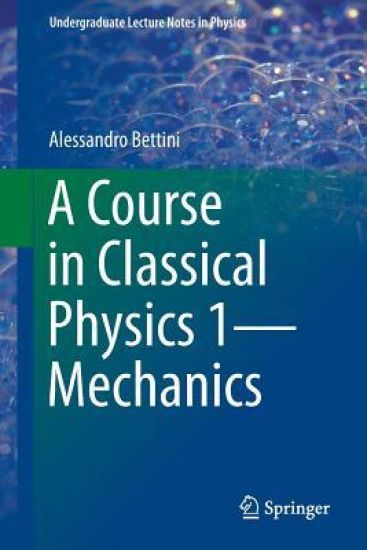
A Course in Classical Physics 1—Mechanics

A Course in Classical Physics 1—Mechanics

Alessandro Bettini

Springer International Publishing AG
2016
nidottu
This first volume covers the mechanics of point particles, gravitation, extended systems (starting from the two-body system), the basic concepts of relativistic mechanics and the mechanics of rigid bodies and fluids. It is part of a four-volume textbook, which covers electromagnetism, mechanics, fluids and thermodynamics, and waves and light, and is designed to reflect the typical syllabus during the first two years of a calculus-based university physics program. Throughout all four volumes, particular attention is paid to in-depth clarification of conceptual aspects, and to this end the historical roots of the principal concepts are traced. Writings by the founders of classical mechanics, G. Galilei and I. Newton, are reproduced, encouraging students to consult them. Emphasis is also consistently placed on the experimental basis of the concepts, highlighting the experimental nature of physics. Whenever feasible at the elementary level, concepts relevant to more advanced courses in modern physics are included. Each chapter begins with an introduction that briefly describes the subjects to be discussed and ends with a summary of the main results. A number of “Questions” are included to help readers check their level of understanding.The textbook offers an ideal resource for physics students, lecturers and, last but not least, all those seeking a deeper understanding of the experimental basics of physics.
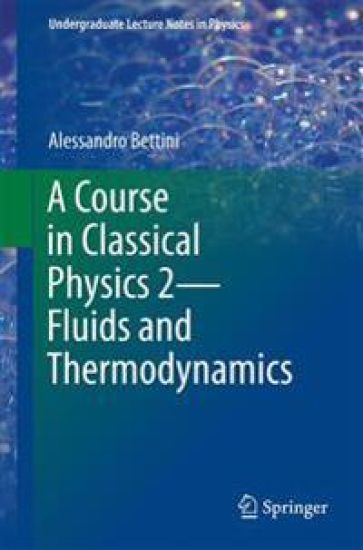
A Course in Classical Physics 2—Fluids and Thermodynamics

A Course in Classical Physics 2—Fluids and Thermodynamics

Alessandro Bettini

Springer International Publishing AG
2016
nidottu
This second volume covers the mechanics of fluids, the principles of thermodynamics and their applications (without reference to the microscopic structure of systems), and the microscopic interpretation of thermodynamics.It is part of a four-volume textbook, which covers electromagnetism, mechanics, fluids and thermodynamics, and waves and light, is designed to reflect the typical syllabus during the first two years of a calculus-based university physics program. Throughout all four volumes, particular attention is paid to in-depth clarification of conceptual aspects, and to this end the historical roots of the principal concepts are traced. Emphasis is also consistently placed on the experimental basis of the concepts, highlighting the experimental nature of physics. Whenever feasible at the elementary level, concepts relevant to more advanced courses in quantum mechanics and atomic, solid state, nuclear, and particle physics are included. Each chapter begins with an introduction that briefly describes the subjects to be discussed and ends with a summary of the main results. A number of “Questions” are included to help readers check their level of understanding.The textbook offers an ideal resource for physics students, lecturers and, last but not least, all those seeking a deeper understanding of the experimental basics of physics.
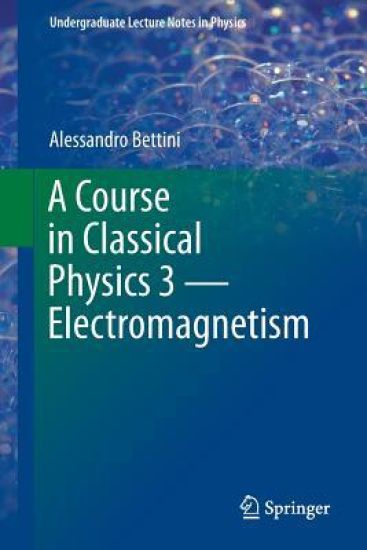
A Course in Classical Physics 3 — Electromagnetism

A Course in Classical Physics 3 — Electromagnetism

Alessandro Bettini

Springer International Publishing AG
2016
nidottu
Focusing on electromagnetism, this third volume of a four-volume textbook covers the electric field under static conditions, constant electric currents and their laws, the magnetic field in a vacuum, electromagnetic induction, magnetic energy under static conditions, the magnetic properties of matter, and the unified description of electromagnetic phenomena provided by Maxwell’s equations.The four-volume textbook as a whole covers electromagnetism, mechanics, fluids and thermodynamics, and waves and light, and is designed to reflect the typical syllabus during the first two years of a calculus-based university physics program. Throughout all four volumes, particular attention is paid to in-depth clarification of conceptual aspects, and to this end the historical roots of the principal concepts are traced. Emphasis is also consistently placed on the experimental basis of the concepts, highlighting the experimental nature of physics. Whenever feasible at theelementary level, concepts relevant to more advanced courses in quantum mechanics and atomic, solid state, nuclear, and particle physics are included. The textbook offers an ideal resource for physics students, lecturers and, last but not least, all those seeking a deeper understanding of the experimental basics of physics.
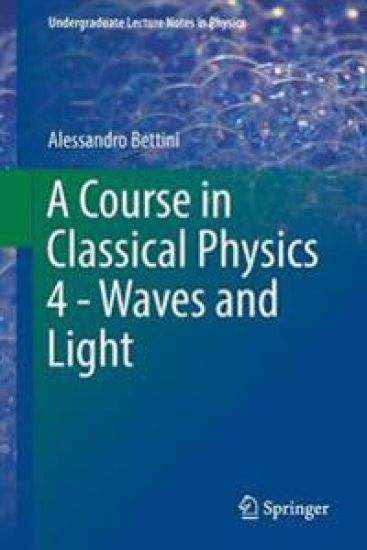
A Course in Classical Physics 4 - Waves and Light

A Course in Classical Physics 4 - Waves and Light

Alessandro Bettini

Springer International Publishing AG
2016
nidottu
This fourth volume of a four-volume textbook covers the oscillations of systems with one or more degrees of freedom; the concept of waves, focusing on light and sound; phase and group velocities, their physical meaning, and their measurement; diffraction and interference of light; polarization phenomena; and the formation of images in the eye and in optical instruments.The textbook as a whole covers electromagnetism, mechanics, fluids and thermodynamics, and waves and light, and is designed to reflect the typical syllabus during the first two years of a calculus-based university physics program. Throughout all four volumes, particular attention is paid to in-depth clarification of conceptual aspects, and to this end the historical roots of the principal concepts are traced. Emphasis is also consistently placed on the experimental basis of the concepts, highlighting the experimental nature of physics. Whenever feasible at the elementary level, concepts relevant to more advanced courses in quantum mechanics and atomic, solid state, nuclear, and particle physics are included. The textbook offers an ideal resource for physics students, lecturers and, last but not least, all those seeking a deeper understanding of the experimental basics of physics.