Kirjojen hintavertailu. Mukana 12 083 983 kirjaa ja 12 kauppaa.

Kirjahaku

Etsi kirjoja tekijän nimen, kirjan nimen tai ISBN:n perusteella.

4 kirjaa tekijältä Alessandro de Iaco Veris

Fundamental Concepts of Liquid-Propellant Rocket Engines

Fundamental Concepts of Liquid-Propellant Rocket Engines

Alessandro de Iaco Veris

Springer Nature Switzerland AG
2020
sidottu
This book is intended for students and engineers who design and develop liquid-propellant rocket engines, offering them a guide to the theory and practice alike. It first presents the fundamental concepts (the generation of thrust, the gas flow through the combustion chamber and the nozzle, the liquid propellants used, and the combustion process) and then qualitatively and quantitatively describes the principal components involved (the combustion chamber, nozzle, feed systems, control systems, valves, propellant tanks, and interconnecting elements). The book includes extensive data on existing engines, typical values for design parameters, and worked-out examples of how the concepts discussed can be applied, helping readers integrate them in their own work. Detailed bibliographical references (including books, articles, and items from the “gray literature”) are provided at the end of each chapter, together with information on valuable resources that can be found online. Given its scope, the book will be of particular interest to undergraduate and graduate students of aerospace engineering.
Fundamental Concepts of Liquid-Propellant Rocket Engines

Fundamental Concepts of Liquid-Propellant Rocket Engines

Alessandro de Iaco Veris

Springer Nature Switzerland AG
2021
nidottu
This book is intended for students and engineers who design and develop liquid-propellant rocket engines, offering them a guide to the theory and practice alike. It first presents the fundamental concepts (the generation of thrust, the gas flow through the combustion chamber and the nozzle, the liquid propellants used, and the combustion process) and then qualitatively and quantitatively describes the principal components involved (the combustion chamber, nozzle, feed systems, control systems, valves, propellant tanks, and interconnecting elements). The book includes extensive data on existing engines, typical values for design parameters, and worked-out examples of how the concepts discussed can be applied, helping readers integrate them in their own work. Detailed bibliographical references (including books, articles, and items from the “gray literature”) are provided at the end of each chapter, together with information on valuable resources that can be found online. Given its scope, the book will be of particular interest to undergraduate and graduate students of aerospace engineering.
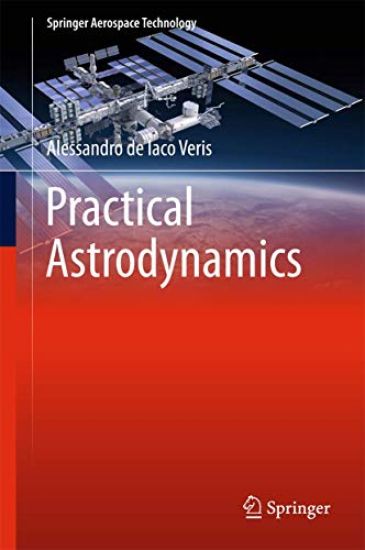
Practical Astrodynamics

Practical Astrodynamics

Alessandro de Iaco Veris

Springer International Publishing AG
2017
sidottu
This modern textbook guides the reader through the theory and practice of the motion and attitude control of space vehicles. It first presents the fundamental principles of spaceflight mechanics and then addresses more complex concepts and applications of perturbation theory, orbit determination and refinement, space propulsion, orbital maneuvers, interplanetary trajectories, gyroscope dynamics, attitude control, and rocket performance. Many algorithms used in the modern practice of trajectory computation are also provided. The numerical treatment of the equations of motion, the related methods, and the tables needed to use them receive particular emphasis. A large collection of bibliographical references (including books, articles, and items from the "gray literature") is provided at the end of each chapter, and attention is drawn to many internet resources available to the reader. The book will be of particular value to undergraduate and graduate students in aerospace engineering.
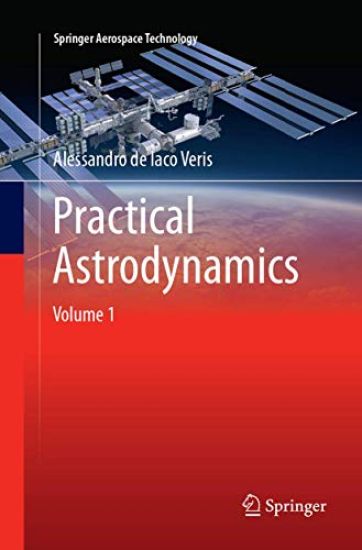
Practical Astrodynamics

Practical Astrodynamics

Alessandro de Iaco Veris

Springer International Publishing AG
2018
nidottu
This modern textbook guides the reader through the theory and practice of the motion and attitude control of space vehicles. It first presents the fundamental principles of spaceflight mechanics and then addresses more complex concepts and applications of perturbation theory, orbit determination and refinement, space propulsion, orbital maneuvers, interplanetary trajectories, gyroscope dynamics, attitude control, and rocket performance. Many algorithms used in the modern practice of trajectory computation are also provided. The numerical treatment of the equations of motion, the related methods, and the tables needed to use them receive particular emphasis. A large collection of bibliographical references (including books, articles, and items from the "gray literature") is provided at the end of each chapter, and attention is drawn to many internet resources available to the reader. The book will be of particular value to undergraduate and graduate students in aerospace engineering.