Kirjojen hintavertailu. Mukana 11 627 064 kirjaa ja 12 kauppaa.

Kirjahaku

Etsi kirjoja tekijän nimen, kirjan nimen tai ISBN:n perusteella.

2 kirjaa tekijältä Alexander J. Field

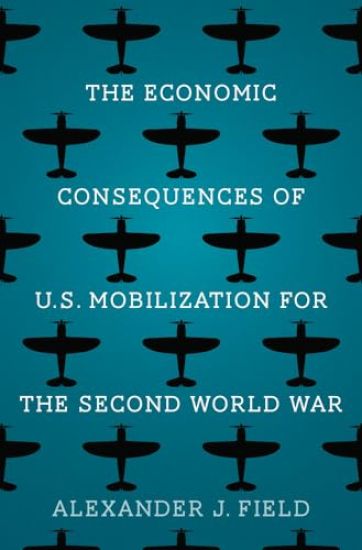
The Economic Consequences of U.S. Mobilization for the Second World War
A reminder that war is not always, or even generally, good for long-term growth Many believe that despite its destructive character, war ultimately boosts long-term economic growth. For the United States this view is often supported by appeal to the experience of the Second World War, understood as a triumph of both production and productivity. Alexander Field shows that between 1941 and 1945 manufacturing productivity actually declined, depressed by changes in the output mix and resource shocks from enemy action, including curtailed access to natural rubber and, on the Eastern Seaboard, petroleum. The war forced a shift away from producing goods in which the country had a great deal of experience toward those in which it had little. Learning by doing was only a partial counterbalance to the intermittent idleness and input hoarding that characterized a shortage economy and dragged down productivity. The conflict distorted human and physical capital accumulation, and once it ended, America stopped producing most of the new goods. The war temporarily shut down basic scientific research and the ongoing development of civilian goods. U.S. world economic dominance in 1948, Field shows, was due less to the experience of making war goods and more to the country’s productive potential in 1941.
Altruistically Inclined?

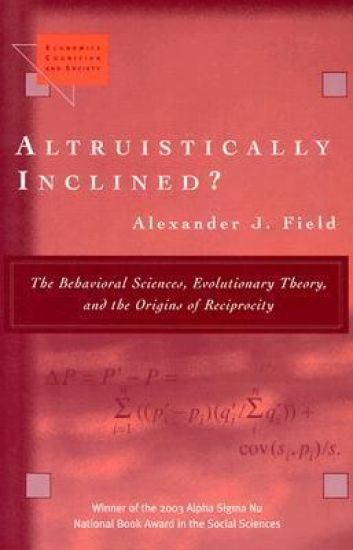
Altruistically Inclined?

Alexander J. Field

The University of Michigan Press
2004
nidottu
Altruistically Inclined? examines the implications of recent research in the natural sciences for two important social scientific approaches to individual behavior: the economic/rational choice approach and the sociological/anthropological. It considers jointly two controversial and related ideas: the operation of group selection within early human evolutionary processes and the likelihood of modularity—domain-specific adaptations in our cognitive mechanisms and behavioral predispositions.Experimental research shows that people will often cooperate in one-shot prisoner's dilemma (PD) games and reject positive offers in ultimatum games, contradicting commonly accepted notions of rationality. Upon first appearance, predispositions to behave in this fashion could not have been favored by natural selection operating only at the level of the individual organism.Emphasizing universal and variable features of human culture, developing research on how the brain functions, and refinements of thinking about levels of selection in evolutionary processes, Alexander J. Field argues that humans are born with the rudiments of a PD solution module—and differentially prepared to learn norms supportive of it. His emphasis on failure to harm, as opposed to the provision of affirmative assistance, as the empirically dominant form of altruistic behavior is also novel.The point of departure and principal point of reference is economics. But Altruistically Inclined? will interest a broad range of scholars in the social and behavioral sciences, natural scientists concerned with the implications of research and debates within their fields for the conduct of work elsewhere, and educated lay readers curious about essential features of human nature.Alexander J. Field is the Michel and Mary Orradre Professor of Economics at Santa Clara University.