Kirjojen hintavertailu. Mukana 11 699 587 kirjaa ja 12 kauppaa.

Kirjahaku

Etsi kirjoja tekijän nimen, kirjan nimen tai ISBN:n perusteella.

4 kirjaa tekijältä Alexander R. Thomas

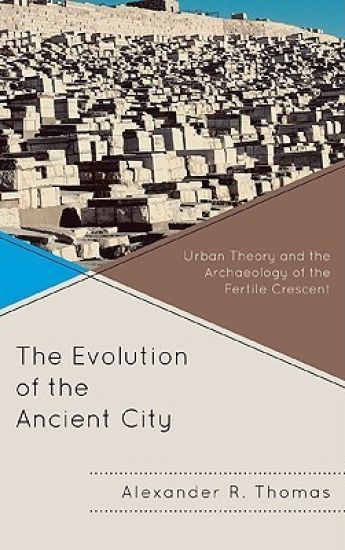
The Evolution of the Ancient City

The Evolution of the Ancient City

Alexander R. Thomas

Lexington Books
2010
sidottu
Urban theory and archaeology merge to create a readable discussion of how ancient cities came to be. Although many consider our modern social ills to be the consequence of Capitalism, many urban problems are traceable to pre-Capitalist times and thus are more related to Urbanization. Ancient cities shared many characteristics with modern cities. For instance, the ancient cities of Rome and Carthage at the time of Christ had population densities approaching that of Manhattan Island today. The Canaanites, fifteen hundred years before, lived in cities oriented toward trade and dependent upon mass production of such items as wine, olive oil, and the pottery to contain such goods. Over three thousand years before the Common Era, the city of Uruk was part of a larger "global system" that resembled in its own way the globalization that we know today. Cities first arose in Mesopotamia about 5,500 years ago, but for 5,500 years before the rise of cities the small agricultural village was the most complex form of human social organization—clearly there was nothing inevitable about the city. The Evolution of the Ancient City explores what we can learn of modern cities by tracing the development of ancient cities.
The Evolution of the Ancient City

The Evolution of the Ancient City

Alexander R. Thomas

Lexington Books
2012
nidottu
Urban theory and archaeology merge to create a readable discussion of how ancient cities came to be. Although many consider our modern social ills to be the consequence of Capitalism, many urban problems are traceable to pre-Capitalist times and thus are more related to Urbanization. Ancient cities shared many characteristics with modern cities. For instance, the ancient cities of Rome and Carthage at the time of Christ had population densities approaching that of Manhattan Island today. The Canaanites, fifteen hundred years before, lived in cities oriented toward trade and dependent upon mass production of such items as wine, olive oil, and the pottery to contain such goods. Over three thousand years before the Common Era, the city of Uruk was part of a larger "global system" that resembled in its own way the globalization that we know today. Cities first arose in Mesopotamia about 5,500 years ago, but for 5,500 years before the rise of cities the small agricultural village was the most complex form of human social organization—clearly there was nothing inevitable about the city. The Evolution of the Ancient City explores what we can learn of modern cities by tracing the development of ancient cities.

Gilboa

Gilboa

Alexander R. Thomas

University Press of America
2005
nidottu
On the night of October 18, 1925, fire raged through the downtown area of the tiny Catskill Mountain Village of Gilboa, New York. Firefighters came from miles around to fight the inferno while tourists sat on the hilltops to watch the show. In the end, 18 buildings lay in smoldering ruins. Yet, this fire was not the end of Gilboa, merely a climax of events that were razing the community more slowly. Gilboa was in the way of the Schoharie Reservoir, one of the numerous artificial lakes collecting water for thirsty New Yorkers. In order for New York City to growing, the people of Gilboa would be forced to move, and the town would need to be burned to the ground. In Gilboa, Alexander Thomas traces the evolving dynamics between New York and its hinterland. Starting with the role of native inhabitants, their Dutch colonizers, and the role of British manor law, this historical investigation then explores the construction of the original reservoir, battles against a second reservoir in the 1970s, and battles over environmental regulations in the 1990s. Gilboa is a must read for those interested in urban and rural issues, social conflict and social movements, and anyone who enjoys New York-state and city-history.
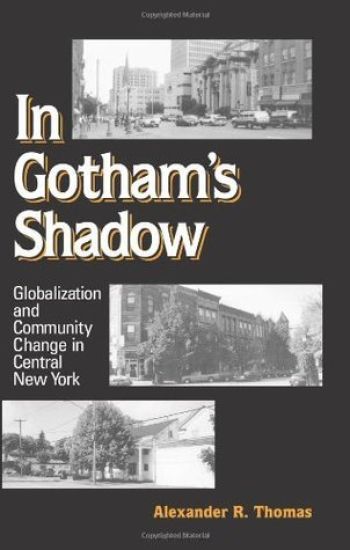
In Gotham's Shadow

In Gotham's Shadow

Alexander R. Thomas

State University of New York Press
2003
pokkari
Examines the effects of globalization on three New York communities—Utica, Cooperstown, and Hartwick.In what may be the first explicitly comparative study of the effects of globalization on metropolitan and rural communities, In Gotham's Shadow examines how three central New York communities struggled over the last half century to survive in a global economy that seems to have forgotten them. Utica, formerly a city of one hundred thousand, experienced the same trends of suburbanization, deindustrialization, and urban renewal as nearly every American city, with the same mixed results. In Cooperstown and Hartwick, two small villages forty miles south of Utica, the same trends were at work, though with different outcomes. Hartwick may be seen as an example of how small towns have lost their core, while Cooperstown may be seen as an example of how a small town can survive by transforming itself into a tourist destination. Thomas provides extensive historical background mixed with newspaper excerpts and lively interviews that add a human dimension to the transformations these communities have experienced.