Kirjojen hintavertailu. Mukana 11 244 527 kirjaa ja 12 kauppaa.

Kirjahaku

Etsi kirjoja tekijän nimen, kirjan nimen tai ISBN:n perusteella.

3 kirjaa tekijältä Alexander Treiger

Inspired Knowledge in Islamic Thought

Inspired Knowledge in Islamic Thought

Alexander Treiger

Routledge
2011
sidottu
It has been customary to see the Muslim theologian Abu Hamid al-Ghazali (d. 1111) as a vehement critic of philosophy, who rejected it in favour of Islamic mysticism (Sufism), a view which has come under increased scrutiny in recent years. This book argues that al-Ghazali was, instead, one of the greatest popularisers of philosophy in medieval Islam. The author supplies new evidence showing that al-Ghazali was indebted to philosophy in his theory of mystical cognition and his eschatology, and that, moreover, in these two areas he accepted even those philosophical teachings which he ostensibly criticized. Through careful translation into English and detailed discussion of more than 80 key passages (with many more surveyed throughout the book), the author shows how al-Ghazali’s understanding of "mystical cognition" is patterned after the philosophyof Avicenna (d. 1037). Arguing that despite overt criticism, al-Ghazali never rejected Avicennian philosophy and that his mysticism itself is grounded in Avicenna’s teachings, the book offers a clear and systematic presentation of al-Ghazali’s "philosophical mysticism." Challenging popular assumptions about one of the greatest Muslim theologians of all time, this is an important reference for scholars and laymen interested in Islamic theology and in the relations between philosophy and mysticism.

Inspired Knowledge in Islamic Thought

Inspired Knowledge in Islamic Thought

Alexander Treiger

Routledge
2014
nidottu
It has been customary to see the Muslim theologian Abu Hamid al-Ghazali (d. 1111) as a vehement critic of philosophy, who rejected it in favour of Islamic mysticism (Sufism), a view which has come under increased scrutiny in recent years. This book argues that al-Ghazali was, instead, one of the greatest popularisers of philosophy in medieval Islam. The author supplies new evidence showing that al-Ghazali was indebted to philosophy in his theory of mystical cognition and his eschatology, and that, moreover, in these two areas he accepted even those philosophical teachings which he ostensibly criticized. Through careful translation into English and detailed discussion of more than 80 key passages (with many more surveyed throughout the book), the author shows how al-Ghazali’s understanding of "mystical cognition" is patterned after the philosophyof Avicenna (d. 1037). Arguing that despite overt criticism, al-Ghazali never rejected Avicennian philosophy and that his mysticism itself is grounded in Avicenna’s teachings, the book offers a clear and systematic presentation of al-Ghazali’s "philosophical mysticism." Challenging popular assumptions about one of the greatest Muslim theologians of all time, this is an important reference for scholars and laymen interested in Islamic theology and in the relations between philosophy and mysticism.
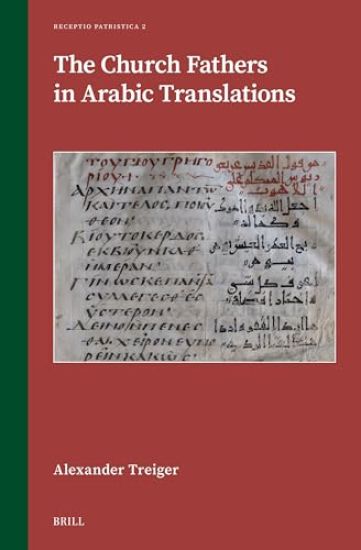
The Church Fathers in Arabic Translations
This volume tells the story of the Arabic translations of the Church Fathers. By tracing the history of major translation centres, such as Palestine, Sinai, and Antioch, it describes how Middle Eastern Christians translated into Arabic, preserved, and engaged with their Patristic heritage. In addition to well-known authors, such as Gregory of Nazianzus, Ephrem the Syrian, and Dionysius the Areopagite, the volume presents a Patristic treatise written in Greek but preserved only in Arabic: the Noetic Paradise. Finally, by reconstructing a lost Arabic Dionysian paraphrase used by the Muslim theologian al-Ghazali, the volume explores Patristic influences on Islamic thought.