Kirjojen hintavertailu. Mukana 12 390 323 kirjaa ja 12 kauppaa.

Kirjahaku

Etsi kirjoja tekijän nimen, kirjan nimen tai ISBN:n perusteella.

7 kirjaa tekijältä Alexandra Juhasz

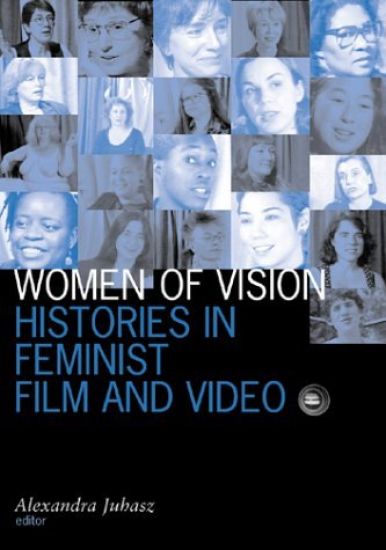
Women Of Vision

Women Of Vision

Alexandra Juhasz

University of Minnesota Press
2001
nidottu
Legends and rising stars of feminist film and video tell their stories.Alexandra Juhasz asked twenty-one women to tell their stories-women whose names make up a who is (and who will be) who of independent and experimental film and video. What emerged in the resulting conversations is a compelling (and previously underdocumented) history of feminism and feminist film and video, from its origins in the fifties and sixties to its apex in the seventies, to today. Women of Vision is a companion piece to Juhasz’s 1998 documentary of the same name. The book presents the complete interviews, allowing readers to hear directly the voices of these articulate, passionate women in an interactive remembering of feminist media history. Juhasz’s introduction provides a historical, theoretical, and aesthetic context for the interviews. These subjects have all shaped late twentieth-century film and video in fundamental ways, either as artists, producers, distributors, critics, or scholars, and they all believe that media are the most powerful tools for effecting change. Yet they are a very diverse group, with widely varying personal and professional backgrounds. By presenting their interviews together, Juhasz shows the differences among those involved in feminist media, but also the connections among them, and the way in which the field has been enriched by their sharing of knowledge and power. In the end, Juhasz not only records these women’s careers, she broadens our understanding of feminism and shows how feminist history and documentary are made.Interviewees: Pearl Bowser; Margaret Caples; Michelle Citron; Megan Cunningham; Cheryl Dunye; Vanalyne Green; Barbara Hammer; Kate Horsfield; Carol Leigh; Susan Mogul; Juanita Mohammed; Frances Negrón-Muntaner; Eve Oishi; Constance Penley; Wendy Quinn; Julia Reichert; Carolee Schneemann; Valerie Soe; Victoria Vesna; and Yvonne Welbon.

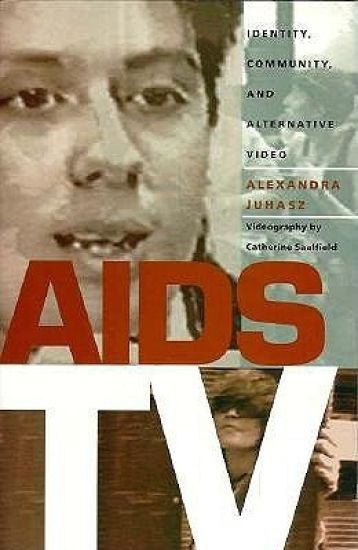
AIDS TV

AIDS TV

Alexandra Juhasz

Duke University Press
1995
sidottu
Camcorder AIDS activism is a prime example of a new form of political expression-an outburst of committed, low-budget, community-produced, political video work made possible by new accessible technologies. As Alexandra Juhasz looks at this phenomenon-why and how video has become the medium for so much AIDS activism-she also tries to make sense of the bigger picture: How is this work different from mainstream television? How does it alter what we think of the media’s form and function? The result is an eloquent and vital assessment of the role media activism plays in the development of community identity and self-empowerment. An AIDS videomaker herself, Juhasz writes from the standpoint of an AIDS activist and blends feminist film critique with her own experience. She offers a detailed description of alternative AIDS video, including her own work on the Women’s AIDS Video Enterprise (WAVE). Along with WAVE, Juhasz discusses amateur video tapes of ACT UP demonstrations, safer sex videos produced by Gay Men’s Health Crisis, public access programming, and PBS documentaries, as well as network television productions. From its close-up look at camcorder AIDS activism to its critical account of mainstream representations, AIDS TV offers a better understanding of the media, politics, identity, and community in the face of AIDS. It will challenge and encourage those who hope to change the course of this crisis both in the ‘real world’ and in the world of representation.
AIDS TV

AIDS TV

Alexandra Juhasz

Duke University Press
1995
pokkari
Camcorder AIDS activism is a prime example of a new form of political expression-an outburst of committed, low-budget, community-produced, political video work made possible by new accessible technologies. As Alexandra Juhasz looks at this phenomenon-why and how video has become the medium for so much AIDS activism-she also tries to make sense of the bigger picture: How is this work different from mainstream television? How does it alter what we think of the media’s form and function? The result is an eloquent and vital assessment of the role media activism plays in the development of community identity and self-empowerment. An AIDS videomaker herself, Juhasz writes from the standpoint of an AIDS activist and blends feminist film critique with her own experience. She offers a detailed description of alternative AIDS video, including her own work on the Women’s AIDS Video Enterprise (WAVE). Along with WAVE, Juhasz discusses amateur video tapes of ACT UP demonstrations, safer sex videos produced by Gay Men’s Health Crisis, public access programming, and PBS documentaries, as well as network television productions. From its close-up look at camcorder AIDS activism to its critical account of mainstream representations, AIDS TV offers a better understanding of the media, politics, identity, and community in the face of AIDS. It will challenge and encourage those who hope to change the course of this crisis both in the ‘real world’ and in the world of representation.
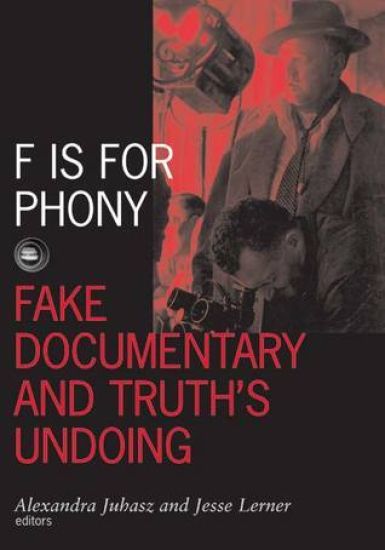
F Is for Phony

F Is for Phony

Alexandra Juhasz; Jesse Lerner

University of Minnesota Press
2006
nidottu
Fake documentaries mimic documentary genre expectations, unraveling the documentary’s authority and dismantling understandings of identity, history, and nation. The interdisciplinary essays in F Is for Phony discuss a broad scope of works and explore issues raised by “fake docs” such as the fiction/documentary divide, the ethics of reality-based manipulation, and whether documentariness derives from form or reception. Defining the borderline between fact and fiction, the contributors reveal what fake documentaries imply and usually make explicit: that many documentaries lie to tell the truth, and that the truth is relative. Contributors: Steve Anderson, Catherine L. Benamou, Mitchell W. Block, Luis Buñuel, Marlon Fuentes, Craig Hight, Charlie Keil, Alisa Lebow, Eve Oishi, Robert F. Reid-Pharr, Gregorio C. Rocha, Jane Roscoe, Catherine Russell, Elisabeth Subrin. Alexandra Juhasz is professor of media studies at Pitzer College. She is author of Women of Vision: Histories in Feminist Film and Video (Minnesota, 2001). Jesse Lerner is associate professor of media studies at Pitzer College.
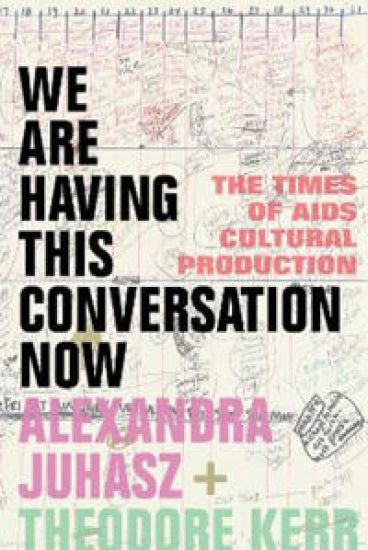
We Are Having This Conversation Now

We Are Having This Conversation Now

Alexandra Juhasz; Theodore Kerr

DUKE UNIVERSITY PRESS
2022
sidottu
We Are Having This Conversation Now offers a history, present, and future of AIDS through thirteen short conversations between Alexandra Juhasz and Theodore Kerr, scholars deeply embedded in HIV responses. They establish multiple timelines of the epidemic, offering six foundational periodizations of AIDS culture, tracing how attention to the crisis has waxed and waned from the 1980s to the present. They begin the book with a 1990 educational video produced by a Black health collective, using it to consider organizing intersectionally, theories of videotape, empowerment movements, and memorialization. This video is one of many powerful yet overlooked objects that the pair focus on through conversation to understand HIV across time. Along the way, they share their own artwork, activism, and stories of the epidemic. Their conversations illuminate the vital role personal experience, community, cultural production, and connection play in the creation of AIDS-related knowledge, archives, and social change. Throughout, Juhasz and Kerr invite readers to reflect and find ways to engage in their own AIDS-related culture and conversation.
We Are Having This Conversation Now

We Are Having This Conversation Now

Alexandra Juhasz; Theodore Kerr

DUKE UNIVERSITY PRESS
2022
pokkari
We Are Having This Conversation Now offers a history, present, and future of AIDS through thirteen short conversations between Alexandra Juhasz and Theodore Kerr, scholars deeply embedded in HIV responses. They establish multiple timelines of the epidemic, offering six foundational periodizations of AIDS culture, tracing how attention to the crisis has waxed and waned from the 1980s to the present. They begin the book with a 1990 educational video produced by a Black health collective, using it to consider organizing intersectionally, theories of videotape, empowerment movements, and memorialization. This video is one of many powerful yet overlooked objects that the pair focus on through conversation to understand HIV across time. Along the way, they share their own artwork, activism, and stories of the epidemic. Their conversations illuminate the vital role personal experience, community, cultural production, and connection play in the creation of AIDS-related knowledge, archives, and social change. Throughout, Juhasz and Kerr invite readers to reflect and find ways to engage in their own AIDS-related culture and conversation.
Really Fake

Really Fake

Alexandra Juhasz; Ganaele Langlois; Nishant Shah

University of Minnesota Press
2021
nidottu
More important than flagging things “really fake” is to understand why they are dismissed as fake The new truth is the one that circulates: digital truth emerges from lists, databases, archives, and conditions of storage. Multiple truths may be activated through search, link, and retrieve queries. Alexandra Juhasz, Ganaele Langlois, and Nishant Shah respond by taking up story, poetry, and other human logics of care, intelligence, and dignity to explore sociotechnological and politico-aesthetic emergences in a world where information overload has become a new ontology of not-knowing. Their feminist digital methods allow considerations of internet things through alternative networked internet time: slowing down to see, honor, and engage with our past; invoking indeterminacy as a human capacity that lets multiple truths commingle on a page or in a body; and saving the truths of ourselves and our others differently from the corporate internet’s perpetual viral movement. Writing across their own shared truisms, actors, and touchstones, the authors propose creative tactics, theoretical overtures, and experimental escape routes built to a human scale as ways to regain our capacities to know and tell truths about ourselves.