
Kirjahaku
Etsi kirjoja tekijän nimen, kirjan nimen tai ISBN:n perusteella.
6 kirjaa tekijältä Alexandre Leupin

Visions was born out of interviews Alexandre Leupin had with Francis X. Pavy, a significant painter of Southern culture with a career spanning five decades. This three-part book begins with a general introduction situating Pavy in the history of painting, and underscoring his radical authenticity and originality, as well as a universality paradoxically stemming from his deep regional connection. The second part reproduces Leupin and Pavy's interviews over the years, where Pavy's artistic beginnings, his technique, his vision, and the origins of his creations are discussed. In the third section, entitled Pavicons, Pavy presents the sources of his artistic inspiration and the recurrent themes that run through his body of work through a large sample of his iconographic elements.

A fresh look at the relationship between theology and rhetoric.Focusing on the Incarnation-the only dogma original to Christianity, in which God becomes man and history-this book offers a wide-ranging and theoretically sophisticated investigation of the relationship between Christian discourse and literature from Roman antiquity to the fourteenth century through a look at texts by Cicero, Quintilian, Martianus Capella, Tertullian, Saint Augustine, Alain of Lille, Guillaume de Machaut, and others.Alexandre Leupin asks if it is possible to go beyond the dialectics of the Incarnated God and the Devil without harking back to the beautiful but partially obsolete truths of paganism and sophistry. Employing a method inspired by psychoanalysis, Leupin repudiates the sophistry and relativism of postmodern theory while calling into question old commonplaces that have been invalidated by modernity. He does so by attending to the larger and deeper structures hidden within the discourses of theology, rhetoric, literature, and psychoanalysis. The result is an innovative perspective on the Middle Ages, an original and promising view of the problems of Western literature in relation to theology and rhetoric. Alexandre Leupin is Gregorie Professor in French studies at Louisiana State University. He is the author of many books, including, in English translation, Barbarolexis: Medieval Literature and Sexuality (1989).David Laatsch is a Ph.D. candidate in the French department of Louisiana State University.
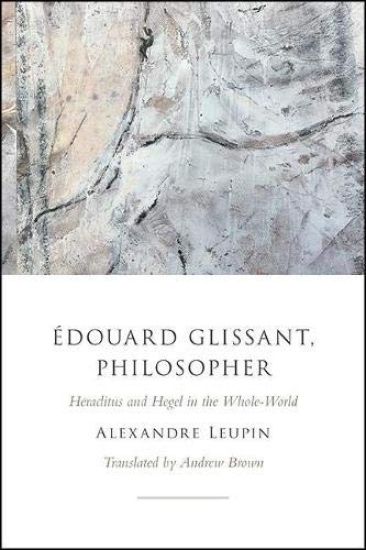
Translation of Alexandre Leupin's award-winning study of Édouard Glissant's entire work in relation to philosophy.One of the greatest writers of the late twentieth century, Édouard Glissant's body of work covers multiple genres and addresses many cogent contemporary problems, such as borders, multiculturalism, postcolonial and decolonial studies, and global humanities. Édouard Glissant, Philosopher is the first study that maps out this writer's entire work in relation to philosophy. Glissant is reputed to be a "difficult writer;" however, Alexandre Leupin demonstrates the clarity and coherence of his thinking. Glissant's rereading of Western philosophy entirely remaps its age-old questions and offers answers that have never been proposed. In doing so, Glissant offers a new way to think about questions that are at the forefront of Global Humanities today: identity, race, communities, diasporas, slavery, nation-states and nationalism, aesthetics, ethics, and the place and function of poetry and art in a globalized world. This book will elucidate Glissant's theoretical writings, not only in England and in America but also in the anglophone Caribbean, Africa, and India.
Translation of Alexandre Leupin's award-winning study of Édouard Glissant's entire work in relation to philosophy.One of the greatest writers of the late twentieth century, Édouard Glissant's body of work covers multiple genres and addresses many cogent contemporary problems, such as borders, multiculturalism, postcolonial and decolonial studies, and global humanities. Édouard Glissant, Philosopher is the first study that maps out this writer's entire work in relation to philosophy. Glissant is reputed to be a "difficult writer;" however, Alexandre Leupin demonstrates the clarity and coherence of his thinking. Glissant's rereading of Western philosophy entirely remaps its age-old questions and offers answers that have never been proposed. In doing so, Glissant offers a new way to think about questions that are at the forefront of Global Humanities today: identity, race, communities, diasporas, slavery, nation-states and nationalism, aesthetics, ethics, and the place and function of poetry and art in a globalized world. This book will elucidate Glissant's theoretical writings, not only in England and in America but also in the anglophone Caribbean, Africa, and India.