Kirjojen hintavertailu. Mukana 12 411 919 kirjaa ja 12 kauppaa.

Kirjahaku

Etsi kirjoja tekijän nimen, kirjan nimen tai ISBN:n perusteella.

8 kirjaa tekijältä Alexandru Buium

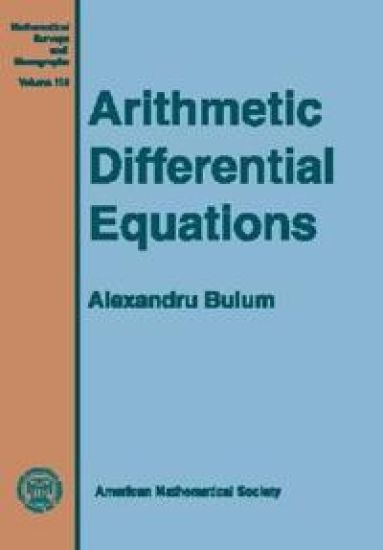
Arithmetic Differential Equations

Arithmetic Differential Equations

Alexandru Buium

Amer Mathematical Society
2005
sidottu
This monograph contains exciting original mathematics that will inspire new directions of research in algebraic geometry. Developed here is an arithmetic analog of the theory of ordinary differential equations, where functions are replaced by integer numbers, the derivative operator is replaced by a 'Fermat quotient operator', and differential equations (viewed as functions on jet spaces) are replaced by 'arithmetic differential equations'. The main application of this theory concerns the construction and study of quotients of algebraic curves by correspondences with infinite orbits.Any such quotient reduces to a point in algebraic geometry. But many of the above quotients cease to be trivial (and become quite interesting) if one enlarges algebraic geometry by using arithmetic differential equations in place of algebraic equations. This book, in part, follows a series of papers written by the author. However, a substantial amount of the material has never been published before. For most of the book, the only prerequisites are the basic facts of algebraic geometry and algebraic number theory.It is suitable for graduate students and researchers interested in algebraic geometry and number theory.

Mathematics

Mathematics

Alexandru Buium

CRC Press
2017
sidottu
Bridging the gap between procedural mathematics that emphasizes calculations and conceptual mathematics that focuses on ideas, Mathematics: A Minimal Introduction presents an undergraduate-level introduction to pure mathematics and basic concepts of logic. The author builds logic and mathematics from scratch using essentially no background except natural language. He also carefully avoids circularities that are often encountered in related books and places special emphasis on separating the language of mathematics from metalanguage and eliminating semantics from set theory. The first part of the text focuses on pre-mathematical logic, including syntax, semantics, and inference. The author develops these topics entirely outside the mathematical paradigm. In the second part, the discussion of mathematics starts with axiomatic set theory and ends with advanced topics, such as the geometry of cubics, real and p-adic analysis, and the quadratic reciprocity law. The final part covers mathematical logic and offers a brief introduction to model theory and incompleteness. Taking a formalist approach to the subject, this text shows students how to reconstruct mathematics from language itself. It helps them understand the mathematical discourse needed to advance in the field.
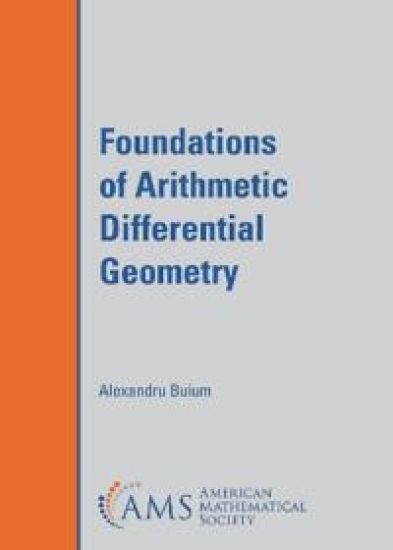
Foundations of Arithmetic Differential Geometry

Foundations of Arithmetic Differential Geometry

Alexandru Buium

AMERICAN MATHEMATICAL SOCIETY
2017
nidottu
The aim of this book is to introduce and develop an arithmetic analogue of classical differential geometry. In this new geometry the ring of integers plays the role of a ring of functions on an infinite dimensional manifold. The role of coordinate functions on this manifold is played by the prime numbers. The role of partial derivatives of functions with respect to the coordinates is played by the Fermat quotients of integers with respect to the primes. The role of metrics is played by symmetric matrices with integer coefficients. The role of connections (respectively curvature) attached to metrics is played by certain adelic (respectively global) objects attached to the corresponding matrices.One of the main conclusions of the theory is that the spectrum of the integers is ""intrinsically curved""; the study of this curvature is then the main task of the theory. The book follows, and builds upon, a series of recent research papers. A significant part of the material has never been published before.
Mathematics

Mathematics

Alexandru Buium

Apple Academic Press Inc.
2013
nidottu
Bridging the gap between procedural mathematics that emphasizes calculations and conceptual mathematics that focuses on ideas, Mathematics: A Minimal Introduction presents an undergraduate-level introduction to pure mathematics and basic concepts of logic. The author builds logic and mathematics from scratch using essentially no background except natural language. He also carefully avoids circularities that are often encountered in related books and places special emphasis on separating the language of mathematics from metalanguage and eliminating semantics from set theory.The first part of the text focuses on pre-mathematical logic, including syntax, semantics, and inference. The author develops these topics entirely outside the mathematical paradigm. In the second part, the discussion of mathematics starts with axiomatic set theory and ends with advanced topics, such as the geometry of cubics, real and p-adic analysis, and the quadratic reciprocity law. The final part covers mathematical logic and offers a brief introduction to model theory and incompleteness.Taking a formalist approach to the subject, this text shows students how to reconstruct mathematics from language itself. It helps them understand the mathematical discourse needed to advance in the field.
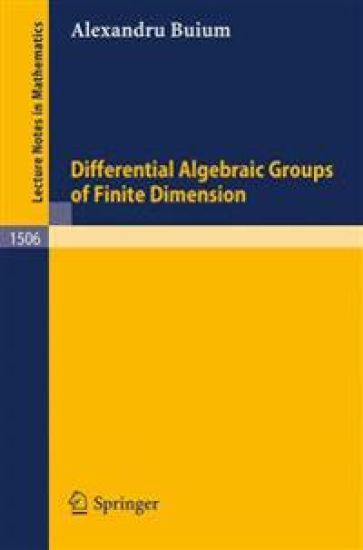
Differential Algebraic Groups of Finite Dimension

Differential Algebraic Groups of Finite Dimension

Alexandru Buium

Springer-Verlag Berlin and Heidelberg GmbH Co. K
1992
nidottu
Differential algebraic groups were introduced by P. Cassidy and E. Kolchin and are, roughly speaking, groups defined by algebraic differential equations in the same way as algebraic groups are groups defined by algebraic equations. The aim of the book is two-fold: 1) the provide an algebraic geometer's introduction to differential algebraic groups and 2) to provide a structure and classification theory for the finite dimensional ones. The main idea of the approach is to relate this topic to the study of: a) deformations of (not necessarily linear) algebraic groups and b) deformations of their automorphisms. The reader is assumed to possesssome standard knowledge of algebraic geometry but no familiarity with Kolchin's work is necessary. The book is both a research monograph and an introduction to a new topic and thus will be of interest to a wide audience ranging from researchers to graduate students.
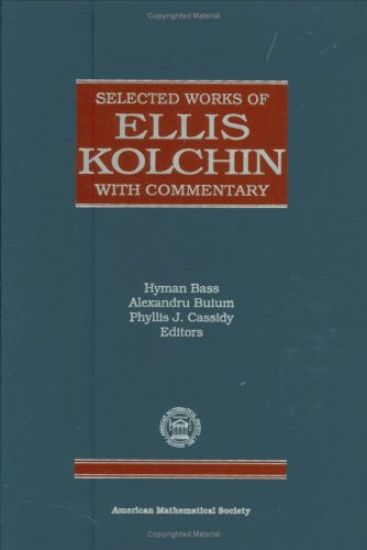
Selected Works of Ellis Kolchin with Commentary

Selected Works of Ellis Kolchin with Commentary

E.R. Kolchin; Alexandru Buium; Phyllis J. Cassidy

American Mathematical Society
1999
sidottu
The work of Joseph Fels Ritt and Ellis Kolchin in differential algebra paved the way for exciting new applications in constructive symbolic computation, differential Galois theory, the model theory of fields, and Diophantine geometry. This volume assembles Kolchin's mathematical papers, contributing solidly to the archive on construction of modern differential algebra. This collection of Kolchin's clear and comprehensive papers - in themselves constituting a history of the subject - is an invaluable aid to the student of differential algebra. In 1910, Ritt created a theory of algebraic differential equations modeled not on the existing transcendental methods of Lie, but rather on the new algebra being developed by E. Noether and B. van der Waerden.Building on Ritt's foundation, and deeply influenced by Weil and Chevalley, Kolchin opened up Ritt theory to modern algebraic geometry. In so doing, he led differential geometry in a new direction. By creating differential algebraic geometry and the theory of differential algebraic groups, Kolchin provided the foundation for a 'new geometry' that has led to both a striking and an original approach to arithmetic algebraic geometry. Intriguing possibilities were introduced for a new language for nonlinear differential equations theory. The volume includes commentary by A. Borel, M. Singer, and B. Poizat.Also Buium and Cassidy trace the development of Kolchin's ideas, from his important early work on the differential Galois theory to his later groundbreaking results on the theory of differential algebraic geometry and differential algebraic groups. Commentaries are self-contained with numerous examples of various aspects of differential algebra and its applications. Central topics of Kolchin's work are discussed, presenting the history of differential algebra and exploring how his work grew from and transformed the work of Ritt. New directions of differential algebra are illustrated, outlining important current advances. Prerequisite to understanding the text is a background at the beginning graduate level in algebra, specifically commutative algebra, the theory of field extensions, and Galois theory.