Kirjojen hintavertailu. Mukana 11 342 296 kirjaa ja 12 kauppaa.

Kirjahaku

Etsi kirjoja tekijän nimen, kirjan nimen tai ISBN:n perusteella.

6 kirjaa tekijältä Alexej P. Pynko

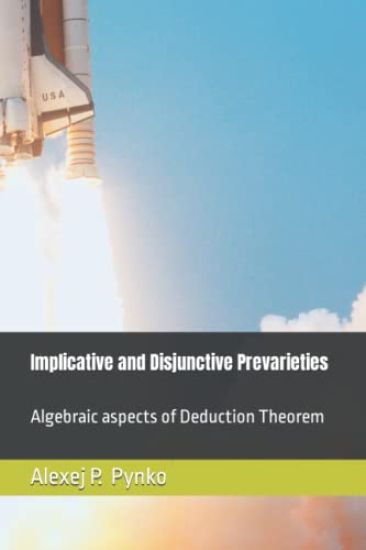
Implicative and Disjunctive Prevarieties: Algebraic aspects of Deduction Theorem
An (equational) implication/disjunction system for a class of algebrasis a set of quadruple equations defining implication/disjunction of equalities in algebras of the class.Then, a prevariety (viz., an implicational class), i.e., an abstract hereditary multiplicative class of algebras issaid to be finitely] implicative/disjunctive, provided it is generated by a class with finite] implication/disjunction system.One of preliminary general results of the book is that a pre]variety is implicative/disjunctive iff it hasrestricted equationally definable principal relative] congruences/(congruence diagonal )meets (REDP R]C/ (CD)M) and isthe prevariety generated by its relatively] simple/finitely-subdirectly-irreducible membersiff both has REDP R]C/CDM and is relatively ]semi-simple/congruence-fmi-based.In particular, a quasi]variety is implicative/disjunctive iff itboth has REDP R]C and is relatively ]semi-simple/just has REDP R]CDM.And what is more, we prove that any class K of algebras ofa given algebraic signature S generates the quasivariety being a variety, whenever, for some subsinature S' of S, K-S' has a finite implication systemand generates the quasivariety being a variety.As for disjunctive pre]varieties, we also prove that these are relatively] congruence-distributive.This, in particular, implies the relative ]congruence-distributivity of (finitely )implicative quasi(pre)]varieties.And what is more, it collectively with Jonsson's Ultrafilter Lemma imply that any implicative quasivariety is a variety iff it is congruence-distributive and semi-simple.At last, we obtain congruence characterizations of finitely ]disjunctive/implicative (pre/quasi)varieties.In this connection, we also prove that there is no non-trivial implicative relatively congruence-Boolean prevariety.As a consequence, there is no non-trivial relatively] congruence-Boolean quasi]variety.In addition, we introduce the notion of semilattice congruence generalizing that ofideal one and prove that a quasi]variety has (R)EDP R]C iffit is relatively] (sub)directly semilattice iff it is relatively] (sub)directly ideal, and what is more, is relatively ](sub)directly filtral iff it both is relatively ]semi-simple and either has (R)EDP R]Cor is relatively] (sub)directly congruence-distributivewith (universally )axiomatizable class of relatively] simple(and trivial algebras) iff it is subdirecltly (non-)parmeterized implicative.As a consequence, a variety is discriminator iff it is arithmetical and semi-simple with universally axiomatizable class of simple and trivial algebras.And what is more, we prove that any prevariety generated by the algebra reductsof a finite class of finite prime filter expansions of latticeswith equality determinant is a finitely disjunctive quasivariety, the disjunction system being naturally defined by the equality determinant, with relative subdirectly-irreducibles, being exactly non-trivialalgebras embeddable into a member of the generating class, andis implicative iff it is relatively semi-simple, in which caseit is a variety iff it is semi-simple.And what is much more, we prove that any finite distributive latticeexpansion with a uniform equality determinant for all its primefilters has an implication system naturally defined by the equality determinant.These (merely, the former) prove to be well-applicable to both the varieties ofdistributive and De Morgan lattices( as well as Stone algebras)
Deduction Theorem and Peirce Law in General Algebraic Logic: Constructive Proofs in General Sentential Logic and Universal Algebra
In this book we study the issues of Deduction Theorem and Peirce Law within the context of finitary universal Horn theories andequivalence between them. As basic general results, we first obtain a model-theoretic chracterization of sushtheories having Deduction Theorem with Peirce Law and then prove that equivalence between them preserves both Deduction Theorem and Peirce law. Next, we argue that our Deduction Theorem scema for enlargable multiple-conclusionsequent calculi with structural rules found earlier respects Peirce Law.As a consequence, we provide a natural and quite useful semanticsof such calculi. Finally, we explore the issues involved within the context of the Weak Contraposition extensions of so-called contraposable propositional calculi of the mentioned kind.After all, we successfully apply our generic elaborationto both certain sentential logics and varieties of algebras, providing constructive and quite transparent proofsof Deduction Theorem with Peirce Law for the formers as well asimplicativity (or, at least, restricted equational definabilityof principal congruences) for the latters.
Equivalential Universal Horn Theories: Algebraic Systems Versus Pure Algebras Within General Algebraic Logic
As a peliminary point, we start from extending Mal'cev's conceptof rational equivalence of prevarieties ofpure algebras to those of algebraic systemsjustifying this extension by a Mal'cev-stylecategorical characterization.Next, we extend the concept of equivalentpurely-algebraic semantics, being a prevariety ofpure algebras, to prevarieities of algebraic systems.In this way, the concept of equivalential UHTarises as the respective extension of the oneof algebraizable UHT, each equivalential UHT having a unique(modulo rational equivalence) equivalentalgebraic semantics.We then apply our general theory of equivalence ofuniversal Horn theories to reducing the problemof finding extensions of an equivalential UHT to thatof finding subprevarieties of its equivalent algebraic semantics.Our general elaboration is well-applicable tosequent calculi with structural rules assiciated with finitely-valued logics with equality determinantknown to be equivalential.Finally, we exemplify our general study by exploringfour examples of non-algebraizable sequent calculiof such a kind, one of them being equivalent tothe corresponding sentential logic
Abstract sequent axiomatizations of finitary universal Horn theories: Abstract Proof Theory versus General Algebraic Logic
Here, we introduce and study the concept of abstract sequent axiomatization of generalized logics based upon the concept of abstract derivation from absolutely free algebras to arbitrary ones. As a general result, we prove thatany logic having a deduction theorem has an equivalent abstract sequent axiomatization.Conversely, we prove that any algebraizable logic having an algebraizableabstract sequent axiomatization has a deduction theorem. As for sentential logics, we prove that any conjunctive self-extensional logic has an algebraizable abstract sequent axiomatization equivalent to the intrinsic variety of the logic.As a consequence, we prove that any algebraizable self-extensional conjunctivelogic has a deduction theorem. Finally, we explore several non-protoalgebraicsentential logics, each being proved to have an algebraizable abstract sequentaxiomatization equivalent to the intrinsic variety of the logic