Kirjojen hintavertailu. Mukana 11 627 220 kirjaa ja 12 kauppaa.

Kirjahaku

Etsi kirjoja tekijän nimen, kirjan nimen tai ISBN:n perusteella.

8 kirjaa tekijältä Alfred J. Rieber

Storms over the Balkans during the Second World War

Storms over the Balkans during the Second World War

Alfred J. Rieber

Oxford University Press
2022
sidottu
In a new interpretation of the history of the Balkans during the Second World War, Alfred J. Rieber explores the tangled political rivalries, cultural clashes, and armed conflicts among the great powers and the indigenous people competing for influence and domination. The study takes an original approach to the region based on the geography, social conditions, and imperial rivalries that spans several centuries, culminating in three wars during the first half of the twentieth century. Against this background, Rieber focuses on leadership - personified by Mussolini, Hitler, Stalin, Churchill, and Tito - as the key to explaining events. For each one the Balkans represented a strategic prize vital for the fulfilment of their ambitious war aims. For the local forces the destabilization of the war offered the opportunity to reorder societies, expel ethnic minorities, and expand national borders. Storms over the Balkans during the Second World War illustrates how the leaders of the external powers were forced to improvise their tactics and compromise their ideologies under the pressure of war and the competing claims of their allies and clients. Neither the Axis nor the Allied camps were uniform blocs, and deep divisions ran through the ranks of the resistance and those collaborating with the occupying powers. These tensions contributed to the failure of all the participants in the struggle to achieve their aims. The complexities of the wartime experiences help to explain the persistence of memories and unfulfilled aspirations that continue to haunt the region. The study is based on extensive research in new sources in seven languages.

Stalin as Warlord

Stalin as Warlord

Alfred J. Rieber

YALE UNIVERSITY PRESS
2022
sidottu
An authoritative account of Stalin as a wartime leader—showing how his paradoxical policies of mass mobilization and repression affected all aspects of Soviet society “A superb new history. . . . Rieber analyses with clarity the impact of the war.”—Wendy Slater, Times Literary Supplement The Second World War was the defining moment in the history of the Soviet Union. With Stalin at the helm, it emerged victorious at a huge economic and human cost. But even before the fighting had ended, Stalin began to turn against the architects of success. In this original and comprehensive study, Alfred J. Rieber examines Stalin as a wartime leader, arguing that his policies were profoundly paradoxical. In preparation for the war, Stalin mobilized the whole of Soviet society in pursuit of his military goals and intensified the centralization of his power. Yet at the same time, his use of terror weakened the forces vital to the defense of the country. In his efforts to rebuild the country after the devastating losses and destruction, he suppressed groups that had contributed immeasurably to victory. His steady, ruthless leadership cultivated a legacy that was to burden the Soviet Union and Russia to the present day.
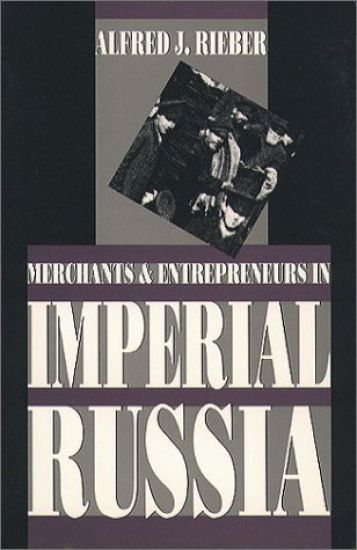
Merchants and Entrepreneurs in Imperial Russia

Merchants and Entrepreneurs in Imperial Russia

Alfred J. Rieber

The University of North Carolina Press
1991
nidottu
This book is the first general history of Russian ""businessmen"" from Peter the Great to the Revolution of 1917. It is also a challenging new interpretation of the nature of social change in tsarist Russia.Alfred Rieber seeks to explain how Russia developed a capitalist economy and launched a major industrialization without giving rise to a mature bourgeoisie. His analysis concentrates on the deep-seated social divisions that prevented the political unity of the Russian middle classes even when their vital interests were threatened by powerful bureaucrats and a workers' revolution. He concludes that the fate of the Russian merchants and industrialists was part of a larger social fragmentation in Russia on the eve of World War I.Rieber argues that the merchantry was throughout its history the most unstable and politically passive group in Russian society. Periodically swamped by an influx of peasants, the merchants were never able to free themselves from state tutelage or their own traditional values. Surrounded by ethnic rivals, the Great Russian merchantry adopted the mentality of a besieged camp. The real innovators in Russia's industrialization were social deviants--Old Believer peasants, declasse nobles, and non-Russian peoples on the periphery of the empire. But even these ""entrepreneurial groups"" failed to provide the leadership for a strong middle class because they were deeply marked by competing regional and ethnic attachments. In Rieber's analysis the Russian bureaucracy shares much of the blame for the absence of a cohesive class structure in Russia. It feared and opposed the emergence of a bourgeoisie, and it was deeply split over the question of industrialization. Rieber concludes that the bureaucracy helped to maintain the legal distinctions within Russian society that contributed to its fragmentation.This work touches on almost every aspect of imperial Russian society--its political and legal institutions, social movements, intellectual currents, and economic development. Rieber has drawn on a wide range of sources including Soviet archives, merchant memoirs, contemporary journals, pamphlets and newspapers, and the proceedings and reports of many specialized societies and organizations.A UNC Press Enduring Edition -- UNC Press Enduring Editions use the latest in digital technology to make available again books from our distinguished backlist that were previously out of print. These editions are published unaltered from the original, and are presented in affordable paperback formats, bringing readers both historical and cultural value.
The Struggle for the Eurasian Borderlands

The Struggle for the Eurasian Borderlands

Alfred J. Rieber

Cambridge University Press
2014
sidottu
This book explores the Eurasian borderlands as contested 'shatter zones' which have generated some of the world's most significant conflicts. Analyzing the struggles of Habsburg, Russian, Ottoman, Iranian and Qing empires, Alfred J. Rieber surveys the period from the rise of the great multicultural, conquest empires in the late medieval/early modern period to their collapse in the early twentieth century. He charts how these empires expanded along moving, military frontiers, competing with one another in war, diplomacy and cultural practices, while the subjugated peoples of the borderlands strove to maintain their cultures and to defend their autonomy. The gradual and fragmentary adaptation of Western constitutional ideas, military reforms, cultural practices and economic penetration began to undermine these ruling ideologies and institutions, leading to the collapse of all five empires in revolution and war within little more than a decade between 1911 and 1923.
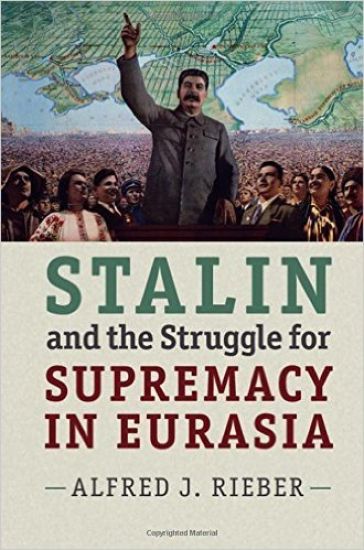
Stalin and the Struggle for Supremacy in Eurasia

Stalin and the Struggle for Supremacy in Eurasia

Alfred J. Rieber

Cambridge University Press
2015
sidottu
This is a major new study of the successor states that emerged in the wake of the collapse of the great Russian, Habsburg, Iranian, Ottoman and Qing Empires and of the expansionist powers who renewed their struggle over the Eurasian borderlands through to the end of the Second World War. Surveying the great power rivalry between the Soviet Union, Nazi Germany and Imperial Japan for control over the Western and Far Eastern boundaries of Eurasia, Alfred J. Rieber provides a new framework for understanding the evolution of Soviet policy from the Revolution through to the beginning of the Cold War. Paying particular attention to the Soviet Union, the book charts how these powers adopted similar methods to the old ruling elites to expand and consolidate their conquests, ranging from colonisation and deportation to forced assimilation, but applied them with a force that far surpassed the practices of their imperial predecessors.
Stalin and the Struggle for Supremacy in Eurasia

Stalin and the Struggle for Supremacy in Eurasia

Alfred J. Rieber

Cambridge University Press
2015
pokkari
This is a major new study of the successor states that emerged in the wake of the collapse of the great Russian, Habsburg, Iranian, Ottoman and Qing Empires and of the expansionist powers who renewed their struggle over the Eurasian borderlands through to the end of the Second World War. Surveying the great power rivalry between the Soviet Union, Nazi Germany and Imperial Japan for control over the Western and Far Eastern boundaries of Eurasia, Alfred J. Rieber provides a new framework for understanding the evolution of Soviet policy from the Revolution through to the beginning of the Cold War. Paying particular attention to the Soviet Union, the book charts how these powers adopted similar methods to the old ruling elites to expand and consolidate their conquests, ranging from colonisation and deportation to forced assimilation, but applied them with a force that far surpassed the practices of their imperial predecessors.
The Struggle for the Eurasian Borderlands

The Struggle for the Eurasian Borderlands

Alfred J. Rieber

Cambridge University Press
2014
pokkari
This book explores the Eurasian borderlands as contested 'shatter zones' which have generated some of the world's most significant conflicts. Analyzing the struggles of Habsburg, Russian, Ottoman, Iranian and Qing empires, Alfred J. Rieber surveys the period from the rise of the great multicultural, conquest empires in the late medieval/early modern period to their collapse in the early twentieth century. He charts how these empires expanded along moving, military frontiers, competing with one another in war, diplomacy and cultural practices, while the subjugated peoples of the borderlands strove to maintain their cultures and to defend their autonomy. The gradual and fragmentary adaptation of Western constitutional ideas, military reforms, cultural practices and economic penetration began to undermine these ruling ideologies and institutions, leading to the collapse of all five empires in revolution and war within little more than a decade between 1911 and 1923.