Kirjojen hintavertailu. Mukana 12 016 292 kirjaa ja 12 kauppaa.

Kirjahaku

Etsi kirjoja tekijän nimen, kirjan nimen tai ISBN:n perusteella.

19 kirjaa tekijältä Alfred Thomas

Prague Palimpsest

Prague Palimpsest

Alfred Thomas

University of Chicago Press
2010
sidottu
A city of immense literary mystique, Prague has inspired writers across the centuries with its beauty, cosmopolitanism, and tragic history. Envisioning the ancient city in central Europe as a multilayered text, or palimpsest, that has been constantly revised and rewritten - from the medieval and Renaissance chroniclers who legitimized the city's foundational origins to the modernists of the early twentieth century who established its reputation as the new capital of the avant-garde - Alfred Thomas argues that Prague has become a paradoxical site of inscription and effacement, of memory and forgetting, a utopian link to the prewar and pre-Holocaust European past and a dystopia of totalitarian amnesia. Considering a wide range of writers, including the city's most famous son, Franz Kafka, Prague Palimpsest reassesses the work of poets and novelists such as Bohumil Hrabal, Milan Kundera, Gustav Meyrink, Jan Neruda, Vitezslav Nezval, and Rainer Maria Rilke and engages with other famous authors who 'wrote' Prague, including Guillaume Apollinaire, Ingeborg Bachmann, Albert Camus, Paul Celan, and W. G. Sebald. The result is a comparative, interdisciplinary study that helps to explain why Prague - more than any other major European city - has haunted the cultural and political imagination of the West.
The Bohemian Body

The Bohemian Body

Alfred Thomas

University of Wisconsin Press
2007
sidottu
The Bohemian Body examines the modernist forces within nineteenth- and twentieth-century Europe that helped shape both Czech nationalism and artistic interaction among ethnic and social groups - Czechs and Germans, men and women, gays and straights. By re-examining the work of key Czech male and female writers and poets from the National Revival to the Velvet Revolution, Alfred Thomas exposes the tendency of Czech literary criticism to separate the political and the personal in modern Czech culture. He points instead to the complex interplay of the political and the personal across ethnic, cultural, and intellectual lines and within the works of such individual writers as Karel Hynek Macha, Bozena Nemcova, and Rainer Maria Rilke, resulting in the emergence and evolution of a protean modern identity. The product is a seemingly paradoxical yet nuanced understanding of Czech culture (including literature, opera, and film), long overlooked or misunderstood by Western scholars.
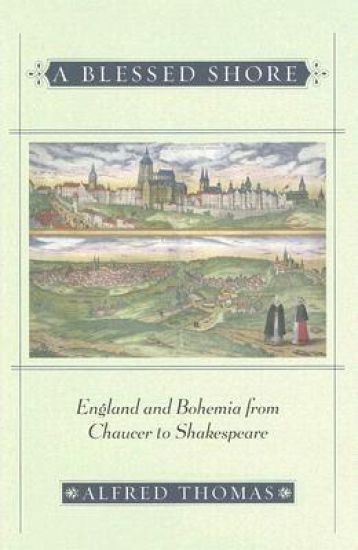
A Blessed Shore

A Blessed Shore

Alfred Thomas

Cornell University Press
2007
sidottu
In The Winter's Tale, Antigonus announces that his ship has washed up on the shores of Bohemia. How and why landlocked Bohemia? Did Shakespeare not know his geography, or is something else at work here? Alfred Thomas answers these questions by exploring cross-cultural interactions between England and Bohemia from the fourteenth to the early seventeenth century. He is interested less in the diplomacy and politics of this history than in the images—the shifting blends of fact and fiction—that each of the two cultures nourished about the other. Although Thomas gives original readings of famous English texts by Chaucer and Shakespeare, this is also a book about Czech writers and travelers; one Czech expatriate, Anne of Bohemia, became Queen of England. For both countries these were decades of religious and dynastic turbulence, and Thomas's analyses of the relations between Wyclif and Hus, Lollards and Hussites, help us to understand why Bohemia was viewed as an almost utopian land of refuge ("a blessed shore" on which a ship might wash up) for persecuted English men and women. Of particular interest is his analysis of the ways in which English court culture emulated that of Prague, which was an imperial seat at a time when England was still a peripheral place with little influence on the heart of Europe. Thomas shows that the relationship between the two cultures was never a straightforward one, but a mirror-like formation in which each saw the other "through the distorted and subjective effect of its own reflection."
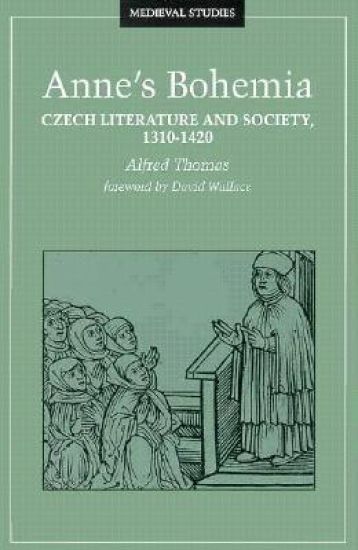
Anne's Bohemia

Anne's Bohemia

Alfred Thomas

University of Minnesota Press
1998
nidottu
The first book in English on medieval Czech literature.Anne’s Bohemia is the first general book in English to introduce the little-known riches of medieval Bohemian culture. Alfred Thomas considers the development of Czech literature and society from the election of Count John of Luxembourg as king of Bohemia in 1310 to the year 1420, when the papacy declared a Catholic crusade against the Hussite reformers. This period is of particular relevance to the study of medieval England because of the marriage of Richard II to Anne of Bohemia, the figure around whom this book is focused.Anne’s Bohemia provides a social context for the most important works of literature written in the Czech language, from the earliest spiritual songs and prayers to the principal Hussite and anti-Hussite tracts of the fifteenth century. The picture that emerges from Thomas’s close readings of these texts is one of a society undergoing momentous political and religious upheavals in which kings, queens, clergy, and heretics all played crucial roles. During the reign of Charles IV (1346-78), the Bohemian Lands became the administrative and cultural center of the Holy Roman Empire and Prague its splendid capital. Comparing and contrasting the situation in Bohemia with the England of Richard II, Anne’s Bohemia charts the growth and decline of the international court culture and the gradual ascendancy of the Hussite reformers in the fifteenth century. Expert but accessibly written, the book offers an engaging overview of medieval Bohemian culture for specialist and nonspecialist alike.ISBN 0-8166-3053-4 Cloth $49.95xxISBN 0-8166-3054-2 Paper $19.95x232 pages 6 black-and-white photos 5 7/8 x 9 AprilMedieval Cultures Series, volume 13Translation inquiries: University of Minnesota Press
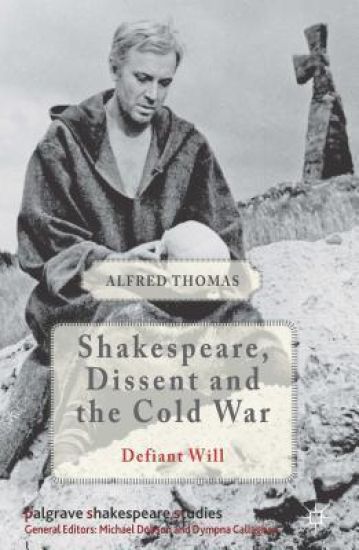
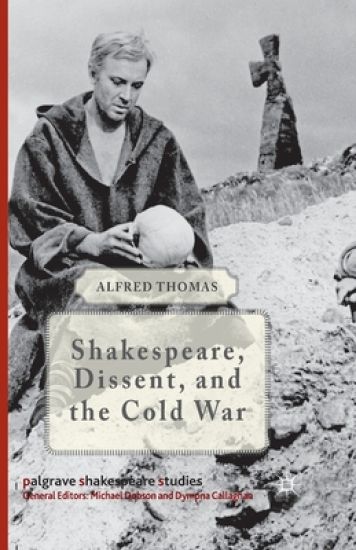
Shakespeare, Dissent and the Cold War

Shakespeare, Dissent and the Cold War

Alfred Thomas

Palgrave Macmillan
2014
sidottu
Shakespeare, Dissent and the Cold War is the first book to read Shakespeare's drama through the lens of Cold War politics. The book uses the Cold War experience of dissenting artists in theatre and film to highlight the coded religio-political subtexts in Hamlet, King Lear, Macbeth and The Winter's Tale.
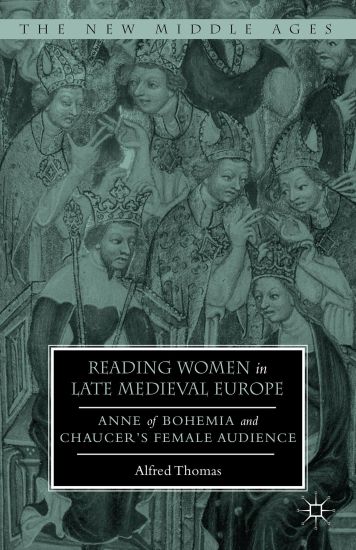
Reading Women in Late Medieval Europe

Reading Women in Late Medieval Europe

Alfred Thomas

Palgrave Macmillan
2015
sidottu
Although Chaucer is typically labeled as the "Father of English Literature," evidence shows that his work appealed to Europe and specifically European women. Rereading the Canterbury Tales , Thomas argues that Chaucer imagined Anne of Bohemia, wife of famed Richard II, as an ideal reader, an aspect that came to greatly affect his writing.
Shakespeare, Dissent and the Cold War

Shakespeare, Dissent and the Cold War

Alfred Thomas

Palgrave Macmillan
2014
nidottu
Shakespeare, Dissent and the Cold War is the first book to read Shakespeare's drama through the lens of Cold War politics. The book uses the Cold War experience of dissenting artists in theatre and film to highlight the coded religio-political subtexts in Hamlet, King Lear, Macbeth and The Winter's Tale.
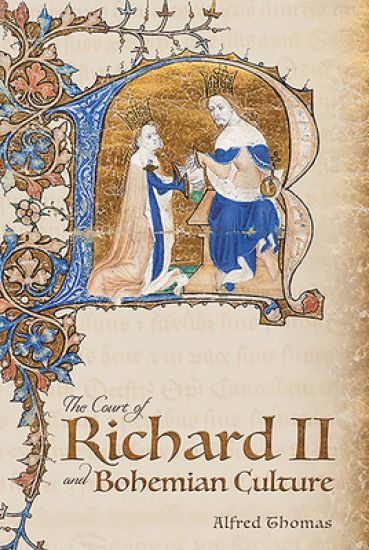
The Court of Richard II and Bohemian Culture
First detailed exploration of the role played by Bohemian tradition and customs in the court of Richard II. Bohemian culture exercised an important influence on the court of King Richard II, but it has been somewhat overlooked, with previous scholarship on its writers and artists generally confined to the role played by the French courtof King Charles V and the Italian city states of Milan and Florence. This book aims to fill that gap. It argues that Richard's marriage to Anne of Bohemia, daughter of the Holy Roman Emperor Charles IV, one of the greatest rulersand patrons of the age, exposed England to the full extent of this international court culture. Ricardian writers, including Chaucer, Gower and the Gawain-poet, wrote in their native language not because they felt "English" in the modern national sense but because they aspired to be part of a burgeoning vernacular European culture stretching from Paris to Prague and from Brabant to Brandenburg; thus, one of the major periods of English literature can only be properly understood in relation to this larger European context.
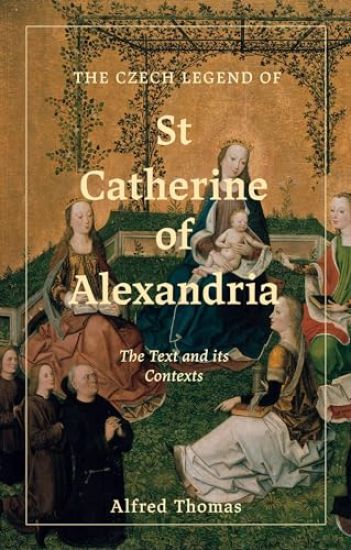
The Czech Legend of St Catherine of Alexandria

The Czech Legend of St Catherine of Alexandria

Alfred Thomas

BOYDELL BREWER LTD
2024
sidottu
The first complete translation of a fascinating piece of Czech literature. The virgin martyr St Catherine was one of the pre-eminent and most popular saints in the Middle Ages, her legend spreading far and wide throughout Europe. A Bohemian version of her Vita was written in the second half of the fourteenth century, probably for the court of Emperor Charles IV in Prague; it is a fascinating account of her life and passion, with many unique features. However, partly because of the language barrier, it has received relatively little attention. This book provides the first complete translation of this important text. It is accompanied by a full, interdisciplinary introduction, which places the legend in its cultural and historical context, and emphasizes both the importance of the Dominican friars as court writers and the prominence of royal and noble women as patrons and consumers of their work. It also highlights the numerous representations of Catherine in contemporary art. Meanwhile, elucidatory notes to the translation illuminate its most important features.
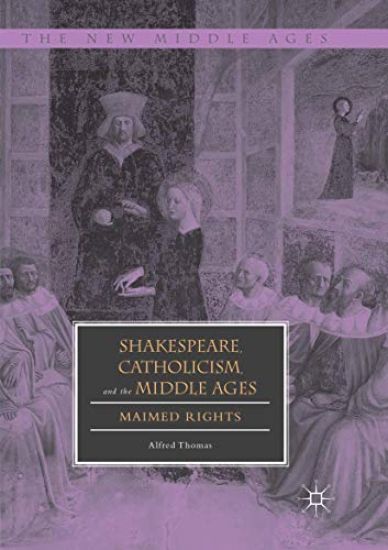
Shakespeare, Catholicism, and the Middle Ages

Shakespeare, Catholicism, and the Middle Ages

Alfred Thomas

Springer Nature Switzerland AG
2019
nidottu
Whereas traditional scholarship assumed that William Shakespeare used the medieval past as a negative foil to legitimate the present, Shakespeare, Catholicism, and the Middle Ages offers a revisionist perspective, arguing that the playwright valorizes the Middle Ages in order to critique the oppressive nature of the Tudor-Stuart state. In examining Shakespeare’s Richard II, The Merchant of Venice, Hamlet, King Lear, Macbeth, and The Winter’s Tale, the text explores how Shakespeare repossessed the medieval past to articulate political and religious dissent. By comparing these and other plays by Shakespeare’s contemporaries with their medieval analogues, Alfred Thomas argues that Shakespeare was an ecumenical writer concerned with promoting tolerance in a highly intolerant and partisan age.
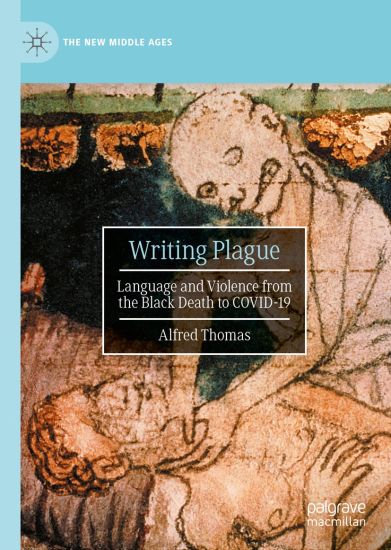
Writing Plague

Writing Plague

Alfred Thomas

Springer Nature Switzerland AG
2022
sidottu
Writing Plague: Language and Violence from the Black Death to COVID-19 brings a holistic and comparative perspective to “plague writing” from the later Middle Ages to the twenty-first century. It argues that while the human “hardware” has changed enormously between the medieval past and the present (urbanization, technology, mass warfare, and advances in medical science), the human “software” (emotional and psychological reactions to the shock of pandemic) has remained remarkably similar across time. Through close readings of works by medieval writers like Guillaume de Machaut, Giovanni Boccaccio, and Geoffrey Chaucer in the fourteenth century, select plays by Shakespeare, and modern “plague” fiction and film, Alfred Thomas convincingly demonstrates psychological continuities between the Black Death and COVID-19. In showing how in times of plague human beings repress their fears and fantasies and displace them onto the threatening “other,” Thomas highlights the danger of scapegoating vulnerable minority groups such as Asian Americans and Jews in today’s America. This wide-ranging study will thus be of interest not only to medievalists but also to students of modernity as well as the general reader.
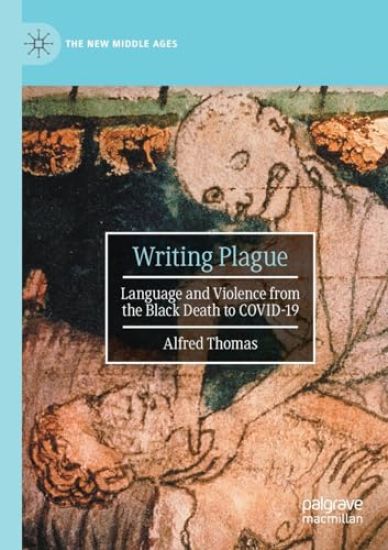
Writing Plague

Writing Plague

Alfred Thomas

Springer Nature Switzerland AG
2023
nidottu
Writing Plague: Language and Violence from the Black Death to COVID-19 brings a holistic and comparative perspective to “plague writing” from the later Middle Ages to the twenty-first century. It argues that while the human “hardware” has changed enormously between the medieval past and the present (urbanization, technology, mass warfare, and advances in medical science), the human “software” (emotional and psychological reactions to the shock of pandemic) has remained remarkably similar across time. Through close readings of works by medieval writers like Guillaume de Machaut, Giovanni Boccaccio, and Geoffrey Chaucer in the fourteenth century, select plays by Shakespeare, and modern “plague” fiction and film, Alfred Thomas convincingly demonstrates psychological continuities between the Black Death and COVID-19. In showing how in times of plague human beings repress their fears and fantasies and displace them onto the threatening “other,” Thomas highlights the danger of scapegoating vulnerable minority groups such as Asian Americans and Jews in today’s America. This wide-ranging study will thus be of interest not only to medievalists but also to students of modernity as well as the general reader.
Shakespeare, Catholicism, and the Middle Ages

Shakespeare, Catholicism, and the Middle Ages

Alfred Thomas

Springer International Publishing AG
2018
sidottu
Whereas traditional scholarship assumed that William Shakespeare used the medieval past as a negative foil to legitimate the present, Shakespeare, Catholicism, and the Middle Ages offers a revisionist perspective, arguing that the playwright valorizes the Middle Ages in order to critique the oppressive nature of the Tudor-Stuart state. In examining Shakespeare’s Richard II, The Merchant of Venice, Hamlet, King Lear, Macbeth, and The Winter’s Tale, the text explores how Shakespeare repossessed the medieval past to articulate political and religious dissent. By comparing these and other plays by Shakespeare’s contemporaries with their medieval analogues, Alfred Thomas argues that Shakespeare was an ecumenical writer concerned with promoting tolerance in a highly intolerant and partisan age.