Kirjojen hintavertailu. Mukana 11 244 527 kirjaa ja 12 kauppaa.

Kirjahaku

Etsi kirjoja tekijän nimen, kirjan nimen tai ISBN:n perusteella.

7 kirjaa tekijältä Alice Kaplan

Dreaming in French

Dreaming in French

Alice Kaplan

University of Chicago Press
2013
nidottu
"A year in Paris"...Countless American students have been lured by that vision - and been transformed by their sojourn in the City of Light. "Dreaming in French" tells three stories of that experience and how it changed the lives of three extraordinary American women. All three women would go on to become icons, key figures in American cultural, intellectual, and political life, yet their backgrounds and their dreams couldn't have been more different. Jacqueline Bouvier was a twenty-year-old debutante from a wealthy East Coast family. Susan Sontag was twenty-four, a precocious Jewish intellectual from a family of modest means. Angela Davis, a French major at Brandeis from a prominent African American family in Birmingham, Alabama, found herself the only black student in her year abroad program - in a summer when the news from Birmingham was of unprecedented racial violence. Kaplan takes readers into the lives of these young women, tracing their paths to Paris and tracking the intellectual adventures, friendships, and loves that they found there. For all three women, France was far from a passing fancy; rather, the year abroad continued to influence them for the rest of their lives. Jackie Kennedy carried her love of France to the White House and to her later career as a book editor. Sontag discovered the intellectual world she observed from afar during that first year in Paris that would remain a key influence for the rest of her life. Davis, meanwhile, found that her Parisian vantage strengthened her sense of solidarity with the burgeoning Algerian independence movement, which would inform her own revolutionary agenda. Kaplan spins these three different stories into one evocative biography and explores how a single year - and a magical city - can change a whole life.
Looking for The Stranger

Looking for The Stranger

Alice Kaplan

University of Chicago Press
2016
sidottu
The Stranger is a rite of passage for readers around the world. Since its publication in France in 1942, Camus’s novel has been translated into sixty languages and sold more than six million copies. It’s the rare novel that’s as at likely to be found in a teen’s backpack as in a graduate philosophy seminar. If the twentieth century produced a novel that could be called ubiquitous, The Stranger is it. How did a young man in his twenties who had never written a novel turn out a masterpiece that still grips readers more than seventy years later? With Looking for “The Stranger”, Alice Kaplan tells that story. In the process, she reveals Camus’s achievement to have been even more impressive—and more unlikely—than even his most devoted readers knew. Born in poverty in colonial Algeria, Camus started out as a journalist covering the criminal courts. The murder trials he attended, Kaplan shows, would be a major influence on the development and themes of The Stranger. She follows Camus to France, and, making deft use of his diaries and letters, re-creates his lonely struggle with the novel in Montmartre, where he finally hit upon the unforgettable first-person voice that enabled him to break through and complete The Stranger. Even then, the book’s publication was far from certain. France was straining under German occupation, Camus’s closest mentor was unsure of the book’s merit, and Camus himself was suffering from near-fatal tuberculosis. Yet the book did appear, thanks in part to a resourceful publisher, Gaston Gallimard, who was undeterred by paper shortages and Nazi censorship. The initial critical reception of The Stranger was mixed, and it wasn’t until after liberation that The Stranger began its meteoric rise. As France and the rest of the world began to move out of the shadow of war, Kaplan shows, Camus’s book— with the help of an aggressive marketing campaign by Knopf for their 1946 publication of the first English translation—became a critical and commercial success, and Camus found himself one of the most famous writers in the world. Suddenly, his seemingly modest tale of alienation was being seen for what it really was: a powerful parable of the absurd, an existentialist masterpiece. Few books inspire devotion and excitement the way The Stranger does. And it couldn’t have a better biographer than Alice Kaplan, whose books about twentieth-century French culture and history have won her legions of fans. No reader of Camus will want to miss this brilliant exploration.
The Collaborator

The Collaborator

Alice Kaplan

University of Chicago Press
2001
nidottu
On February 6, 1945, a 35-year-old French writer and newspaper editor named Robert Brasillach was executed for treason by a French firing squad. He was the only writer of any distinction to be put to death by the French Liberation government during the violent days of score-settling known as the Purge. In this book, Alice Kaplan, author of the memoir "French Lessons" tells the story of Brasillach's rise and fall: his emergence as the golden boy of literary fascism during the 1930s, his wartime collaboration with the Nazis, his dramatic trial and his afterlife as a martyr for French rightists and Holocaust revisionists. A prolific novelist and critic, Brasillach was a witty, flamboyant product of France's prestigious Ecole Normale Superieure. He was also an anti-Semite, an acerbic opponent of French demnocracy, and the editor in chief of France's infamous fascist weekly "Je Suis Partout". His trial and execution, carefully reconstructed in "The Collaborator", remain one of the most controversial episodes in the history of 20th-century France. In the charged days of January 1945 - with Paris liberated but France still at war - a monumental courtroom drama pitted a fierce government prosecutor against a florid defence lawyer for what each considered justice on both a personal and a national scale. Paris in 1945 is also the venue for Kaplan's ethical examination of the questions raised by Brasillach's trial. Was he in fact guilty of treason? Was he condemned for his denunciations of the resistance or singled out as a suspected homosexual? Was it right that he was executed when others who were directly responsible for the murder of thousands were set free? The verdict on these momentous issues was left to four jurors from the working-class suburbs of Paris, whose stories Kaplan presents here for the first time. In recreating the trial, she also uncovers more material never before published: damaging writings by Brasillach omitted from his "Complete Works", and the file that Charles de Gaulle used to reach his decision not to pardon the writer.
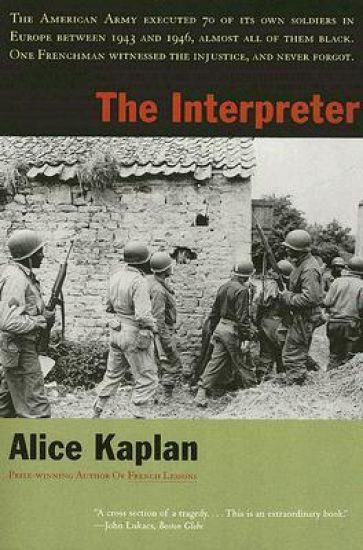
The Interpreter

The Interpreter

Alice Kaplan

University of Chicago Press
2007
nidottu
"No story of World War II" is more triumphant than the liberation of France, made famous in countless photos of Parisians waving American flags and kissing GIs as columns of troops paraded down the Champs-Elysees. But one of the least-known stories from that era is also one of the ugliest chapters in the history of Jim Crow. In "The Interpreter", celebrated author Alice Kaplan recovers this story both as eyewitnesses first saw it, and as it still haunts us today. The U.S. Army executed seventy of its own soldiers between 1943 and 1946 - almost all of them black, in an army that was overwhelmingly white. Through the French interpreter Louis Guilloux's eyes, Kaplan narrates two different trials: one of a white officer, one of a black soldier, both accused of murder. Both were court-martialed in the same room, yet the outcomes could not have been more different. Kaplan's insight into character and setting creates an indelible portrait of war, race relations, and the dangers of capital punishment.
French Lessons

French Lessons

Alice Kaplan

University of Chicago Press
2018
pokkari
Brilliantly uniting the personal and the critical, French Lessons is a powerful autobiographical experiment. It tells the story of an American woman escaping into the French language and of a scholar and teacher coming to grips with her history of learning. Kaplan begins with a distinctly American quest for an imaginary France of the intelligence. But soon her infatuation with all things French comes up against the dark, unimagined recesses of French political and cultural life. The daughter of a Jewish lawyer who prosecuted Nazi war criminals at Nuremburg, Kaplan grew up in the 1960s in the Midwest. After her father's death when she was seven, French became her way of "leaving home" and finding herself in another language and culture. In spare, midwestern prose, by turns intimate and wry, Kaplan describes how, as a student in a Swiss boarding school and later in a junior year abroad in Bordeaux, she passionately sought the French "r," attentively honed her accent, and learned the idioms of her French lover. When, as a graduate student, her passion for French culture turned to the elegance and sophistication of its intellectual life, she found herself drawn to the language and style of the novelist Louis-Ferdinand Celine. At the same time she was repulsed by his anti-Semitism. At Yale in the late 70s, during the heyday of deconstruction she chose to transgress its apolitical purity and work on a subject "that made history impossible to ignore:" French fascist intellectuals. Kaplan's discussion of the "de Man affair"--the discovery that her brilliant and charismatic Yale professor had written compromising articles for the pro-Nazi Belgian press--and her personal account of the paradoxes of deconstruction are among the most compelling available on this subject. French Lessons belongs in the company of Sartre's Words and the memoirs of Nathalie Sarraute, Annie Ernaux, and Eva Hoffman. No book so engrossingly conveys both the excitement of learning and the moral dilemmas of the intellectual life.
Looking for the Stranger

Looking for the Stranger

Alice Kaplan

University of Chicago Press
2018
pokkari
The Stranger is a rite of passage for readers around the world. Since its publication in France in 1942, Camus's novel has been translated into sixty languages and sold more than six million copies. It's the rare novel that's as at likely to be found in a teen's backpack as in a graduate philosophy seminar. If the twentieth century produced a novel that could be called ubiquitous, The Stranger is it. How did a young man in his twenties who had never written a novel turn out a masterpiece that still grips readers more than seventy years later? With Looking for "The Stranger", Alice Kaplan tells that story. In the process, she reveals Camus's achievement to have been even more impressive--and more unlikely--than even his most devoted readers knew. Born in poverty in colonial Algeria, Camus started out as a journalist covering the criminal courts. The murder trials he attended, Kaplan shows, would be a major influence on the development and themes of The Stranger. She follows Camus to France, and, making deft use of his diaries and letters, recreates his lonely struggle with the novel in Montmartre, where he finally hit upon the unforgettable first-person voice that enabled him to break through and complete The Stranger. Even then, the book's publication was far from certain. France was straining under German occupation, Camus's closest mentor was unsure of the book's merit, and Camus himself was suffering from near-fatal tuberculosis. Yet the book did appear, thanks in part to a resourceful publisher, Gaston Gallimard, who was undeterred by paper shortages and Nazi censorship. The initial critical reception of The Stranger was mixed, and it wasn't until after liberation that The Stranger began its meteoric rise. As France and the rest of the world began to move out of the shadow of war, Kaplan shows, Camus's book--with the help of an aggressive marketing campaign by Knopf for their 1946 publication of the first English translation--became a critical and commercial success, and Camus found himself one of the most famous writers in the world. Suddenly, his seemingly modest tale of alienation was being seen for what it really was: a powerful parable of the absurd, an existentialist masterpiece. Few books inspire devotion and excitement the way The Stranger does. And it couldn't have a better biographer than Alice Kaplan, whose books about twentieth-century French culture and history have won her legions of fans. No reader of Camus will want to miss this brilliant exploration.
Seeing Baya

Seeing Baya

Alice Kaplan

THE UNIVERSITY OF CHICAGO PRESS
2024
sidottu
The first biography of the Algerian artist Baya Mahieddine, celebrated in mid-twentieth-century Paris, her life shrouded in myth. On a flower farm in colonial Algeria, a servant and field worker known as Baya escaped the drudgery of her labor by coloring the skirts in fashion magazines. Three years later, in November 1947, her paintings and fanciful clay beasts were featured in a solo show in Paris. She wasn’t yet sixteen years old. In this first biography of Baya, Alice Kaplan tells the story of a young woman seemingly trapped in subsistence who becomes a sensation in the French capital, then mysteriously fades from the history of modern art—only to reemerge after independence as an icon of Algerian artistic heritage. The toast of Paris for the 1947 season, Baya inspired colonialist fantasies about her “primitive” genius as well as genuine appreciation. She was featured in newspapers, on the radio, and in a newsreel; her art was praised by Breton and Camus, Marchand and Braque. At the dawn of Algerian liberation, her appearance in Paris was used to stage the illusion of French-Algerian friendship, while horrific French massacres in Algeria were still fresh in memory. Kaplan uncovers the central figures in Baya’s life and the role they played in her artistic career. Among the most poignant was Marguerite Caminat-McEwen-Benhoura, who took Baya from her sister’s farm to Algiers, where Baya worked as Marguerite’s maid and was given paint and brushes. A complex and endearing character, Marguerite—and her Pygmalion ambitions—was decisive in shaping Baya’s destiny. Kaplan also looks closely at Baya’s earliest paintings with an eye to their themes, their palette and design, and their enduring influence. In vivid prose that brings Baya’s story into the present, Kaplan’s book, the fruit of scrupulous research in Algiers, Blida, Paris, and Provence, allows us to see in a whole new light the beloved artist who signed her paintings simply “Baya.”