Kirjojen hintavertailu. Mukana 12 390 323 kirjaa ja 12 kauppaa.

Kirjahaku

Etsi kirjoja tekijän nimen, kirjan nimen tai ISBN:n perusteella.

3 kirjaa tekijältä Alison Joiner

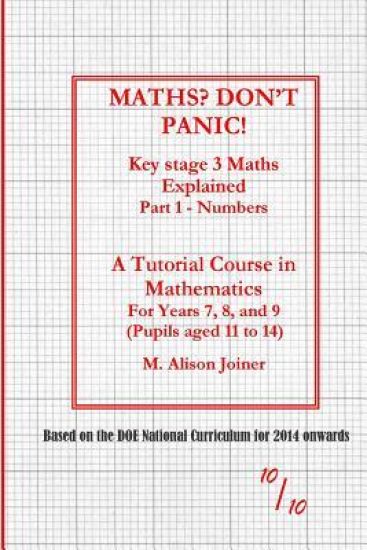
Maths? Don't Panic!: Key Stage Maths Explained Part 1 Numbers

Maths? Don't Panic!: Key Stage Maths Explained Part 1 Numbers

Alison Joiner

Createspace Independent Publishing Platform
2015
nidottu
Maths? Don't Panic? is a friendly guide to mathematics for the UK Key Stage 3 Examination. The book has been written for students aged 11 to 14 (in school years 7 to 9), and the parents who want to help them. It is based on the Department of Education's Curriculum for 2014 onwards. It is not a formal textbook. Each chapter covers a single topic and provides explanations, tips, memory aids, worked examples and exercises. Mathematics doesn't have to be 'learned'. Once you understand the basic rules it's about knowing how to apply them to find the answer to the question. When you have understood a topic you will find that there is very little which needs to be memorized. It is just common sense. You don't need to work through the whole book. You can look-up any topic and find a straight forward explanation of the things which puzzle you. Exercises, with answers are set at the end of each chapter. A final chapter gives advice on how to pass examinations. The author has devoted many years to teaching individual students. In this book she makes use of the explanations she has found most helpful. She always hopes to get the response "Is that what it's all about." "I didn't know it was so easy". She aims to explain each topic in a way which makes it simple, so that her students feel confident that they really understand the subject This book, Part 1, covers basic arithmetic with whole numbers and decimals. It includes the use of fractions, indices, squares and cubes, series and many other topics. Further parts, which are under preparation, will cover Algebra, Geometry, Statistics, and Ratio and Proportion, so completing the Department of Education requirements.
Maths? Don't Panic!: Algebra and Geometry

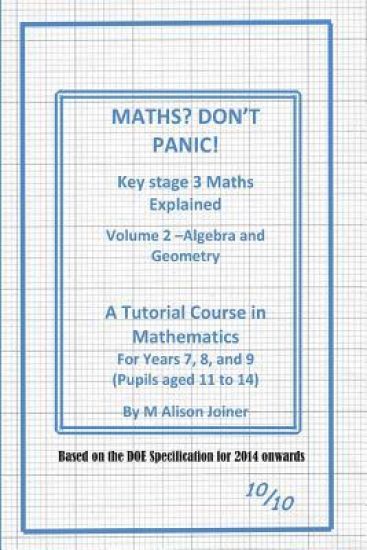
Maths? Don't Panic!: Algebra and Geometry

Alison Joiner

Createspace Independent Publishing Platform
2016
nidottu
Maths? Don't Panic is a friendly guide to mathematics for students aged 11 to 14 (in school years 7 to 9). It will also help parents who want to help them, but are not quite sure how to do it. It is not a formal textbook. Each chapter covers a single topic and provides explanations, tips, memory aids, worked examples and exercises. Volume 1, covered basic arithmetic, with whole numbers and decimals. It included the use of fractions, percentages, indices, squares and cubes, series and many other topics. This volume, volume 2, covers Algebra and Geometry. It starts with the basic idea of simplifying calculations by substituting letters for numbers. It explains linear, quadratic and more complex equations. It shows you how to use graphs to solve problems. Geometry is a practical subject, used extensively by graphic designers, surveyors architects and builders. This book shows you how to use rulers, compasses and protractors to draw lines and angles, and to measure accurately. Mathematics doesn't have to be 'learned'. Once you understand the basic rules you will know how to use them to find the answers to the questions. When you have understood a topic you will find that there is very little which needs to be memorized. It is just common sense. You don't need to work through the whole book. You can look-up any topic and find a straight forward explanation of the things which puzzle you. Exercises, with answers are set at the end of each chapter. A final chapter gives advice on how to pass examinations. Alison Joiner has devoted many years to teaching individual students. In this book she makes use of the explanations she has found most helpful. She often gets the response "Is that what it's all about." "I didn't know it was so easy". She aims to explain each topic in a way which makes it simple, so that her students feel confident that they really understand the subject A further part, which is under preparation, will cover Statistics, and Ratio and Proportion, so completing the Department of Education requirements the UK Key Stage 3 Examination syllabus, based on the Curriculum for 2014 onwards.
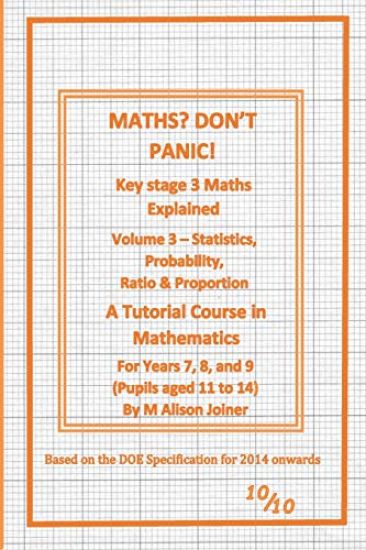
Maths? Don't Panic!: Statistics, Probability, Ratio & Proportion

Maths? Don't Panic!: Statistics, Probability, Ratio & Proportion

Alison Joiner

Createspace Independent Publishing Platform
2018
nidottu
Maths? Don't Panic? is a friendly guide to mathematics for the UK Key Stage 3 Examination. The book has been written for students aged 11 to 15 (in school years 7 to 9), and the parents who want to help them. It is based on the Department of Education's Curriculum for 2014 onwards. It is not a formal textbook. Each chapter covers a single topic and provides explanations, tips, memory aids, worked examples and exercises. Mathematics doesn't have to be 'learned'. Once you understand the basic rules it's about knowing how to apply them to find the answer to the question. When you have understood a topic you will find that there is very little which needs to be memorized. It is just common sense. You don't need to work through the whole book. You can look-up any topic and find a straight forward explanation of the things which puzzle you. Exercises, with answers are set at the end of each chapter. A final chapter gives advice on how to pass examinations. The author has devoted many years to teaching individual students. In this book she makes use of the explanations she has found most helpful. She always hopes to get the response "Is that what it's all about." "I didn't know it was so easy". She aims to explain each topic in a way which makes it simple. Then her students feel confident that they really understand the subject This book, Volume 3, covers the basic concepts of Statistics and Probability, Ratio and Proportion, converting between Metric and British Units and the use of complex units such as speed and density. A final section gives advice to young people starting their first job. It included the basics of taxation and personal budgeting.