Kirjojen hintavertailu. Mukana 11 699 587 kirjaa ja 12 kauppaa.

Kirjahaku

Etsi kirjoja tekijän nimen, kirjan nimen tai ISBN:n perusteella.

10 kirjaa tekijältä Allen B. Downey

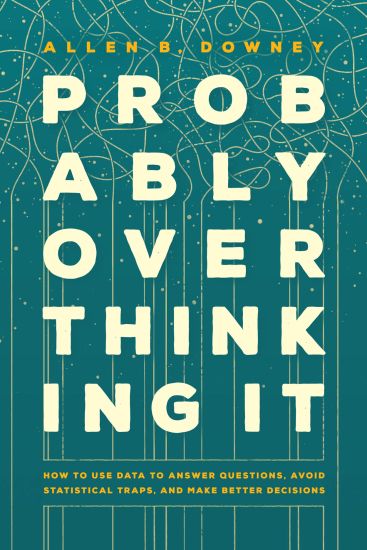
Probably Overthinking It

Probably Overthinking It

Allen B. Downey

THE UNIVERSITY OF CHICAGO PRESS
2023
sidottu
An essential guide to the ways data can improve decision making. Statistics are everywhere: in news reports, at the doctor’s office, and in every sort of forecast, from the stock market to the weather. Blogger, teacher, and computer scientist Allen B. Downey knows well that people have an innate ability both to understand statistics and to be fooled by them. As he makes clear in this accessible introduction to statistical thinking, the stakes are big. Simple misunderstandings have led to incorrect medical prognoses, underestimated the likelihood of large earthquakes, hindered social justice efforts, and resulted in dubious policy decisions. There are right and wrong ways to look at numbers, and Downey will help you see which are which. Probably Overthinking It uses real data to delve into real examples with real consequences, drawing on cases from health campaigns, political movements, chess rankings, and more. He lays out common pitfalls—like the base rate fallacy, length-biased sampling, and Simpson’s paradox—and shines a light on what we learn when we interpret data correctly, and what goes wrong when we don’t. Using data visualizations instead of equations, he builds understanding from the basics to help you recognize errors, whether in your own thinking or in media reports. Even if you have never studied statistics—or if you have and forgot everything you learned—this book will offer new insight into the methods and measurements that help us understand the world.
Probably Overthinking It

Probably Overthinking It

Allen B. Downey

THE UNIVERSITY OF CHICAGO PRESS
2025
nidottu
An essential guide to the ways data can improve decision making. Statistics are everywhere: in news reports, at the doctor’s office, and in every sort of forecast, from the stock market to the weather. Blogger, teacher, and computer scientist Allen B. Downey knows well that people have an innate ability both to understand statistics and to be fooled by them. As he makes clear in this accessible introduction to statistical thinking, the stakes are big. Simple misunderstandings have led to incorrect medical prognoses, underestimated the likelihood of large earthquakes, hindered social justice efforts, and resulted in dubious policy decisions. There are right and wrong ways to look at numbers, and Downey will help you see which are which. Probably Overthinking It uses real data to delve into real examples with real consequences, drawing on cases from health campaigns, political movements, chess rankings, and more. He lays out common pitfalls—like the base rate fallacy, length-biased sampling, and Simpson’s paradox—and shines a light on what we learn when we interpret data correctly, and what goes wrong when we don’t. Using data visualizations instead of equations, he builds understanding from the basics to help you recognize errors, whether in your own thinking or in media reports. Even if you have never studied statistics—or if you have and forgot everything you learned—this book will offer new insight into the methods and measurements that help us understand the world.
Python for Software Design

Python for Software Design

Allen B. Downey

Cambridge University Press
2009
pokkari
A no-nonsense introduction to software design using the Python programming language. Written for people with no programming experience, this book starts with the most basic concepts and gradually adds new material. Some of the ideas students find most challenging, like recursion and object-oriented programming, are divided into a sequence of smaller steps and introduced over the course of several chapters. The focus is on the programming process, with special emphasis on debugging. The book includes a wide range of exercises, from short examples to substantial projects, so that students have ample opportunity to practise each new concept. Exercise solutions and code examples are available from thinkpython.com, along with Swampy, a suite of Python programs that is used in some of the exercises.
Python for Software Design

Python for Software Design

Allen B. Downey

Cambridge University Press
2009
sidottu
A no-nonsense introduction to software design using the Python programming language. Written for people with no programming experience, this book starts with the most basic concepts and gradually adds new material. Some of the ideas students find most challenging, like recursion and object-oriented programming, are divided into a sequence of smaller steps and introduced over the course of several chapters. The focus is on the programming process, with special emphasis on debugging. The book includes a wide range of exercises, from short examples to substantial projects, so that students have ample opportunity to practise each new concept. Exercise solutions and code examples are available from thinkpython.com, along with Swampy, a suite of Python programs that is used in some of the exercises.
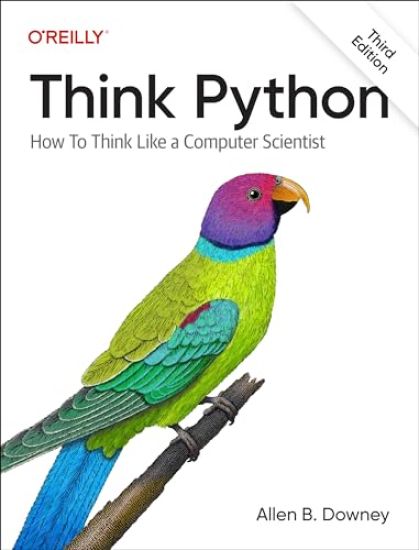
Think Python

Think Python

Allen B. Downey

O'Reilly Media
2024
nidottu
Python is an excellent way to get started in programming, and this clear, concise guide walks you through Python a step at a time-beginning with basic programming concepts before moving on to functions, data structures, and object-oriented design. This revised third edition reflects the growing role of large language models (LLMs) in programming and includes exercises on effective LLM prompts, testing code, and debugging skills. With this popular hands-on guide at your side, you'll get: A grounding in the syntax and semantics of the Python language A clear definition of each programming concept, with emphasis on clear vocabulary How to work with variables, statements, functions, and data structures in a logical progression Techniques for reading and writing files and databases A solid understanding of objects, methods, and object-oriented programming Debugging strategies for syntax, runtime, and semantic errors An introduction to recursion, interface design, data structures, and basic algorithms How to use LLMs-including effective prompts, testing code, and debugging And more
Think Stats

Think Stats

Allen B. Downey

O'Reilly Media
2025
nidottu
If you know how to program, you have the skills to turn data into knowledge. This thoroughly revised edition presents statistical concepts computationally, rather than mathematically, using programs written in Python. Through practical examples and exercises based on real-world datasets, you'll learn the entire process of exploratory data analysis-from wrangling data and generating statistics to identifying patterns and testing hypotheses.Whether you're a data scientist, software engineer, or data enthusiast, you'll get up to speed on commonly used tools including NumPy, SciPy, and Pandas. You'll explore distributions, relationships between variables, visualization, and many other concepts. And all chapters are available as Jupyter notebooks, so you can read the text, run the code, and work on exercises all in one place.Analyze data distributions and visualize patterns using Python librariesImprove predictions and insights with regression modelsDive into specialized topics like time series analysis and survival analysisIntegrate statistical techniques and tools for validation, inference, and moreCommunicate findings with effective data visualizationTroubleshoot common data analysis challengesBoost reproducibility and collaboration in data analysis projects with interactive notebooks
Think DSP

Think DSP

Allen B. Downey

O'Reilly Media, Inc, USA
2016
nidottu
"Think DSP: Digital Signal Processing in Python" is an introduction to signal processing and system analysis using a computational approach. The premise of this book (like the others in the Think X series) is that if you know how to program, you can use that skill to learn other things. By the end of the first chapter, you'll be able to decompose a sound into its harmonics, modify the harmonics, and generate new sounds. Subsequent chapters follow a logical progression that develops the important ideas incrementally, with a focus on applications.
Think Data Structures

Think Data Structures

Allen B. Downey

O'Reilly Media, Inc, USA
2017
nidottu
If you’re a student studying computer science or a software developer preparing for technical interviews, this practical book will help you learn and review some of the most important ideas in software engineering—data structures and algorithms—in a way that’s clearer, more concise, and more engaging than other materials. By emphasizing practical knowledge and skills over theory, author Allen Downey shows you how to use data structures to implement efficient algorithms, and then analyze and measure their performance. You’ll explore the important classes in the Java collections framework (JCF), how they’re implemented, and how they’re expected to perform. Each chapter presents hands-on exercises supported by test code online. Use data structures such as lists and maps, and understand how they work Build an application that reads Wikipedia pages, parses the contents, and navigates the resulting data tree Analyze code to predict how fast it will run and how much memory it will require Write classes that implement the Map interface, using a hash table and binary search tree Build a simple web search engine with a crawler, an indexer that stores web page contents, and a retriever that returns user query results Other books by Allen Downey include Think Java, Think Python, Think Stats, and Think Bayes.
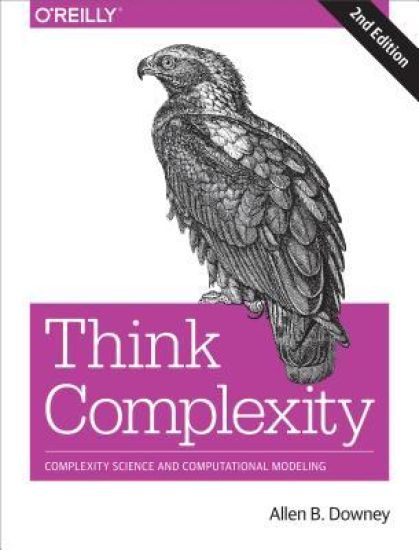
Think Complexity

Think Complexity

Allen B. Downey

O'Reilly Media, Inc, USA
2018
nidottu
Complexity science uses computation to explore the physical and social sciences. In Think Complexity, you’ll use graphs, cellular automata, and agent-based models to study topics in physics, biology, and economics. Whether you’re an intermediate-level Python programmer or a student of computational modeling, you’ll delve into examples of complex systems through a series of worked examples, exercises, case studies, and easy-to-understand explanations. In this updated second edition, you will: Work with NumPy arrays and SciPy methods, including basic signal processing and Fast Fourier Transform Study abstract models of complex physical systems, including power laws, fractals and pink noise, and Turing machines Get Jupyter notebooks filled with starter code and solutions to help you re-implement and extend original experiments in complexity; and models of computation like Turmites, Turing machines, and cellular automata Explore the philosophy of science, including the nature of scientific laws, theory choice, and realism and instrumentalism Ideal as a text for a course on computational modeling in Python, Think Complexity also helps self-learners gain valuable experience with topics and ideas they might not encounter otherwise.