Kirjojen hintavertailu. Mukana 11 612 371 kirjaa ja 12 kauppaa.

Kirjahaku

Etsi kirjoja tekijän nimen, kirjan nimen tai ISBN:n perusteella.

11 kirjaa tekijältä Amol Sasane

The How and Why of One Variable Calculus

The How and Why of One Variable Calculus

Amol Sasane

Wiley-Blackwell
2015
sidottu
First course calculus texts have traditionally been either “engineering/science-oriented” with too little rigor, or have thrown students in the deep end with a rigorous analysis text. The How and Why of One Variable Calculus closes this gap in providing a rigorous treatment that takes an original and valuable approach between calculus and analysis. Logically organized and also very clear and user-friendly, it covers 6 main topics; real numbers, sequences, continuity, differentiation, integration, and series. It is primarily concerned with developing an understanding of the tools of calculus. The author presents numerous examples and exercises that illustrate how the techniques of calculus have universal application. The How and Why of One Variable Calculus presents an excellent text for a first course in calculus for students in the mathematical sciences, statistics and analytics, as well as a text for a bridge course between single and multi-variable calculus as well as between single variable calculus and upper level theory courses for math majors.
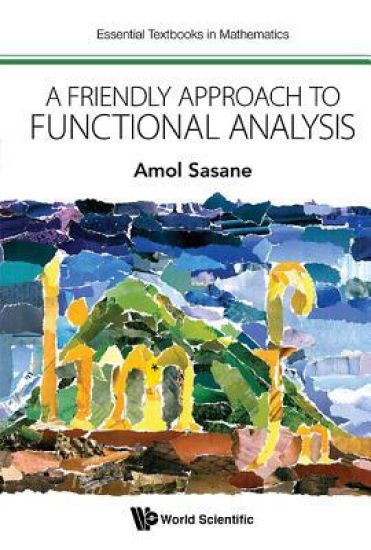
Friendly Approach To Functional Analysis, A

Friendly Approach To Functional Analysis, A

Amol Sasane

World Scientific Europe Ltd
2017
sidottu
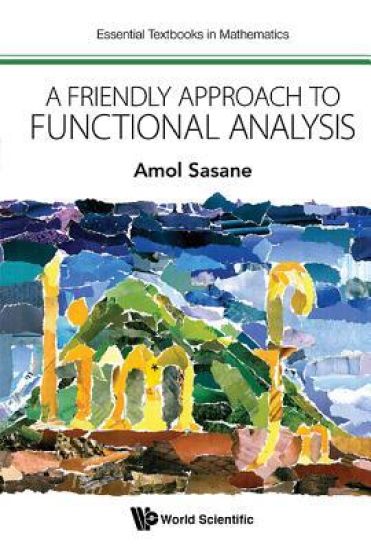
'The book is unusual among functional analysis books in devoting a lot of space to the derivative. The ‘friendly’ aspect promised in the title is not explained, but there are three things I think would strike most students as friendly: the slow pace, the enormous number of examples, and complete solutions to all the exercises.'MAA ReviewsThis book constitutes a concise introductory course on Functional Analysis for students who have studied calculus and linear algebra. The topics covered are Banach spaces, continuous linear transformations, Frechet derivative, geometry of Hilbert spaces, compact operators, and distributions. In addition, the book includes selected applications of functional analysis to differential equations, optimization, physics (classical and quantum mechanics), and numerical analysis. The book contains 197 problems, meant to reinforce the fundamental concepts. The inclusion of detailed solutions to all the exercises makes the book ideal also for self-study.A Friendly Approach to Functional Analysis is written specifically for undergraduate students of pure mathematics and engineering, and those studying joint programmes with mathematics.
Friendly Approach To Functional Analysis, A

Friendly Approach To Functional Analysis, A

Amol Sasane

World Scientific Europe Ltd
2017
nidottu
'The book is unusual among functional analysis books in devoting a lot of space to the derivative. The ‘friendly’ aspect promised in the title is not explained, but there are three things I think would strike most students as friendly: the slow pace, the enormous number of examples, and complete solutions to all the exercises.'MAA ReviewsThis book constitutes a concise introductory course on Functional Analysis for students who have studied calculus and linear algebra. The topics covered are Banach spaces, continuous linear transformations, Frechet derivative, geometry of Hilbert spaces, compact operators, and distributions. In addition, the book includes selected applications of functional analysis to differential equations, optimization, physics (classical and quantum mechanics), and numerical analysis. The book contains 197 problems, meant to reinforce the fundamental concepts. The inclusion of detailed solutions to all the exercises makes the book ideal also for self-study.A Friendly Approach to Functional Analysis is written specifically for undergraduate students of pure mathematics and engineering, and those studying joint programmes with mathematics.
Mathematical Introduction To General Relativity, A

Mathematical Introduction To General Relativity, A

Amol Sasane

WORLD SCIENTIFIC PUBLISHING CO PTE LTD
2021
sidottu
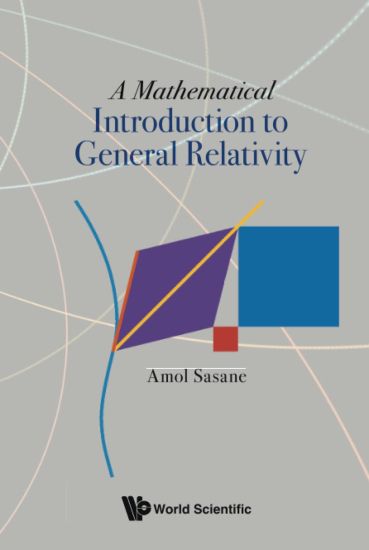
The book aims to give a mathematical presentation of the theory of general relativity (that is, spacetime-geometry-based gravitation theory) to advanced undergraduate mathematics students. Mathematicians will find spacetime physics presented in the definition-theorem-proof format familiar to them. The given precise mathematical definitions of physical notions help avoiding pitfalls, especially in the context of spacetime physics describing phenomena that are counter-intuitive to everyday experiences.In the first part, the differential geometry of smooth manifolds, which is needed to present the spacetime-based gravitation theory, is developed from scratch. Here, many of the illustrating examples are the Lorentzian manifolds which later serve as spacetime models. This has the twofold purpose of making the physics forthcoming in the second part relatable, and the mathematics learnt in the first part less dry. The book uses the modern coordinate-free language of semi-Riemannian geometry. Nevertheless, to familiarise the reader with the useful tool of coordinates for computations, and to bridge the gap with the physics literature, the link to coordinates is made through exercises, and via frequent remarks on how the two languages are related.In the second part, the focus is on physics, covering essential material of the 20th century spacetime-based view of gravity: energy-momentum tensor field of matter, field equation, spacetime examples, Newtonian approximation, geodesics, tests of the theory, black holes, and cosmological models of the universe.Prior knowledge of differential geometry or physics is not assumed. The book is intended for self-study, and the solutions to the (over 200) exercises are included.
Mathematical Introduction To General Relativity, A

Mathematical Introduction To General Relativity, A

Amol Sasane

WORLD SCIENTIFIC PUBLISHING CO PTE LTD
2021
nidottu
The book aims to give a mathematical presentation of the theory of general relativity (that is, spacetime-geometry-based gravitation theory) to advanced undergraduate mathematics students. Mathematicians will find spacetime physics presented in the definition-theorem-proof format familiar to them. The given precise mathematical definitions of physical notions help avoiding pitfalls, especially in the context of spacetime physics describing phenomena that are counter-intuitive to everyday experiences.In the first part, the differential geometry of smooth manifolds, which is needed to present the spacetime-based gravitation theory, is developed from scratch. Here, many of the illustrating examples are the Lorentzian manifolds which later serve as spacetime models. This has the twofold purpose of making the physics forthcoming in the second part relatable, and the mathematics learnt in the first part less dry. The book uses the modern coordinate-free language of semi-Riemannian geometry. Nevertheless, to familiarise the reader with the useful tool of coordinates for computations, and to bridge the gap with the physics literature, the link to coordinates is made through exercises, and via frequent remarks on how the two languages are related.In the second part, the focus is on physics, covering essential material of the 20th century spacetime-based view of gravity: energy-momentum tensor field of matter, field equation, spacetime examples, Newtonian approximation, geodesics, tests of the theory, black holes, and cosmological models of the universe.Prior knowledge of differential geometry or physics is not assumed. The book is intended for self-study, and the solutions to the (over 200) exercises are included.
Plain Plane Geometry

Plain Plane Geometry

Amol Sasane

World Scientific Publishing Co Pte Ltd
2016
sidottu
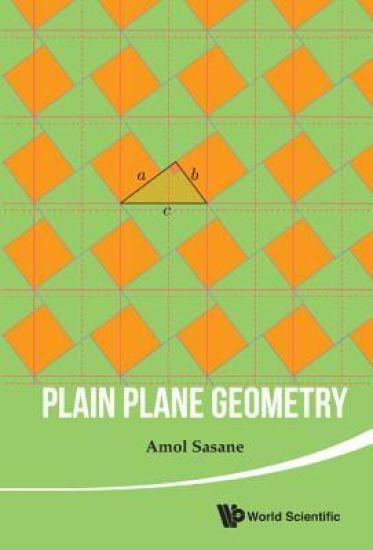
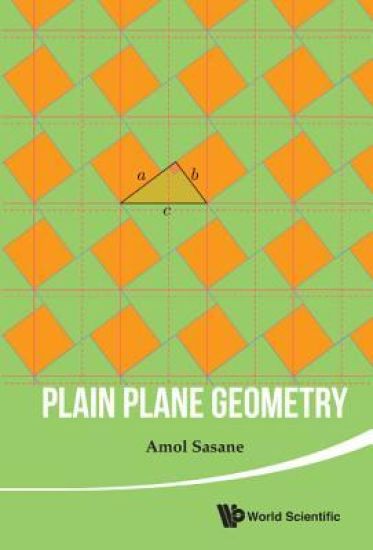
The book constitutes an elementary course on Plane Euclidean Geometry, pitched at pre-university or at advanced high school level. It is a concise book treating the subject axiomatically, but since it is meant to be a first introduction to the subject, excessive rigour is avoided, making it appealing to a younger audience as well. The aim is to cover the basics of the subject, while keeping the subject lively by means of challenging and interesting exercises. This makes it relevant also for students participating in mathematics circles and in mathematics olympiads.Each section contains several problems, which are not purely drill exercises, but are intended to introduce a sense of 'play' in mathematics, and inculcate appreciation of the elegance and beauty of geometric results. There is an abundance of colour pictures illustrating results and their proofs. A section on hints and a further section on detailed solutions to all the exercises appear at the end of the book, making the book ideal also for self-study.
Plain Plane Geometry

Plain Plane Geometry

Amol Sasane

World Scientific Publishing Co Pte Ltd
2016
nidottu
The book constitutes an elementary course on Plane Euclidean Geometry, pitched at pre-university or at advanced high school level. It is a concise book treating the subject axiomatically, but since it is meant to be a first introduction to the subject, excessive rigour is avoided, making it appealing to a younger audience as well. The aim is to cover the basics of the subject, while keeping the subject lively by means of challenging and interesting exercises. This makes it relevant also for students participating in mathematics circles and in mathematics olympiads.Each section contains several problems, which are not purely drill exercises, but are intended to introduce a sense of 'play' in mathematics, and inculcate appreciation of the elegance and beauty of geometric results. There is an abundance of colour pictures illustrating results and their proofs. A section on hints and a further section on detailed solutions to all the exercises appear at the end of the book, making the book ideal also for self-study.
Mathematical Introduction To General Relativity, A

Mathematical Introduction To General Relativity, A

Amol Sasane

WORLD SCIENTIFIC PUBLISHING CO PTE LTD
2025
sidottu
The book aims to give a mathematical presentation of the theory of general relativity (that is, spacetime-geometry-based gravitation theory) to advanced undergraduate mathematics students. Mathematicians will find spacetime physics presented in the definition-theorem-proof format familiar to them. The given precise mathematical definitions of physical notions help avoiding pitfalls, especially in the context of spacetime physics describing phenomena that are counter-intuitive to everyday experiences.In the first part, the differential geometry of smooth manifolds, which is needed to present the spacetime-based gravitation theory, is developed from scratch. Here, many of the illustrating examples are the Lorentzian manifolds which later serve as spacetime models. This has the twofold purpose of making the physics forthcoming in the second part relatable, and the mathematics learnt in the first part less dry. The book uses the modern coordinate-free language of semi-Riemannian geometry. Nevertheless, to familiarise the reader with the useful tool of coordinates for computations, and to bridge the gap with the physics literature, the link to coordinates is made through exercises, and via frequent remarks on how the two languages are related.In the second part, the focus is on physics, covering essential material of the 20th century spacetime-based view of gravity: energy-momentum tensor field of matter, field equation, spacetime examples, Newtonian approximation, geodesics, tests of the theory, black holes, and cosmological models of the universe. Prior knowledge of differential geometry or physics is not assumed. The book is intended for self-study, and the solutions to all the 283 exercises are included.The second edition corrects errors from the first edition, and includes 60 new exercises, 10 new remarks, 29 new figures, some of which cover auxiliary topics that were omitted in the first edition.
Mathematical Introduction To General Relativity, A

Mathematical Introduction To General Relativity, A

Amol Sasane

WORLD SCIENTIFIC PUBLISHING CO PTE LTD
2025
nidottu
The book aims to give a mathematical presentation of the theory of general relativity (that is, spacetime-geometry-based gravitation theory) to advanced undergraduate mathematics students. Mathematicians will find spacetime physics presented in the definition-theorem-proof format familiar to them. The given precise mathematical definitions of physical notions help avoiding pitfalls, especially in the context of spacetime physics describing phenomena that are counter-intuitive to everyday experiences.In the first part, the differential geometry of smooth manifolds, which is needed to present the spacetime-based gravitation theory, is developed from scratch. Here, many of the illustrating examples are the Lorentzian manifolds which later serve as spacetime models. This has the twofold purpose of making the physics forthcoming in the second part relatable, and the mathematics learnt in the first part less dry. The book uses the modern coordinate-free language of semi-Riemannian geometry. Nevertheless, to familiarise the reader with the useful tool of coordinates for computations, and to bridge the gap with the physics literature, the link to coordinates is made through exercises, and via frequent remarks on how the two languages are related.In the second part, the focus is on physics, covering essential material of the 20th century spacetime-based view of gravity: energy-momentum tensor field of matter, field equation, spacetime examples, Newtonian approximation, geodesics, tests of the theory, black holes, and cosmological models of the universe. Prior knowledge of differential geometry or physics is not assumed. The book is intended for self-study, and the solutions to all the 283 exercises are included.The second edition corrects errors from the first edition, and includes 60 new exercises, 10 new remarks, 29 new figures, some of which cover auxiliary topics that were omitted in the first edition.
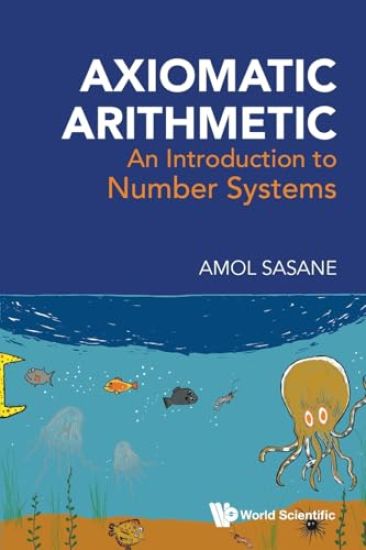
Axiomatic Arithmetic: An Introduction To Number Systems

Axiomatic Arithmetic: An Introduction To Number Systems

Amol Sasane

WORLD SCIENTIFIC PUBLISHING CO PTE LTD
2025
sidottu
The goal of this book is to construct and explore the properties of the most commonly encountered number systems, beginning with the Peano axioms for the natural numbers. The systems discussed include the natural numbers, integers, rational numbers, real numbers, and complex numbers.Along the way, the book covers a range of related topics such as the ring-theoretic properties of integers, Euclid's algorithm, the fundamental theorem of arithmetic, modular arithmetic, and cardinality. It also delves into decimal and continued fraction representations of the reals, the rational zeroes theorem, Liouville's approximation theorem, the extended real number system, and the fundamental theorem of algebra.The book contains 233 exercises with detailed solutions provided at the end, making it well-suited for self-study. These exercises also introduce additional number systems including the quaternions, octonions, and p-adic numbers.The intended audience is first- or second-year undergraduate students in Mathematics or the Applied Sciences who have completed a first course in Calculus. It may also be valuable to school teachers interested in the foundations of algebra and calculus, as well as students in teacher education programs.This book can serve as a supplementary text for introductory courses in real analysis or algebra. It also includes 57 figures to aid understanding throughout.
Axiomatic Arithmetic: An Introduction To Number Systems

Axiomatic Arithmetic: An Introduction To Number Systems

Amol Sasane

WORLD SCIENTIFIC PUBLISHING CO PTE LTD
2025
nidottu
The goal of this book is to construct and explore the properties of the most commonly encountered number systems, beginning with the Peano axioms for the natural numbers. The systems discussed include the natural numbers, integers, rational numbers, real numbers, and complex numbers.Along the way, the book covers a range of related topics such as the ring-theoretic properties of integers, Euclid's algorithm, the fundamental theorem of arithmetic, modular arithmetic, and cardinality. It also delves into decimal and continued fraction representations of the reals, the rational zeroes theorem, Liouville's approximation theorem, the extended real number system, and the fundamental theorem of algebra.The book contains 233 exercises with detailed solutions provided at the end, making it well-suited for self-study. These exercises also introduce additional number systems including the quaternions, octonions, and p-adic numbers.The intended audience is first- or second-year undergraduate students in Mathematics or the Applied Sciences who have completed a first course in Calculus. It may also be valuable to school teachers interested in the foundations of algebra and calculus, as well as students in teacher education programs.This book can serve as a supplementary text for introductory courses in real analysis or algebra. It also includes 57 figures to aid understanding throughout.