Kirjahaku
Etsi kirjoja tekijän nimen, kirjan nimen tai ISBN:n perusteella.
12 kirjaa tekijältä Amy C. Edmondson
New breakthrough thinking in organizational learning, leadership, and change Continuous improvement, understanding complex systems, and promoting innovation are all part of the landscape of learning challenges today's companies face. Amy Edmondson shows that organizations thrive, or fail to thrive, based on how well the small groups within those organizations work. In most organizations, the work that produces value for customers is carried out by teams, and increasingly, by flexible team-like entities. The pace of change and the fluidity of most work structures means that it's not really about creating effective teams anymore, but instead about leading effective teaming. Teaming shows that organizations learn when the flexible, fluid collaborations they encompass are able to learn. The problem is teams, and other dynamic groups, don't learn naturally. Edmondson outlines the factors that prevent them from doing so, such as interpersonal fear, irrational beliefs about failure, groupthink, problematic power dynamics, and information hoarding. With Teaming, leaders can shape these factors by encouraging reflection, creating psychological safety, and overcoming defensive interpersonal dynamics that inhibit the sharing of ideas. Further, they can use practical management strategies to help organizations realize the benefits inherent in both success and failure. Presents a clear explanation of practical management concepts for increasing learning capability for business resultsIntroduces a framework that clarifies how learning processes must be altered for different kinds of workExplains how Collaborative Learning works, and gives tips for how to do it wellIncludes case-study research on Intermountain healthcare, Prudential, GM, Toyota, IDEO, the IRS, and both Cincinnati and Minneapolis Children's Hospitals, among others Based on years of research, this book shows how leaders can make organizational learning happen by building teams that learn.

In a broad sense Design Science is the grammar of a language of images rather than of words. Modern communication techniques enable us to transmit and reconstitute images without the need of knowing a specific verbal sequential language such as the Morse code or Hungarian. International traffic signs use international image symbols which are not specific to any particular verbal language. An image language differs from a verbal one in that the latter uses a linear string of symbols, whereas the former is multidimensional. Architectural renderings commonly show projections onto three mutually perpendicular planes, or consist of cross sections at differ ent altitudes representing a stack of floor plans. Such renderings make it difficult to imagine buildings containing ramps and other features which disguise the separation between floors; consequently, they limit the creativity of the architect. Analogously, we tend to analyze natural structures as if nature had used similar stacked renderings, rather than, for instance, a system of packed spheres, with the result that we fail to perceive the system of organization determining the form of such structures.
Innovation requires teaming. (Put another way, teaming is to innovation what assembly lines are to car production.) This book brings together key insights on teaming, as they pertain to innovation. How do you build a culture of innovation? What does that culture look like? How does it evolve and grow? How are teams most effectively created and then nurtured in this context? What is a leader's role in this culture? This little book is a roadmap for teaming to innovate. We describe five necessary steps along that road: Aim High, Team Up, Fail Well, Learn Fast, and Repeat. This path is not smooth. To illustrate each critical step, we look at real-life scenarios that show how teaming to innovate provides the spark that can fertilize creativity, clarify goals, and redefine the meaning of leadership.

Conquer the most essential adaptation to the knowledge economy The Fearless Organization: Creating Psychological Safety in the Workplace for Learning, Innovation, and Growth offers practical guidance for teams and organizations who are serious about success in the modern economy. With so much riding on innovation, creativity, and spark, it is essential to attract and retain quality talent—but what good does this talent do if no one is able to speak their mind? The traditional culture of "fitting in" and "going along" spells doom in the knowledge economy. Success requires a continuous influx of new ideas, new challenges, and critical thought, and the interpersonal climate must not suppress, silence, ridicule or intimidate. Not every idea is good, and yes there are stupid questions, and yes dissent can slow things down, but talking through these things is an essential part of the creative process. People must be allowed to voice half-finished thoughts, ask questions from left field, and brainstorm out loud; it creates a culture in which a minor flub or momentary lapse is no big deal, and where actual mistakes are owned and corrected, and where the next left-field idea could be the next big thing. This book explores this culture of psychological safety, and provides a blueprint for bringing it to life. The road is sometimes bumpy, but succinct and informative scenario-based explanations provide a clear path forward to constant learning and healthy innovation. Explore the link between psychological safety and high performanceCreate a culture where it’s “safe” to express ideas, ask questions, and admit mistakesNurture the level of engagement and candor required in today’s knowledge economyFollow a step-by-step framework for establishing psychological safety in your team or organization Shed the "yes-men" approach and step into real performance. Fertilize creativity, clarify goals, achieve accountability, redefine leadership, and much more. The Fearless Organization helps you bring about this most critical transformation.

Supercharge your teamwork skills in just three months with expert advice from an industry leader In 90 Days to Level Up Your Teamwork, bestselling author Amy Edmondson teaches you how to become a better team player by focusing on a specific element of cooperative achievement each week. From overcoming barriers to creating psychological safety, this book walks you through exactly how to develop your teamwork skills, one step at a time. Inside you'll find: A crystal-clear, week-by-week roadmap to help you improve your teamwork skillsPractical tasks and actionable steps you can apply immediately to become a better teammateThoughtful prompts to help you think about how what you've learned applies to your own career If you're ready to transform your career and achieve your goals in just one quarter, the 90 Days to Level Up series is for you. Whether you're brand-new to a business, stepping into a leadership role for the first time, or looking to enhance your skills, this series will be your personal guide to unlocking your potential and reaching new professional heights.
Conquer the most essential adaptation to the knowledge economy The Fearless Organization: Creating Psychological Safety in the Workplace for Learning, Innovation, and Growth offers practical guidance for teams and organizations who are serious about success in the modern economy. With so much riding on innovation, creativity, and spark, it is essential to attract and retain quality talent—but what good does this talent do if no one is able to speak their mind? The traditional culture of "fitting in" and "going along" spells doom in the knowledge economy. Success requires a continuous influx of new ideas, new challenges, and critical thought, and the interpersonal climate must not suppress, silence, ridicule or intimidate. Not every idea is good, and yes there are stupid questions, and yes dissent can slow things down, but talking through these things is an essential part of the creative process. People must be allowed to voice half-finished thoughts, ask questions from left field, and brainstorm out loud; it creates a culture in which a minor flub or momentary lapse is no big deal, and where actual mistakes are owned and corrected, and where the next left-field idea could be the next big thing. This book explores this culture of psychological safety, and provides a blueprint for bringing it to life. The road is sometimes bumpy, but succinct and informative scenario-based explanations provide a clear path forward to constant learning and healthy innovation. Explore the link between psychological safety and high performanceCreate a culture where it’s “safe” to express ideas, ask questions, and admit mistakesNurture the level of engagement and candor required in today’s knowledge economyFollow a step-by-step framework for establishing psychological safety in your team or organization Shed the "yes-men" approach and step into real performance. Fertilize creativity, clarify goals, achieve accountability, redefine leadership, and much more. The Fearless Organization helps you bring about this most critical transformation.

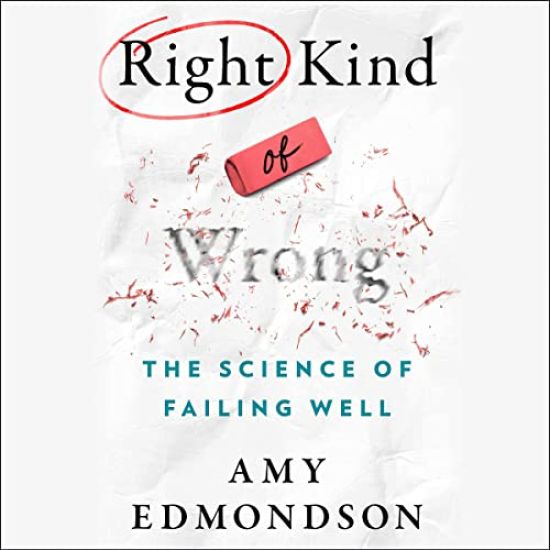
A revolutionary guide that will transform your relationship with failure, from the pioneering researcher of psychological safety and award-winning Harvard Business School professor Amy Edmondson.We used to think of failure as the opposite of success. Now, we're often torn between two failure cultures: one that says to avoid failure at all costs, the other that says to fail fast, fail often. The trouble is that both approaches lack the crucial distinctions to help us separate good failure from bad. As a result, we miss the opportunity to fail well.After decades of award-winning research, Amy Edmondson is here to upend our understanding of failure and make it work for us. In Right Kind of Wrong, Edmondson provides the framework to think, discuss, and practice failure wisely.Outlining the three archetypes of failure--simple, complex, and intelligent--Amy showcases how to minimize unproductive failure while maximizing what we gain from flubs of all stripes. She illustrates how we and our organizations can embrace our human fallibility, learn exactly when failure is our friend, and prevent most of it when it is not. This is the key to pursuing smart risks and preventing avoidable harm.With vivid, real-life stories from business, pop culture, history, and more, Edmondson gives us specifically tailored practices, skills, and mindsets to help us replace shame and blame with curiosity, vulnerability, and personal growth. You'll never look at failure the same way again.
Right Kind of Wrong: The Science of Failing Well
Amy C. Edmondson
Simon Element / Simon Acumen
2023
sidottu
Winner of the Financial Times and Schroders Business Book of the Year 2023 A Behavioral Scientist Notable Book of 2023 A revolutionary guide that will transform your relationship with failure, from the pioneering researcher of psychological safety and award-winning Harvard Business School professor Amy Edmondson. We used to think of failure as the opposite of success. Now, we're often torn between two "failure cultures" one that says to avoid failure at all costs, the other that says fail fast, fail often. The trouble is that both approaches lack the crucial distinctions to help us separate good failure from bad. As a result, we miss the opportunity to fail well. After decades of award-winning research, Amy Edmondson is here to upend our understanding of failure and make it work for us. In Right Kind of Wrong, Edmondson provides the framework to think, discuss, and practice failure wisely. Outlining the three archetypes of failure--basic, complex, and intelligent--Amy showcases how to minimize unproductive failure while maximizing what we gain from flubs of all stripes. She illustrates how we and our organizations can embrace our human fallibility, learn exactly when failure is our friend, and prevent most of it when it is not. This is the key to pursuing smart risks and preventing avoidable harm. With vivid, real-life stories from business, pop culture, history, and more, Edmondson gives us specifically tailored practices, skills, and mindsets to help us replace shame and blame with curiosity, vulnerability, and personal growth. You'll never look at failure the same way again.