Kirjojen hintavertailu. Mukana 11 244 527 kirjaa ja 12 kauppaa.

Kirjahaku

Etsi kirjoja tekijän nimen, kirjan nimen tai ISBN:n perusteella.

4 kirjaa tekijältä Amy Clampitt

The Collected Poems of Amy Clampitt

The Collected Poems of Amy Clampitt

Amy Clampitt

Knopf Publishing Group
1999
nidottu
Now, for the first time, Clammpitt's five poetry collections are brought together in a single volume, allowing us to experience anew the distinctiveness of her voice: the brilliant language--an appealing mix of formal and everyday expression--that poured out with such passion and was shaped in rhythms and patterns entirely her own. - With a foreword by Mary Jo Salter The Collected Poems offers us a chance to consider freshly the breadth of Amy Clampitt's vision and poetic achievement. It is a volume that her many admirers will treasure and that will provide a magnificent introduction for a new generation of readers. When Amy Clampitt's first book of poems, The Kingfisher, was published in January 1983, the response was jubilant. The poet was sixty-three years old, and there had been no debut like hers in recent memory. "A dance of language," said May Swenson. "A genius for places," wrote J. D. McClatchy, and the New York Times Book Review said, "With the publication of her brilliant first book, Clampitt immediately merits consideration as one of the most distinguished contemporary poets." She went on to publish four more collections in the next eleven years, the last one, A Silence Opens, appearing in the year she died. Amy Clampitt's themes are the very American ones of place and displacement. She, like her pioneer ancestors, moved frequently, but she wrote with lasting and deep feeling about all sorts of landscapes--the prairies of her Iowa childhood, the fog-wrapped coast of Maine, and places she visited in Europe, from the western isles of Scotland to Italy's lush countryside. She lived most of her adult life in New York City, and many of her best-known poems, such as "Times Square Water Music" and "Manhattan Elegy," are set there. She did not hesitate to take on the larger upheavals of the twentieth century--war, Holocaust, exile--and poems like "The Burning Child" and "Sed de Correr" remind us of the dark nightmare lurking in the interstices of our daily existence. It is impossible to speak of Amy Clampitt's poetry without mentioning her immense, lifelong love of birds and wildflowers, a love that produced some of her most profound images--like the kingfisher's "burnished plunge, the color / of felicity afire," which came "glancing like an arrow / through landscapes of untended memory" to remind her of the uninhabitable sorrow of an affair gone wrong; or the sun underfoot among the sundews, "so dazzling / . . . that, looking, / you start to fall upward."
Love, Amy

Love, Amy

Amy Clampitt

Columbia University Press
2005
sidottu
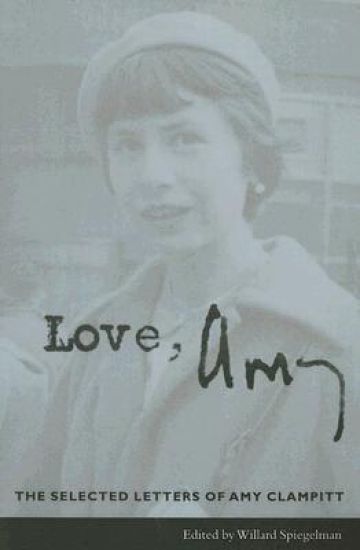
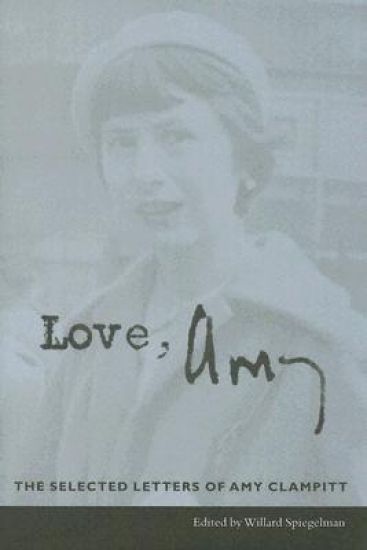
This extraordinary collection of letters sheds light on one of the most important postwar American poets and on a creative woman's life from the 1950s onward. Amy Clampitt was an American original, a literary woman from a Quaker family in rural Iowa who came to New York after college and lived in Manhattan for almost forty years before she found success (or before it found her) at the age of 63 with the publication of The Kingfisher. Her letters from 1950 until her death in 1994 are a testimony to her fiercely independent spirit and her quest for various kinds of truth-religious, spiritual, political, and artistic. Written in clear, limpid prose, Clampitt's letters illuminate the habits of imagination she would later use to such effect in her poetry. She offers, with wit and intelligence, an intimate and personal portrait of life as an independent woman recently arrived in New York City. She recounts her struggle to find a place for herself in the world of literature as well as the excitement of living in Manhattan. In other letters she describes a religious conversion (and then a gradual religious disillusionment) and her work as a political activist. Clampitt also reveals her passionate interest in and fascination with the world around her. She conveys her delight in a variety of day-to-day experiences and sights, reporting on trips to Europe, the books she has read, and her walks in nature. After struggling as a novelist, Clampitt turned to poetry in her fifties and was eventually published in the New Yorker. In the last decade of her life she appeared like a meteor on the national literary scene, lionized and honored. In letters to Helen Vendler, Mary Jo Salter, and others, she discusses her poetry as well as her surprise at her newfound success and the long overdue satisfaction she obviously felt, along with gratitude, for her recognition.
Love, Amy

Love, Amy

Amy Clampitt

Columbia University Press
2007
pokkari
This extraordinary collection of letters sheds light on one of the most important postwar American poets and on a creative woman's life from the 1950s onward. Amy Clampitt was an American original, a literary woman from a Quaker family in rural Iowa who came to New York after college and lived in Manhattan for almost forty years before she found success (or before it found her) at the age of 63 with the publication of The Kingfisher. Her letters from 1950 until her death in 1994 are a testimony to her fiercely independent spirit and her quest for various kinds of truth-religious, spiritual, political, and artistic. Written in clear, limpid prose, Clampitt's letters illuminate the habits of imagination she would later use to such effect in her poetry. She offers, with wit and intelligence, an intimate and personal portrait of life as an independent woman recently arrived in New York City. She recounts her struggle to find a place for herself in the world of literature as well as the excitement of living in Manhattan. In other letters she describes a religious conversion (and then a gradual religious disillusionment) and her work as a political activist. Clampitt also reveals her passionate interest in and fascination with the world around her. She conveys her delight in a variety of day-to-day experiences and sights, reporting on trips to Europe, the books she has read, and her walks in nature. After struggling as a novelist, Clampitt turned to poetry in her fifties and was eventually published in the New Yorker. In the last decade of her life she appeared like a meteor on the national literary scene, lionized and honored. In letters to Helen Vendler, Mary Jo Salter, and others, she discusses her poetry as well as her surprise at her newfound success and the long overdue satisfaction she obviously felt, along with gratitude, for her recognition.
Predecessors, Et Cetera

Predecessors, Et Cetera

Amy Clampitt

The University of Michigan Press
1991
nidottu
Predecessors, Et Cetera collects Amy Clampitt’s reflections on her predecessors (the poets Donne, Wordsworth, Dickinson, Frost, Eliot, and Marianne Moore as well as the novelists Henry James and Edith Wharton) and her contemporaries (including James Merrill, Anthony Hecht, Howard Moss, Thomas McGrath, John Berryman, Stevie Smith, and Seamus Heaney) and reveals the intricate connections inherent in their art. Other essays include “Purloined Sincerity,” which examines the fate of the personal letter in these days of electronic communication, and “The Long, Long Wait,” which looks at the epistles of St. Paul to the Thessalonians. Along the way she offers ruminations on the poet’s craft, the vagaries of reputation, and the perennial question of what makes a poet – or any writer – tick.