Kirjojen hintavertailu. Mukana 11 244 527 kirjaa ja 12 kauppaa.

Kirjahaku

Etsi kirjoja tekijän nimen, kirjan nimen tai ISBN:n perusteella.

3 kirjaa tekijältä Anat Ninio

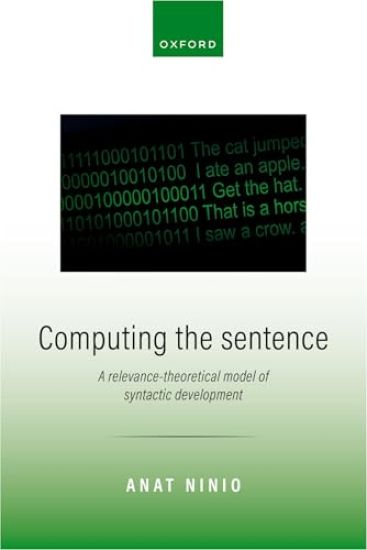
Computing the Sentence

Computing the Sentence

Anat Ninio

Oxford University Press
2025
sidottu
Developmental research is abandoning formal syntax, probably because Chomskyan generative syntax lacks psychological reality. Some studies opt for pure statistics-based definitions of syntactic knowledge, as if humans were similar to Large Language Models of AI and had no structurally meaningful concepts of syntactic relations. Others tend to Constructivist syntax, where patterns of elements are said to possess associated semantic meaning. The problem is that the core syntactic relations that young children acquire, such as verb-object and verb-subject combinations, do not possess particular associated semantics, meaning that the Constructivist approach is not a helpful vehicle for understanding syntactic acquisition. In this book, Anat Ninio approaches syntactic development from a novel point of view, within the framework of Relevance Theory, a theory of pragmatics with a strong commitment to a cognitive conceptualization of linguistic competence. This theory's architecture of linguistic information acknowledges the existence of procedural instructions as part of the content of words, covering various processing acts, including syntactic combination. Methodologically, the study employs computer programming algorithms as heuristic models for the cognitive combinatory processes of syntax, computer programs being a close analogue to mental plans for solving computational problems. The unusual framework and methodology adopted in the book represent a break with current approaches in developmental psycholinguistics and perhaps even with the teachings of mainstream linguistics. The first part of the book proposes a procedural syntax of the central patterns of English, covering argument-structure constructions, phrasal and clausal combinations of function words and content words, wh-questions, relative clauses, and coordination and gapping. This modelling resolves significant issues that have been eluding linguistic theory for decades. The second part of the book describes the development of certain syntactic procedures in English-speaking children, employing a microgenetic analysis to demonstrate that syntactic learning is guesswork by trial and error. Despite the apparent chaos, the many different attempts that children make to arrive at some syntactic construct belong to a single learning process, and gradually converge on the adult algorithm. Defining syntax in terms of combinatory procedures provides a novel perspective on our 'predictive brain', on language structure, and on cross-linguistic variation.
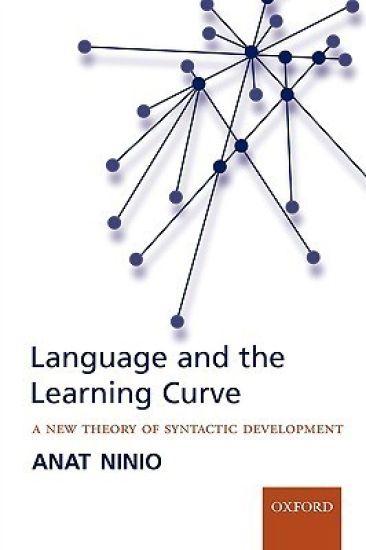
Language and the Learning Curve

Language and the Learning Curve

Anat Ninio

Oxford University Press
2006
sidottu
Language development remains one of the most hotly debated topics in the cognitive sciences. In recent years we have seen contributions to the debate from researchers in psychology, linguistics, artificial intelligence, and philosophy, though there have been surprisingly few interdisciplinary attempts at unifying the various theories. In Language and the Learning Curve, a leading researcher in the field offers a radical new view of language development. Drawing on formal linguistic theory (the Minimalist Program, Dependency Grammars), cognitive psychology (skill learning) computational linguistics (Zipf curves), and Complexity Theory (networks), it takes the view that syntactic development is a simple process and that syntax can be learned just like any other cognitive or motor skill. In a thought provoking and accessible style, it develops a learning theory of the acquisition of syntax that builds on the contribution of the different source theories in a detailed and explicit manner. Each chapter starts by laying the relevant theoretical background, before examining empirical data on child language acquisition. The result is a bold new theory of the acquisition of syntax, unusual in its combination of Chomskian linguistics and learning theory. Language and the Learning Curve is an important new work that challenges many of our usual assumptions about syntactic development.
Language and the Learning Curve

Language and the Learning Curve

Anat Ninio

Oxford University Press
2006
nidottu
Language development remains one of the most hotly debated topics in the cognitive sciences. In recent years we have seen contributions to the debate from researchers in psychology, linguistics, artificial intelligence, and philosophy, though there have been surprisingly few interdisciplinary attempts at unifying the various theories. In Language and the Learning Curve, a leading researcher in the field offers a radical new view of language development. Drawing on formal linguistic theory (the Minimalist Program, Dependency Grammars), cognitive psychology (Skill Learning) computational linguistics (Zipf curves), and Complexity Theory (networks), it takes the view that syntactic development is a simple process and that syntax can be learned just like any other cognitive or motor skill. In a thought provoking and accessible style, it develops a learning theory of the acquisition of syntax that builds on the contribution of the different source theories in a detailed and explicit manner. Each chapter starts by laying the relevant theoretical background, before examining empirical data on child language acquisition. The result is a bold new theory of the acquisition of syntax, unusual in its combination of Chomskian linguistics and learning theory. Language and the Learning Curve is an important new work that challenges many of our usual assumptions about syntactic development.