Kirjojen hintavertailu. Mukana 11 627 067 kirjaa ja 12 kauppaa.

Kirjahaku

Etsi kirjoja tekijän nimen, kirjan nimen tai ISBN:n perusteella.

2 kirjaa tekijältä Anderson Chris

Style as Argument

Style as Argument

Anderson Chris

SOUTHERN ILLINOIS UNIVERSITY PRESS
2006
sidottu
Taking the position that style has a value in its own right, that language forms a major component of the story a nonfiction writer has to tell, Anderson analyzes the work of America s foremost practitioners of New JournalismTom Wolfe, Truman Capote, Norman Mailer, and Joan Didion.Anderson does for nonfiction what insightful critics have long been doing for fiction and poetry. His approach is rhetorical, and his message is that the rhetoric of Wolfe, Capote, Mailer, and Didion is a direct response to the problem of trying to convey to a general audience the sublime, inexplicable, or private and intuitive experiences that conventional rhetoric cannot evoke.The emphasis in this book is on style, not genre, and the analysis characterizes the distinctive styles of four American writers, showing how the richness and complexity of their prose discloses an important argument about the value of language itself. Their prose is complex, nuanced, layered, affecting, always aware of itself as style. This self-consciousness, Anderson contends, prepares the reader to regard style as argument, a tacit but powerful statement about the value of form as form, style as style. "
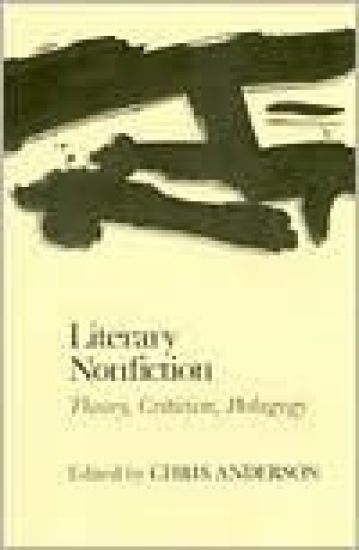
Literary Nonfiction

Literary Nonfiction

Anderson Chris

SOUTHERN ILLINOIS UNIVERSITY PRESS
2006
sidottu
Recognizing nonfiction as something of intrinsic value, Chris Anderson calls on writing teachers who are also literature teachers and literary critics who also work in composition to study the styles and forms of literary nonfiction. Each essayist shares Anderson s views of nonfiction prose as crossing genre and discipline boundaries.In Part I: Readings, contributors examine seven nonfiction authors from different critical methodologies. These include aesthetic analysis, linguistic, rhetorical, formalist, psychoanalytical, feminist, and deconstructionist approaches. Richard Selzer, Stephen Crane, and George Orwell are among the writers examined. These essays provide not only a grammar of critical approaches to nonfiction but also offer introductions to several of the major nonfiction writers of this century.The genre and theory questions raised in Part I, particularly problems of definition and boundary of literary nonfiction, are reviewed in Part II: Generalizations and Definitions. Carl H. Klaus looks at how essayists themselves conceived and refined the essay form and what this tells us about the nature of this type of prose. Klaus points out that "essay" has been a very slippery term, both historically and theoretically. As Peter Elbow examines the prose of Gretel Ehrlich and Richard Selzer, he explores how we account for the literary quality of voice in nonfiction and what this says about the nature of voice.In Part III: Implications for Pedagogy, five contributors, including Jim W. Corder and Chris Anderson, show how the theories expressed in the earlier essays can be applied to the classroom. All of the contributors argue that literary nonfiction, by its nature, reveals the complexity, power, and rhetorical possibilities of languageand that this ought to be the unifying concern of rhetoric and composition as a discipline."