Kirjojen hintavertailu. Mukana 11 717 486 kirjaa ja 12 kauppaa.

Kirjahaku

Etsi kirjoja tekijän nimen, kirjan nimen tai ISBN:n perusteella.

4 kirjaa tekijältä André Authier

Dynamical Theory of X-Ray Diffraction

Dynamical Theory of X-Ray Diffraction

André Authier

Oxford University Press
2003
nidottu
The dynamical theory of diffraction has witnessed exciting developments since the advent of synchroton radiation. This book provides an up-to-date account of the theory of diffraction and its applications. The first part serves as an introduction to the subject, presenting early developments and the basic results. It is followed by a detailed development of the diffraction and propagation properties of x-rays in perfect crystals and by an extension of the theory to the case of slightly and highly deformed crystals. The last part gives three applications of the theory: X-ray optics for synchroton radiation, locations of atoms at surfaces, and X-ray diffraction topography. The book is richly illustrated and contains a wide range of references to the literature. It will be a most useful reference work for graduate students, lecturers and researchers.
Dynamical Theory of X-Ray Diffraction

Dynamical Theory of X-Ray Diffraction

André Authier

Oxford University Press
2001
sidottu
The dynamical theory of diffraction has witnessed exciting developments since the advent of synchrotron radiation. The present book is an up-to-date account of the theory of diffraction and its applications. The first part serves as an introduction to the subject, presenting the early developments and the basic results. It is followed by a detailed development of the diffraction and propagation properties of x-rays in perfect crystals and by an extension of the theory to the case of slightly and highly deformed crystals. The last part gives three applications of the theory: X-ray optics for synchrotron radiation, locations of atoms at surfaces, and X-ray diffraction topography. The book is richly illustrated and contains a wide range of references to the literature. It will be a useful reference work for graduate students, lecturers, and researchers.
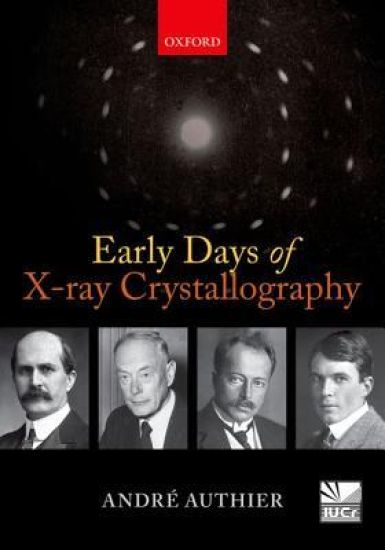
Early Days of X-ray Crystallography

Early Days of X-ray Crystallography

André Authier

Oxford University Press
2015
nidottu
The year 2012 marked the centenary of one of the most significant discoveries of the early twentieth century, the discovery of X-ray diffraction (March 1912, by Laue, Friedrich and Knipping) and of Bragg's law (November 1912). The discovery of X-ray diffraction confirmed the wave nature of X-rays and the space-lattice hypothesis. It had two major consequences: the analysis of the structure of atoms, and the determination of the atomic structure of materials. This had a momentous impact in chemistry, physics, mineralogy, material science, biology and X-ray spectroscopy. The book relates the discovery itself, the early days of X-ray crystallography, and the way the news of the discovery spread round the world. It explains how the first crystal structures were determined by William Bragg and his son Lawrence, and recounts which were the early applications of X-ray crystallography in chemistry, mineralogy, materials science, physics, biological sciences and X-ray spectroscopy. It also tells how the concept of space lattice developed since ancient times up to the nineteenth century, and how our conception of the nature of light has changed over time. The contributions of the main actors of the story, prior to the discovery, at the time of the discovery and immediately afterwards, are described through their writings and are put into the context of the time, accompanied by brief biographical details. This thoroughly researched account on the multiple faces of a scientific specialty, X-ray crystallography, is aimed both at the scientists, who rarely subject the historical material of past discoveries in their field to particular scrutiny with regard to the historical details and at the historians of science who often lack the required expert knowledge to scrutinize the involved technical content in sufficient depth (M. Eckert - Metascience).
Early Days of X-ray Crystallography

Early Days of X-ray Crystallography

André Authier

Oxford University Press
2013
sidottu
2012 marked the centenary of one of the most significant discoveries of the early twentieth century, the discovery of X-ray diffraction (March 1912, by Laue, Friedrich, and Knipping) and of Bragg's law (November 1912). The discovery of X-ray diffraction confirmed the wave nature of X-rays and the space-lattice hypothesis. It had two major consequences: the analysis of the structure of atoms, and the determination of the atomic structure of materials. The momentous impact of the discovery in the fields of chemistry, physics, mineralogy, material science, biochemistry and biotechnology has been recognized by the General Assembly of the United Nations by establishing 2014 as the International Year of Crystallography. This book relates the discovery itself, the early days of X-ray crystallography, and the way the news of the discovery spread round the world. It explains how the first crystal structures were determined, and recounts which were the early applications of X-ray crystallography. It also tells how the concept of space lattice has developed since ancient times, and how our understanding of the nature of light has changed over time. The contributions of the main actors of the story, prior to the discovery, at the time of the discovery and immediately afterwards, are described through their writings and are put into the context of the time, accompanied by brief biographical details.