Kirjojen hintavertailu. Mukana 11 342 296 kirjaa ja 12 kauppaa.

Kirjahaku

Etsi kirjoja tekijän nimen, kirjan nimen tai ISBN:n perusteella.

6 kirjaa tekijältä Andre Furlani

Guy Davenport

Guy Davenport

Andre Furlani

Northwestern University Press
2007
sidottu
Guy Davenport (1927-2005), an American writer of fiction, poetry, criticism, and essays, a translator, painter, intellectual, and teacher, brought a breadth and depth of knowledge to his pursuits that few other writers could approach, let alone appraise. In Andre Furlani, this twentieth-century American master has finally found an apt critical reader. In this first sustained critical study of Davenport, Furlani elucidates the depths of Davenport's fiction and its poetic precedents, brings a rare understanding to the author's reworking of twentieth-century literature and intellectual history, and offers unusual insight into his compositional technique. Furlani explores key themes across the spectrum of Davenport's fiction: pastoral utopia; twentieth-century dystopia; sexual ethics; the mythologizing of childhood; the inseparability of the archaic and the modern; and a celebration of the union of sophia, eros, and poesia. Whether Davenport's view of art and the cosmos should be called ""postmodern"" is a question that Furlani considers closely - offering, finally, a new aesthetic for this American original who, in these pages, at last receives the thorough and meticulous attention he has long merited.

Guy Davenport

Guy Davenport

Andre Furlani

Northwestern University Press
2007
nidottu
Guy Davenport (1927-2005), an American writer of fiction, poetry, criticism, and essays, a translator, painter, intellectual, and teacher, brought a breadth and depth of knowledge to his pursuits that few other writers could approach, let alone appraise. In Andre Furlani, this twentieth-century American master has finally found an apt critical reader. In this first sustained critical study of Davenport, Furlani elucidates the depths of Davenport's fiction and its poetic precedents, brings a rare understanding to the author's reworking of twentieth-century literature and intellectual history, and offers unusual insight into his compositional technique. Furlani explores key themes across the spectrum of Davenport's fiction: pastoral utopia; twentieth-century dystopia; sexual ethics; the mythologizing of childhood; the inseparability of the archaic and the modern; and a celebration of the union of sophia, eros, and poesia. Whether Davenport's view of art and the cosmos should be called ""postmodern"" is a question that Furlani considers closely - offering, finally, a new aesthetic for this American original who, in these pages, at last receives the thorough and meticulous attention he has long merited.

Beckett after Wittgenstein

Beckett after Wittgenstein

Andre Furlani

Northwestern University Press
2015
nidottu
Among the best-represented authors in Samuel Beckett’s library was Ludwig Wittgenstein, yet the philosopher’s relevance to the Nobel laureate’s work is scarcely acknowledged and seldom elucidated. Beckett after Wittgenstein is the first book to examine Beckett’s formative encounters with, and profound affinities to, Wittgenstein’s thought, style, and character.While a number of influential critics, including the philosopher Alain Badiou, have discerned a transition in Beckett’s work beginning in the late 1950s, Furlani is the first to identify and clarify how this change occurs in conjunction with the writer’s sustained engagement with Wittgenstein’s thought on, for example, language, cognition, subjectivity, alterity, temporality, belief, hermeneutics, logic, and perception. Drawing on a wealth of Beckett’s archival materials, much of it unpublished, Furlani’s study reveals the extent to which Wittgenstein fostered Beckett’s views and emboldened his purposes.
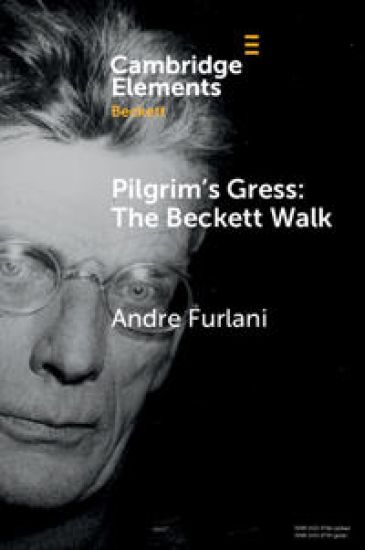
Pilgrim's Gress: The Beckett Walk

Pilgrim's Gress: The Beckett Walk

Andre Furlani

Cambridge University Press
2025
pokkari
Walking is a determining trope and structure in Samuel Beckett's oeuvre, furnishing a textual and performance figure, a framing device, and a material practice. The walk begins as a motif, becomes a rhythm, expands into a compositional principle, and culminates in an ontology -- a defining means by which his characters are cognitively embodied and by which meaning is grounded. The book contends that Beckett's literary pedestrianism involve passage from an evasive and narcissistic vestige of Romanticism and a solipsistic variation on Edwardian autonomy to an embrace of mutuality and transitory being: life not as a network of stations so much as a meshwork of ways, peripatetic coming and going as the basis of human possibility and ethical value. The study examines the Beckett walk with reference to, for instance, cognitive theory, materialities theory, environmental studies, infrastructure theory, cultural and literary history, speech-act theory, mobility studies and performance studies.
Pilgrim's Gress: The Beckett Walk

Pilgrim's Gress: The Beckett Walk

Andre Furlani

Cambridge University Press
2025
sidottu
Walking is a determining trope and structure in Samuel Beckett's oeuvre, furnishing a textual and performance figure, a framing device, and a material practice. The walk begins as a motif, becomes a rhythm, expands into a compositional principle, and culminates in an ontology -- a defining means by which his characters are cognitively embodied and by which meaning is grounded. The book contends that Beckett's literary pedestrianism involve passage from an evasive and narcissistic vestige of Romanticism and a solipsistic variation on Edwardian autonomy to an embrace of mutuality and transitory being: life not as a network of stations so much as a meshwork of ways, peripatetic coming and going as the basis of human possibility and ethical value. The study examines the Beckett walk with reference to, for instance, cognitive theory, materialities theory, environmental studies, infrastructure theory, cultural and literary history, speech-act theory, mobility studies and performance studies.
Walking and the Pedestrian in Literature and Social Practice
Lively, adventurous and comprehensive, this book offers a fascinating account of the contemporary culture of pedestrianism and serves as both investigation and celebration of walking and its literature.Pedestrians have joined the forward ranks of current political debate, social thought and aesthetic practice, with consequences that this book illuminates in literature, art, digital culture and political life from around the globe. Ingeniously structured around the root word 'gress', chapters move through ingress, egress, progress, regress, aggress, congress, digress, transgress and gress itself to touch on matters as diverse as walking as a political and activist activity; notions of pilgrimage; matters of race and indigineity; animal studies; environmental studies; and digital culture. Extraordinarily comprehensive in its coverage, it examines works by writers including W G Sebald; Anne Carson; Chinua Achebe; Cormac McCarthy; Jamaica Kincaid; Paul Celan; Arundhati Roy; Norman Mailer and many more.While its subject is as timeless as the Pliocene footprints preserved in the tuff of Laetoli it is also as timely as lockdown, social distancing, pedestrian-repurposed commercial streets and the anti-racism marches. It demonstrates the scale, diversity and impact of the extensive contemporary walking literature and art in the context of the social forces and politics this resurgence enables.