Kirjojen hintavertailu. Mukana 11 699 587 kirjaa ja 12 kauppaa.

Kirjahaku

Etsi kirjoja tekijän nimen, kirjan nimen tai ISBN:n perusteella.

4 kirjaa tekijältä Andrea L. Bonnicksen

In Vitro Fertilization

In Vitro Fertilization

Andrea L. Bonnicksen

Columbia University Press
1991
pokkari
Few recent technologies have attracted as much attention as In Vitro Fertilization (IVF), a technique in which ova are fertilized in a glass dish and transferred to the prospective mother. Despite a large body of literature and much recent publicity on the ethics of new re-productive technologies, however, we are far from understanding what actually goes on in the nation's 138 in vitro fertilization centers, and even farther from possessing a clear public policy regarding this controversial technology. In this book the author examines two different, and often opposing worlds of in vitro fertilization: the public's political, legal and ethical concerns surrounding the technique, and the personal, pragmatic world of the individual patients who come to the centers seeding a cure for infertility. The crux of this analysis revolves around the intersection, and sometimes the antagonism, between these two worlds. While use of the centers is growing extremely fast, there is an absence of any federal-level policy to monitor this technique. To fill this vacuum, individual practitioners of IVF and other new reproductive technologies. The author investigates the current effects of these guidelines in interviews with physicians, scientists, policy makers, and patients at IVF centers, and argues that in this case, the public policy we implement should take its direction from the self-regulation that is already occurring on a local level and which is so well-developed that it has in effect taken the place of a formal federal policy. For all those interested in, or contemplating the rapidly growing field of in vitro fertilization, this is an objective analysis which answers many perplexing questions.

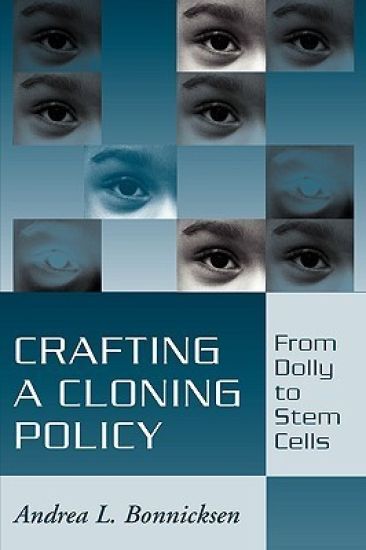
Crafting a Cloning Policy

Crafting a Cloning Policy

Andrea L. Bonnicksen

Georgetown University Press
2002
pokkari
Ever since Dolly, the Scottish lamb, tottered on wobbly legs into our consciousness - followed swiftly by other animals: first, mice; then pigs that may provide human transplants, and even an ordinary house cat - thoughts have flown to the cloning of human beings. Legislators rushed to propose a ban on a technique that remains highly hypothetical, although some independent researchers have announced their determination to pursue the possibilities. Political scientist and well-known expert on reproductive issues, Andrea L. Bonnicksen examines the political reaction to this new-born science and the efforts to construct cloning policy. She also looks at issues that relate to stem cell research, its even newer sibling, and poses a key question: How does the response to Dolly guide us as we manage innovative reproductive technologies in the future? Various legislative endeavors and the efforts by the Food and Drug Administration (FDA) to oversee cloning, as well as policy models related to federal funding, individual state laws, and programs abroad, inform Bonnicksen's identification of four types of cloning policy. She analyzes in depth the roles of diverse interest groups as each struggle to become the dominant voice in the decision-making process. With skill and insight, she clears the mists from a complicated topic, and addresses the legal, political, and ethical arguments that are not likely to disappear from the national conversation or debates any time soon.
Chimeras, Hybrids, and Interspecies Research

Chimeras, Hybrids, and Interspecies Research

Andrea L. Bonnicksen

Georgetown University Press
2009
pokkari
In his 2006 State of the Union speech, President George W. Bush asked the U.S. Congress to prohibit the 'most egregious abuses of medical research', such as the 'creation of animal-human hybrids'. The president's message echoed that of a 2004 report by the President's Council on Bioethics, which recommended that hybrid human-animal embryos be banned by Congress. Discussions of early interspecies research, in which cells or DNA are interchanged between humans and nonhumans at early stages of development, can often devolve into sweeping statements, colorful imagery, and confusing policy. Although today's policy advisory groups are becoming more informed, debate is still limited by the interchangeable use of terms such as chimeras and hybrids, a tendency to treat all forms of interspecies alike, the failure to distinguish between laboratory research and procreation, and not enough serious policy justification. Andrea Bonnicksen seeks to understand reasons behind support of and disdain for interspecies research in such areas as chimerism, hybridization, interspecies nuclear transfer, cross-species embryo transfer, and transgenics. She highlights two claims critics make against early interspecies studies: that the research will violate human dignity and that it can lead to procreation. Are these claims sufficient to justify restrictive policy? Bonnicksen carefully illustrates the challenges of making policy for sensitive and often sensationalized research - research that touches deep-seated values and that probes the boundary between human and nonhuman animals.