Kirjojen hintavertailu. Mukana 11 506 009 kirjaa ja 12 kauppaa.

Kirjahaku

Etsi kirjoja tekijän nimen, kirjan nimen tai ISBN:n perusteella.

8 kirjaa tekijältä Andrea Moro

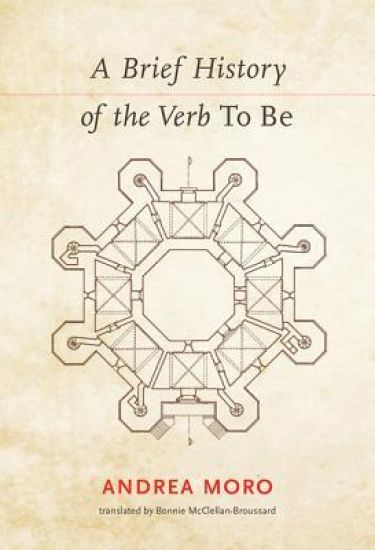
A Brief History of the Verb <i>To Be</i>
A journey through linguistic time and space, from Aristotle through the twentieth century's "era of syntax," in search of a dangerous verb and its significance.Beginning with the early works of Aristotle, the interpretation of the verb to be runs through Western linguistic thought like Ariadne's thread. As it unravels, it becomes intertwined with philosophy, metaphysics, logic, and even with mathematics-so much so that Bertrand Russell showed no hesitation in proclaiming that the verb to be was a disgrace to the human race. With the conviction that this verb penetrates modern linguistic thinking, creating scandal in its wake and, like a Trojan horse of linguistics, introducing disruptive elements that lead us to rethink radically the most basic structure of human language-the sentence-Andrea Moro reconstructs this history. From classical Greece to the dueling masters of medieval logic through the revolutionary geniuses from the seventeenth century to the Enlightenment, and finally to the twentieth century-when linguistics became a driving force and model for neuroscience-the plot unfolds like a detective story, culminating in the discovery of a formula that solves the problem even as it raises new questions-about language, evolution, and the nature and structure of the human mind. While Moro never resorts to easy shortcuts, A Brief History of the Verb To Be isn't burdened with inaccessible formulas and always refers to the broader picture of mind and language. In this way it serves as an engaging introduction to a new field of cutting-edge research.
Impossible Languages

Impossible Languages

Andrea Moro

MIT PRESS LTD
2023
pokkari
An investigation into the possibility of impossible languages, searching for the indelible "fingerprint" of human language. Can there be such a thing as an impossible human language? A biologist could describe an impossible animal as one that goes against the physical laws of nature (entropy, for example, or gravity). Are there any such laws that constrain languages? In this book, Andrea Moro--a distinguished linguist and neuroscientist--investigates the possibility of impossible languages, searching, as he does so, for the indelible "fingerprint" of human language. Moro shows how the very notion of impossible languages has helped shape research on the ultimate aim of linguistics: to define the class of possible human languages. He takes us beyond the boundaries of Babel, to the set of properties that, despite appearances, all languages share, and explores the sources of that order, drawing on scientific experiments he himself helped design. Moro compares syntax to the reverse side of a tapestry revealing a hidden and apparently intricate structure. He describes the brain as a sieve, considers the reality of (linguistic) trees, and listens for the sound of thought by recording electrical activity in the brain. Words and sentences, he tells us, are like symphonies and constellations: they have no content of their own; they exist because we listen to them and look at them. We are part of the data.
A Brief History of the Verb To Be

A Brief History of the Verb To Be

Andrea Moro

MIT PRESS LTD
2024
pokkari
A journey through linguistic time and space, from Aristotle through the twentieth century's "era of syntax," in search of a dangerous verb and its significance. Beginning with the early works of Aristotle, the interpretation of the verb to be runs through Western linguistic thought like Ariadne's thread. As it unravels, it becomes intertwined with philosophy, metaphysics, logic, and even with mathematics--so much so that Bertrand Russell showed no hesitation in proclaiming that the verb to be was a disgrace to the human race.With the conviction that this verb penetrates modern linguistic thinking, creating scandal in its wake and, like a Trojan horse of linguistics, introducing disruptive elements that lead us to rethink radically the most basic structure of human language--the sentence--Andrea Moro reconstructs this history. From classical Greece to the dueling masters of medieval logic through the revolutionary geniuses from the seventeenth century to the Enlightenment, and finally to the twentieth century--when linguistics became a driving force and model for neuroscience--the plot unfolds like a detective story, culminating in the discovery of a formula that solves the problem even as it raises new questions--about language, evolution, and the nature and structure of the human mind. While Moro never resorts to easy shortcuts, A Brief History of the Verb To Be isn't burdened with inaccessible formulas and always refers to the broader picture of mind and language. In this way it serves as an engaging introduction to a new field of cutting-edge research.
Lucretius and the Bat with Blue Eyes

Lucretius and the Bat with Blue Eyes

Andrea Moro

MIT PRESS LTD
2025
nidottu
A novel reading of De rerum natura through the lens of neurolinguistics. In the poem De rerum natura, written in the first century BC, Lucretius set out to explain the atomic theory of the universe and the triumph of reason over superstition to a Roman audience. In Lucretius and the Bat with Blue Eyes, a collection and critical translation of every passage on language in this great classic, renowned neurolinguist and novelist Andrea Moro explores the role of the human language and specifically the generative capacity of the alphabet to reach this goal. In Moro's reading, De rerum natura treats the birth of language as a case study in distinguishing humans from other animals, anticipating some key concepts of the theory of evolution, in both Darwinian and molecular terms. The book considers the major commentaries on Lucretius's work, both ancient and modern, and concludes by looking at a recently discovered letter by Descartes that addresses the idea of a "perfect language." Focusing on a challenging yet highly poetic text and grounded in the ideas of neuroscience and linguistics, Moro's book is also a deeply personal document ultimately addressing the role of reason on contrasting human suffering.
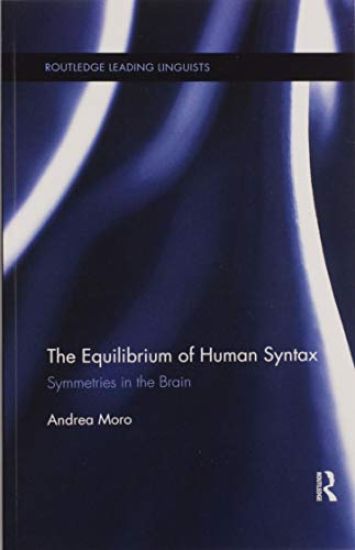
The Equilibrium of Human Syntax

The Equilibrium of Human Syntax

Andrea Moro

Routledge
2020
nidottu
This book assembles a collection of papers in two different domains: formal syntax and neurolinguistics. Here Moro provides evidence that the two fields are becoming more and more interconnected and that the new fascinating empirical questions and results in the latter field cannot be obtained without the theoretical base provided by the former. The book is organized in two parts: Part 1 focuses on theoretical and empirical issues in a comparative perspective (including the nature of syntactic movement, the theory of locality and a far reaching and influential theory of copular sentences). Part 2 provides the original sources of some innovative and pioneering experiments based on neuroimaging techniques (focusing on the biological nature of recursion and the interpretation of negative sentences).Moro concludes with an assessment of the impact of these perspectives on the theory of the evolution of language. The leading and pervasive idea unifying all the arguments developed here is the role of symmetry (breaking) in syntax and in the relationship between language and the human brain.
The Equilibrium of Human Syntax

The Equilibrium of Human Syntax

Andrea Moro

Routledge
2012
sidottu
This book assembles a collection of papers in two different domains: formal syntax and neurolinguistics. Here Moro provides evidence that the two fields are becoming more and more interconnected and that the new fascinating empirical questions and results in the latter field cannot be obtained without the theoretical base provided by the former. The book is organized in two parts: Part 1 focuses on theoretical and empirical issues in a comparative perspective (including the nature of syntactic movement, the theory of locality and a far reaching and influential theory of copular sentences). Part 2 provides the original sources of some innovative and pioneering experiments based on neuroimaging techniques (focusing on the biological nature of recursion and the interpretation of negative sentences).Moro concludes with an assessment of the impact of these perspectives on the theory of the evolution of language. The leading and pervasive idea unifying all the arguments developed here is the role of symmetry (breaking) in syntax and in the relationship between language and the human brain.
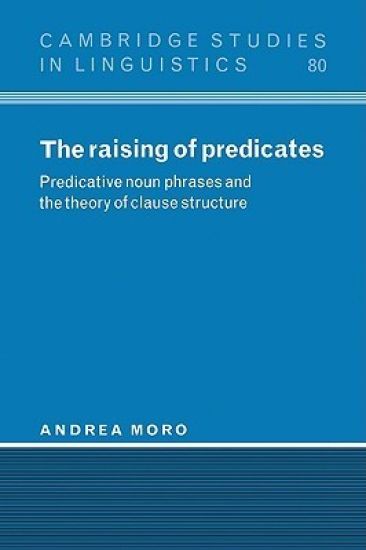
The Raising of Predicates

The Raising of Predicates

Andrea Moro

Cambridge University Press
2006
pokkari
One of the basic premises of the theory of syntax is that clause structures can be minimally identified as containing a verb phrase, playing the role of predicate, and a noun phrase, playing the role of subject. In this study Andrea Moro identifies a new category of copular sentences, namely inverse copular sentences, where the noun phrase which co-occurs with the verb phrase plays the role of predicate, occupying the position which is canonically reserved for subjects, and the subject is embedded in the verb phrase. The consequences of such a discovery are pervasive. Four distinct areas of syntax are unified into a unique natural class. Along with inverse copular sentences, existential sentences, sentences with seem and unaccusative constructions are analysed as involving the raising of a predicative noun phrase to the most prominent position in the clause structure. In addition, new light is shed on some classical issues such as the distribution and nature of expletives, locality theory, cliticization phenomena, possessive constructions, and the cross-linguistic variations of the Definiteness Effect.
The Raising of Predicates

The Raising of Predicates

Andrea Moro

Cambridge University Press
1997
sidottu
One of the basic premises of the theory of syntax is that clause structures can be minimally identified as containing a verb phrase, playing the role of predicate, and a noun phrase, playing the role of subject. In this study Andrea Moro identifies a new category of copular sentences, namely inverse copular sentences, where the noun phrase which co-occurs with the verb phrase plays the role of predicate, occupying the position which is canonically reserved for subjects, and the subject is embedded in the verb phrase. The consequences of such a discovery are pervasive. Four distinct areas of syntax are unified into a unique natural class. Along with inverse copular sentences, existential sentences, sentences with seem, and unaccusative constructions are analysed as involving the raising of a predicative noun phrase to the most prominent position in the clause structure. In addition, new light is shed on some classical issues such as the distribution and nature of expletives, locality theory, cliticisation phenomena, possessive constructions, and the cross-linguistic variations of the Definiteness Effect.