Kirjojen hintavertailu. Mukana 12 083 983 kirjaa ja 12 kauppaa.

Kirjahaku

Etsi kirjoja tekijän nimen, kirjan nimen tai ISBN:n perusteella.

6 kirjaa tekijältä Andreas Rahmatian

Credit and Creed

Credit and Creed

Andreas Rahmatian

Routledge
2019
sidottu
Money is a legal institution with principal economic and sociological consequences. Money is a debt, because that is how it is conceptualised and comes into existence: as circulating credit – if viewed from the creditor’s perspective – or, from the debtor’s viewpoint, as debt. This book presents a legal theory of money, based on the concept of dematerialised property. It describes the money creation or money supply process for cash and for bank money, and looks at modern forms of money, such as cryptocurrencies. It also shows why mainstream economics presupposes, but avoids an analysis of, money by effectively eliminating money from the microeconomic market model and declaring it as merely a neutral medium of exchange and unit of account. The book explains that money rather brings about and influences substantially the exchange or transaction it is supposed to facilitate only as a neutral medium. As the most liquid of all assets, money enables financialisation, monetisation and commodification in the economy. The central role of the banks in the money creation process and in the economy, and their strengthened position after the bank rescue measures in the wake of the financial crisis 2008-9 are also discussed. Providing a rigorous analysis of the most salient legal issues regarding money, this book will appeal to legal theorists, economists and anyone working in commercial or banking law.
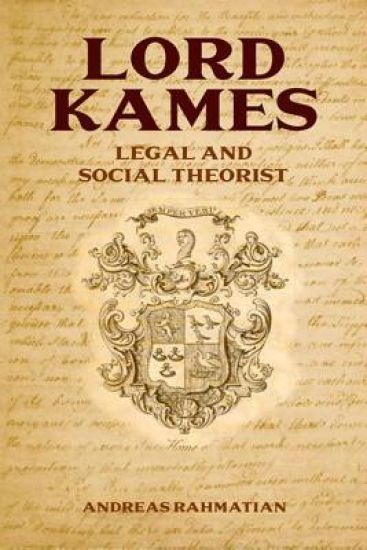
Lord Kames

Lord Kames

Andreas Rahmatian

Edinburgh University Press
2015
sidottu
This book re-establishes the importance of the ideas and legal philosophy of Scottish jurist and philosopher Lord Kames. The Scottish jurist, judge, legal historian and philosopher Henry Home (1696-1782) took the title Lord Kames when he was elevated to the bench of the Scottish Court of Session in 1752. In the 18th century, his books were influential and widely read; the educated classes and representatives of the Enlightenment in England, France and in the German states were all familiar with his aesthetic and philosophical writings. Andreas Rahmatian explains Kames' conceptions of legal philosophy, including black letter law, legal science, legal theory, legal sociology and anthropology in its early stages, setting them in the context of the Scottish Enlightenment. He looks at how Kames came to be one of the forefathers of comparative law, sociology of law, legal psychology and 'legal science' in its proper meaning, as opposed to 'law'.
Credit and Creed

Credit and Creed

Andreas Rahmatian

TAYLOR FRANCIS LTD
2021
nidottu
Money is a legal institution with principal economic and sociological consequences. Money is a debt, because that is how it is conceptualised and comes into existence: as circulating credit – if viewed from the creditor’s perspective – or, from the debtor’s viewpoint, as debt. This book presents a legal theory of money, based on the concept of dematerialised property. It describes the money creation or money supply process for cash and for bank money, and looks at modern forms of money, such as cryptocurrencies. It also shows why mainstream economics presupposes, but avoids an analysis of, money by effectively eliminating money from the microeconomic market model and declaring it as merely a neutral medium of exchange and unit of account. The book explains that money rather brings about and influences substantially the exchange or transaction it is supposed to facilitate only as a neutral medium. As the most liquid of all assets, money enables financialisation, monetisation and commodification in the economy. The central role of the banks in the money creation process and in the economy, and their strengthened position after the bank rescue measures in the wake of the financial crisis 2008-9 are also discussed. Providing a rigorous analysis of the most salient legal issues regarding money, this book will appeal to legal theorists, economists and anyone working in commercial or banking law.
Copyright and Creativity

Copyright and Creativity

Andreas Rahmatian

Edward Elgar Publishing Ltd
2011
sidottu
Copyright and Creativity discusses the making of property out of creative works through the legal mechanism of copyright. It shows the manner in which the law translates a great variety of expressions of the human mind into its normative system and transforms them into the property right of copyright or droit d auteur. This timely book examines the proprietary features of copyright, the inherent limitations of its powers, and its justification and relationship to the non-proprietary realm of the public domain. The latter part of the book deals with the 'propertisation/commodification' of human authors themselves through their works as alienable objects of property, the well-known 'Romantic author' critique as a sophisticated justification of that commodification, and at an international level, neo-feudal and neo-colonial developments as a result of this process. This detailed study will appeal to undergraduate and postgraduate students, legal sociologists, and specialists in copyright, property theory, or legal theory and political philosophy with particular interest in property theory. Practitioners within bodies involved in legal policy, organizations concerned with law reform, European institutions, and international organizations will also find much to interest them in this book.Contents: Preface; 1. Copyright as Property; 2. Copyright-Property and the Public Domain:Explanations and Justifications; 3. The Limitations to the Powers of Copyright Ownership; 4. The Attribution and Allocation of Copyright-Property: Authorship, Creativity and Ownership; 5. The Effects of Copyright-Property I: The Problem of Alienation; 6. The Effects of Copyright-Property II: Neo-Feudal and Neo-Colonial Features of International Copyright Protection; Conclusions; Index
Der Bereicherungsausgleich in Zessionslagen

Der Bereicherungsausgleich in Zessionslagen

Andreas Rahmatian

Peter Lang AG
1996
nidottu
Besonders fur die Finanzierungs- bzw. Kreditformen des Factoring und des drittfinanzierten Kaufs ist von grosser Bedeutung, wie bereicherungsrechtlich vorgegangen werden soll, wenn sich die Forderungen, die im Zusammenhang mit diesen Geschaften abgetreten wurden, oder die Zessionen selbst als unwirksam erweisen. Die Arbeit erortert die bereicherungsrechtliche Ruckabwicklung bei der Doppelzession und der unwirksamen Zession einer Forderung, wobei Problemen der Rechtsscheinhaftung besonderes Augenmerk geschenkt wird. Der grossere Teil der Studie widmet sich der umstrittenen bereicherungsrechtlichen Losung des Falles, dass ein Schuldner auf eine zedierte unwirksame Forderung an den Zessionar leistet. Die Frage, ob der Zessionsschuldner seine Leistungskondiktion gegen den Zedenten oder gegen den Zessionar richten kann, wird nach deutschem und osterreichischem Recht behandelt."
Lord Kames

Lord Kames

Andreas Rahmatian

EDINBURGH UNIVERSITY PRESS
2026
nidottu
The Scottish jurist, judge, legal historian and philosopher Henry Home (1696–1782) took the title Lord Kames when he was elevated to the bench of the Scottish Court of Session in 1752. In the 18th century, his books were influential and widely read; the educated classes and representatives of the Enlightenment in England, France and in the German states were all familiar with his aesthetic and philosophical writings. Andreas Rahmatian explains Kames’ conceptions of legal philosophy, including black-letter law, legal science, legal theory, legal sociology and anthropology in its early stages, setting them in the context of the Scottish Enlightenment. He looks at how Kames came to be one of the forefathers of comparative law, sociology of law, legal psychology and ‘legal science’ in its proper meaning, as opposed to ‘law’. From the APF: Portmahomack today is a serene fishing village on the Dornoch Firth, north east Scotland where archaeological excavations have written a new history of the origins of Scotland. This book brings alive the expedition and its discoveries, most famously a monastery of the eighth century in the land of the Picts. Starting from chance finds of Pictish carved stone in St Colman’s churchyard, the archaeologists unearthed four settlements one on top of the other. An elite farm was succeeded by the Pictish monastery, which, following a Viking raid in AD800, became a trading place and then a medieval village. Scientific analysis shows at each stage where the people came from, their life-style and what they ate. Together it creates a story of the heroic adaptation of a European nation to new politics between the sixth and sixteenth century. The Picts were the outstanding sculptors of their day, producing carved stone monuments equal to anything being made in contemporary Europe. They were Britons, who resisted the Romans invaders and created their own warrior nation in the north east of the island. Coming under pressure from the Scots and the Norse, they disappeared from history in the ninth century AD. Now archaeology is finding them again.