Kirjojen hintavertailu. Mukana 11 699 587 kirjaa ja 12 kauppaa.

Kirjahaku

Etsi kirjoja tekijän nimen, kirjan nimen tai ISBN:n perusteella.

7 kirjaa tekijältä Andrew B. Kipnis

Governing Educational Desire

Governing Educational Desire

Andrew B. Kipnis

University of Chicago Press
2011
sidottu
That parents in China greatly value higher education for their children is a well-known aspect of contemporary Chinese culture, but the intensity and effects of their desire to achieve this goal have largely gone unexamined - until now. "Governing Educational Desire" explores this universal desire for a college education and its vast consequences, which include household and national economic priorities, birthrates, ethnic relations, and patterns of governance. Where does this desire come from? Andrew B. Kipnis approaches this question in four different ways. First, he focuses in detail on one Chinese county, Zouping. Then, he widens his scope to examine the provincial and national governmental policies that affect educational desire. Digging into the history of education in East Asia, Kipnis moves on to explore the way contemporary governing practices were shaped by the Confucian examination system. Finally, to discover the universal in the local, he compares the social dynamics of a cross-section of Zouping communities. In doing so, Kipnis provides not only an illuminating analysis of education in China but also a thought-provoking reflection on what educational desire can tell us about the relationship between culture and government.
Governing Educational Desire

Governing Educational Desire

Andrew B. Kipnis

University of Chicago Press
2011
nidottu
That parents in China greatly value higher education for their children is a well-known aspect of contemporary Chinese culture, but the intensity and effects of their desire to achieve this goal have largely gone unexamined - until now. "Governing Educational Desire" explores this universal desire for a college education and its vast consequences, which include household and national economic priorities, birthrates, ethnic relations, and patterns of governance. Where does this desire come from? Andrew B. Kipnis approaches this question in four different ways. First, he focuses in detail on one Chinese county, Zouping. Then, he widens his scope to examine the provincial and national governmental policies that affect educational desire. Digging into the history of education in East Asia, Kipnis moves on to explore the way contemporary governing practices were shaped by the Confucian examination system. Finally, to discover the universal in the local, he compares the social dynamics of a cross-section of Zouping communities. In doing so, Kipnis provides not only an illuminating analysis of education in China but also a thought-provoking reflection on what educational desire can tell us about the relationship between culture and government.

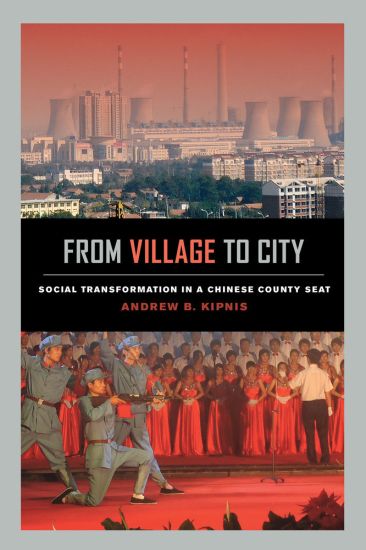
From Village to City

From Village to City

Andrew B. Kipnis

University of California Press
2016
sidottu
Between 1988 and 2013, the Chinese city of Zouping transformed from an impoverished town of 30,000 people to a bustling city of over 300,000, complete with factories, high rises, parks, shopping malls, and all the infrastructure of a wealthy East Asian city. From Village to City paints a vivid portrait of the rapid changes in Zouping and its environs and in the lives of the once-rural people who live there. Despite the benefits of modernization and an improved standard of living for many of its residents, Zouping is far from a utopia; its inhabitants face new challenges and problems such as alienation, class formation and exclusion, and pollution. As he explores the city's transformation, Andrew B. Kipnis develops a new theory of urbanization in this compelling portrayal of an emerging metropolis and its people.
From Village to City

From Village to City

Andrew B. Kipnis

University of California Press
2016
pokkari
Between 1988 and 2013, the Chinese city of Zouping transformed from an impoverished town of 30,000 people to a bustling city of over 300,000, complete with factories, high rises, parks, shopping malls, and all the infrastructure of a wealthy East Asian city. From Village to City paints a vivid portrait of the rapid changes in Zouping and its environs and in the lives of the once-rural people who live there. Despite the benefits of modernization and an improved standard of living for many of its residents, Zouping is far from a utopia; its inhabitants face new challenges and problems such as alienation, class formation and exclusion, and pollution. As he explores the city's transformation, Andrew B. Kipnis develops a new theory of urbanization in this compelling portrayal of an emerging metropolis and its people.
The Funeral of Mr. Wang

The Funeral of Mr. Wang

Andrew B. Kipnis

University of California Press
2021
pokkari
A free open access ebook is available upon publication. Learn more at www.luminosoa.org. In rural China funerals are conducted locally, on village land by village elders. But in urban areas, people have neither land for burials nor elder relatives to conduct funerals. Chinese urbanization, which has increased drastically in recent decades, involves the creation of cemeteries, state-run funeral homes, and small private funerary businesses. The Funeral of Mr. Wang examines social change in urbanizing China through the lens of funerals, the funerary industry, and practices of memorialization. It analyzes changes in family life, patterns of urban sociality, transformations in economic relations, the politics of memorialization, and the echoes of these changes in beliefs about the dead and ghosts.
Producing Guanxi

Producing Guanxi

Andrew B. Kipnis

Duke University Press
1997
pokkari
Throughout China the formation of guanxi, or social connections, involves friends, families, colleagues, and acquaintances in complex networks of social support and sentimental attachment. Focusing on this process in one rural north China village, Fengjia, Andrew Kipnis shows what guanxi production reveals about the evolution of village political economy, kinship and gender, and local patterns of subjectivity in Dengist China. His work offers a detailed description of the communicative actions-such as gift giving, being a host or guest, participating in weddings or funerals-that produce, manage, and deny guanxi in a specific time and place. Kipnis also offers a rare comparative analysis of how these practices relate to the varied and variable phenomenon of guanxi throughout China and as it has changed over time.Producing Guanxi combines the theory of Pierre Bourdieu and the insights of symbolic anthropology to contest past portrayals of guanxi as either a function of Chinese political economics or an unchanging Confucian social structure. In this analysis guanxi emerges as a purposeful human effort that makes use of past cultural logics while generating new ones. By exploring the role of sentiment in the creation of self, Kipnis critiques recent theories of subjectivity for their narrow focus on language and discourse, and contributes to the anthropological discussion of comparative selfhood. Navigating a path between mainstream social science and abstract social theory, Kipnis presents a more nuanced examination of guanxi than has previously been available and contributes generally to our understanding of relationships and human action.
Producing Guanxi

Producing Guanxi

Andrew B. Kipnis

Duke University Press
1997
sidottu
Throughout China the formation of guanxi, or social connections, involves friends, families, colleagues, and acquaintances in complex networks of social support and sentimental attachment. Focusing on this process in one rural north China village, Fengjia, Andrew Kipnis shows what guanxi production reveals about the evolution of village political economy, kinship and gender, and local patterns of subjectivity in Dengist China. His work offers a detailed description of the communicative actions-such as gift giving, being a host or guest, participating in weddings or funerals-that produce, manage, and deny guanxi in a specific time and place. Kipnis also offers a rare comparative analysis of how these practices relate to the varied and variable phenomenon of guanxi throughout China and as it has changed over time.Producing Guanxi combines the theory of Pierre Bourdieu and the insights of symbolic anthropology to contest past portrayals of guanxi as either a function of Chinese political economics or an unchanging Confucian social structure. In this analysis guanxi emerges as a purposeful human effort that makes use of past cultural logics while generating new ones. By exploring the role of sentiment in the creation of self, Kipnis critiques recent theories of subjectivity for their narrow focus on language and discourse, and contributes to the anthropological discussion of comparative selfhood. Navigating a path between mainstream social science and abstract social theory, Kipnis presents a more nuanced examination of guanxi than has previously been available and contributes generally to our understanding of relationships and human action.