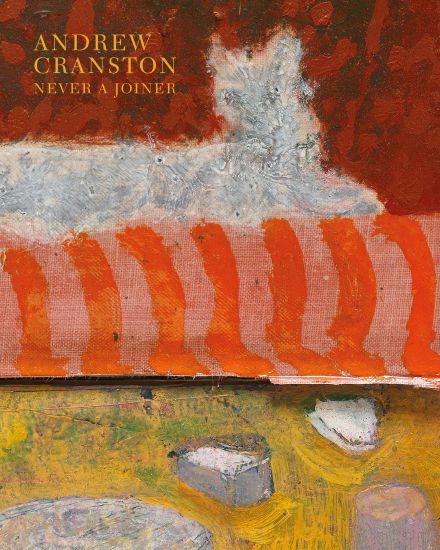
Andrew Cranston (b.1969, Hawick, Scotland; lives and works in Glasgow) is a painter-storyteller, a way of working that is enhanced by his often painting on the linen-bound covers of old books. His stories coalesce in the process of making – the paintings emerging gradually through the manipulation of his materials: layering, lacquering, bleaching, collaging and constantly re-working his way into images that seem to shift backwards and forwards in time. He once described a work as ‘a painting that came out of my brush one day’, a statement that sums up his approach. They are resolutely contemporary in spirit and yet connected by a strong thread to painters of the past, especially perhaps to the intimism of Vuillard and Bonnard, or to Matisse or Munch. These are narrative paintings, drawn from the artist’s memory and observations of life and liberally sprinkled with references to cinema, literature and art history. This publication presents a selection of the book cover paintings for which Cranston has become so well known in recent years. The cover image is a detail of _Cat and cheeseboard_ (2018) in which a cat sits on the upholstered arm of a sofa surveying what the artist describes as ‘a selection of bries and camemberts, as mousetraps’. Other animals pop up from time to time – a horse, some fish, a leopard; the skeleton of an elk. There are still lifes with fruit, flowers and/or pottery, and lots of landscapes, from the bleak to the fantastical. There are peopled and unpeopled interiors, portraits of family members and celebrities (occasionally curious hybrids thereof), and childhood memories from school classrooms and classical music-filled assemblies to holidays in Switzerland and visits to granny’s flat. And there are quite a few watering cans too. Each featured painting is accompanied by a text based on notes made by the artist before, during or after making a work. Mostly private thoughts, memories and anecdotes, these fragments jotted down on scraps of paper or tapped into his mobile phone were never intended to be published, but the resulting texts offer personal observations and reflections that Cranston considers ‘something like album sleeve notes where a musical artist might give some background to each song’. The texts are at times amusing, at others melancholic and moving, offering illuminating insights into the mind and life of the artist and the subjects, references and influences that feed into his painting practice. There are notes about technique and colour, about family and friends, about particular places at certain moments in time. For Cranston, writing has become ‘another way of engaging with painting and of activating the interesting afterlife that a work can have when it leaves the studio and goes out into the world.’ _Andrew Cranston – Never a Joiner_ has been produced by Ingleby, Edinburgh, and co-published with Anomie Publishing, London. It has been published to coincide with an exhibition of the same name at Ingleby, Edinburgh, and launched as part of the Edinburgh Art Festival 2023.Andrew Cranston was born in Hawick in the Scottish Borders in 1969 and currently lives and works in Glasgow. He studied at Gray’s School of Art in Aberdeen and at the Royal College of Art in London. Cranston has exhibited widely in the UK and USA and his work is housed in many museums and institutions across the world. _**Edited by Richard and Florence Ingleby, and designed by Jo Deans, Identity**_ _**A foil-stamped, linen-covered hardback book with dust jacket, printed and bound in Antwerp Co-published in 2023 by Ingleby, Edinburgh, and Anomie Publishing, London**_ _**Launched as part of the Edinburgh Art Festival 2023**_