Kirjojen hintavertailu. Mukana 11 244 527 kirjaa ja 12 kauppaa.

Kirjahaku

Etsi kirjoja tekijän nimen, kirjan nimen tai ISBN:n perusteella.

19 kirjaa tekijältä Andrew Hadfield

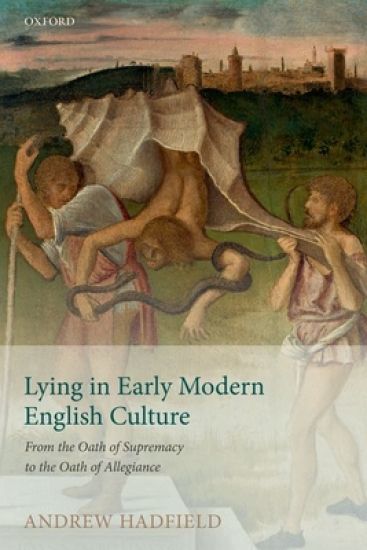
Lying in Early Modern English Culture

Lying in Early Modern English Culture

Andrew Hadfield

Oxford University Press
2021
nidottu
Lying in Early Modern English Culture is a major study of ideas of truth and falsehood in early modern England from the advent of the Reformation to the aftermath of the failed Gunpowder Plot. The period is characterised by panic and chaos when few had any idea how religious, cultural, and social life would develop after the traumatic division of Christendom. While many saw the need for a secular power to define the truth others declared that their allegiances belonged elsewhere. Accordingly there was a constant battle between competing authorities for the right to declare what was the truth and so label opponents as liars. Issues of truth and lying were, therefore, a constant feature of everyday life and determined ideas of individual identity, politics, speech, sex, marriage, and social behaviour, as well as philosophy and religion. This book is a cultural history of truth and lying from the 1530s to the 1610s, showing how lying needs to be understood in action as well as in theory. Unlike most histories of lying, it concentrates on a series of particular events reading them in terms of academic theories and more popular notions of lying. The book covers a wide range of material such as the trials of Ann Boleyn and Thomas More, the divorce of Frances Howard, and the murder of Anthony James by Annis and George Dell; works of literature such as Othello, The Faerie Queene, A Mirror for Magistrates, and The Unfortunate Traveller; works of popular culture such as the herring pamphlet of 1597; and major writings by Castiglione, Montaigne, Erasmus, Luther, and Tyndale.
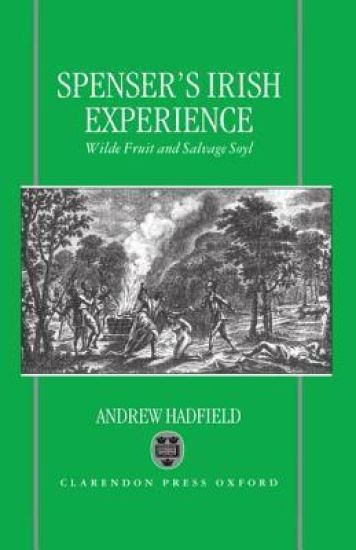
Edmund Spenser's Irish Experience

Edmund Spenser's Irish Experience

Andrew Hadfield

Clarendon Press
1997
sidottu
Spenser's Irish Experience is the first sustained critical work to argue that Edmund Spenser's perception and fragmented representation of Ireland shadows the whole narrative of his major work, The Faerie Queene, traditionally regarded as one of the finest achievements of the English Renaissance. The poem has often been read in specifically English contexts but, as Hadfield argues, demands to be read in terms of England's expanding colonial hegemony within the British Isles and the ensuing fear that such national ambition would actually lead to the destruction of England's post-Reformation legacy. Spenser should be seen less as an English writer and more as a new English writer in Ireland, his prose and poetry expressing the hopes and fears of his class. Where A View of the Present State of Ireland attempts to provide a violent political solution to England's Irish problem, The Faerie Queene exposes the apocalyptic fear that there may be no solution at all. The book contains an analysis of Spenser's life on the Munster plantation, readings of the political rhetoric and antiquarian discourse of A View of the Present State of Ireland, and three chapters which argue the case that the apparently Anglocentric allegory of The Faerie Queene reveals a land gradually--but clearly--transformed into its Irish other. Spenser emerges from this study as a writer whose experience in Ireland rendered him implacably opposed to the vacillations of his English monarch.
Literature, Travel, and Colonial Writing in the English Renaissance, 1545-1625
What was the purpose of representing foreign lands for writers in the English Renaissance? This innovative and wide-ranging study argues that writers often used their works as vehicles to reflect on the state of contemporary English politics, particularly their own lack of representation in public institutions. Sometimes such analyses took the form of displaced allegories, whereby writers contrasted the advantages enjoyed, or disadvantages suffered, by foreign subjects with the political conditions of Tudor and Stuart England. Elsewhere, more often in explicitly colonial writings, authors meditated on the problems of government when faced with the possibly violent creation of a new society. If Venice was commonly held up as a beacon of republican liberty which England would do well to imitate, the fear of tyrannical Catholic Spain was ever present - inspiring and haunting much of the colonial literature from 1580 onwards. This stimulating book examines fictional and non-fictional writings, illustrating both the close connections between the two made by early modern readers and the problems involved in the usual assumption that we can make sense of the past with the categories available to us. Hadfield explores in his work representations of Europe, the Americas, Africa, and the Far East, selecting pertinent examples rather than attempting to embrace a total coverage. He also offers fresh readings of Shakespeare, Marlowe, More, Lyly, Hakluyt, Harriot, Nashe, and others.
Edmund Spenser

Edmund Spenser

Andrew Hadfield

Oxford University Press
2014
nidottu
Edmund Spenser's innovative poetic works have a central place in the canon of English literature. Yet he is remembered as a morally flawed, self-interested sycophant; complicit in England's ruthless colonisation of Ireland; in Karl Marx's words, 'Elizabeth's arse-kissing poet'-- a man on the make who aspired to be at court and who was prepared to exploit the Irish to get what he wanted. In his vibrant and vivid book, the first biography of the poet for 60 years, Andrew Hadfield finds a more complex and subtle Spenser. How did a man who seemed destined to become a priest or a don become embroiled in politics? If he was intent on social climbing, why was he so astonishingly rude to the good and the great - Lord Burghley, the earl of Leicester, Sir Walter Ralegh, Elizabeth I and James VI? Why was he more at home with 'the middling sort' -- writers, publishers and printers, bureaucrats, soldiers, academics, secretaries, and clergymen -- than with the mighty and the powerful? How did the appalling slaughter he witnessed in Ireland impact on his imaginative powers? How did his marriage and family life shape his work? Spenser's brilliant writing has always challenged our preconceptions. So too, Hadfield shows, does the contradictory relationship between his between life and his art.
Lying in Early Modern English Culture

Lying in Early Modern English Culture

Andrew Hadfield

Oxford University Press
2017
sidottu
Lying in Early Modern English Culture is a major study of ideas of truth and falsehood in early modern England from the advent of the Reformation to the aftermath of the failed Gunpowder Plot. The period is characterised by panic and chaos when few had any idea how religious, cultural, and social life would develop after the traumatic division of Christendom. While many saw the need for a secular power to define the truth others declared that their allegiances belonged elsewhere. Accordingly there was a constant battle between competing authorities for the right to declare what was the truth and so label opponents as liars. Issues of truth and lying were, therefore, a constant feature of everyday life and determined ideas of individual identity, politics, speech, sex, marriage, and social behaviour, as well as philosophy and religion. This book is a cultural history of truth and lying from the 1530s to the 1610s, showing how lying needs to be understood in action as well as in theory. Unlike most histories of lying, it concentrates on a series of particular events reading them in terms of academic theories and more popular notions of lying. The book covers a wide range of material such as the trials of Ann Boleyn and Thomas More, the divorce of Frances Howard, and the murder of Anthony James by Annis and George Dell; works of literature such as Othello, The Faerie Queene, A Mirror for Magistrates, and The Unfortunate Traveller; works of popular culture such as the herring pamphlet of 1597; and major writings by Castiglione, Montaigne, Erasmus, Luther, and Tyndale.
Literature, Travel, and Colonial Writing in the English Renaissance, 1545-1625
What was the purpose of representing foreign lands for writers in the English Renaissance? This innovative and wide-ranging study argues that writers often used their works as vehicles to reflect on the state of contemporary English politics, particularly their own lack of representation in public institutions. Sometimes such analyses took the form of displaced allegories, whereby writers contrasted the advantages enjoyed, or disadvantages suffered, by foreign subjects with the political conditions of Tudor and Stuart England. Elsewhere, more often in explicitly colonial writings, authors meditated on the problems of government when faced with the possibly violent creation of a new society. If Venice was commonly held up as a beacon of republican liberty which England would do well to imitate, the fear of tyrannical Catholic Spain was ever present - inspiring and haunting much of the colonial literature from 1580 onwards. This stimulating book examines fictional and non-fictional writings, illustrating both the close connections between the two made by early modern readers and the problems involved in the usual assumption that we can make sense of the past with the categories available to us. Hadfield explores in his work representations of Europe, the Americas, Africa, and the Far East, selecting pertinent examples rather than attempting to embrace a total coverage. He also offers fresh readings of Shakespeare, Marlowe, More, Lyly, Hakluyt, Harriot, Nashe, and others.
Edmund Spenser

Edmund Spenser

Andrew Hadfield

Oxford University Press
2012
sidottu
Edmund Spenser's innovative poetic works have a central place in the canon of English literature. Yet he is remembered as a morally flawed, self-interested sycophant; complicit in England's ruthless colonisation of Ireland; in Karl Marx's words, 'Elizabeth's arse-kissing poet'-- a man on the make who aspired to be at court and who was prepared to exploit the Irish to get what he wanted. In his vibrant and vivid book, the first biography of the poet for 60 years, Andrew Hadfield finds a more complex and subtle Spenser. How did a man who seemed destined to become a priest or a don become embroiled in politics? If he was intent on social climbing, why was he so astonishingly rude to the good and the great - Lord Burghley, the earl of Leicester, Sir Walter Ralegh, Elizabeth I and James VI? Why was he more at home with 'the middling sort' -- writers, publishers and printers, bureaucrats, soldiers, academics, secretaries, and clergymen -- than with the mighty and the powerful? How did the appalling slaughter he witnessed in Ireland impact on his imaginative powers? How did his marriage and family life shape his work? Spenser's brilliant writing has always challenged our preconceptions. So too, Hadfield shows, does the contradictory relationship between his between life and his art.
Literature, Politics and National Identity

Literature, Politics and National Identity

Andrew Hadfield

Cambridge University Press
2009
pokkari
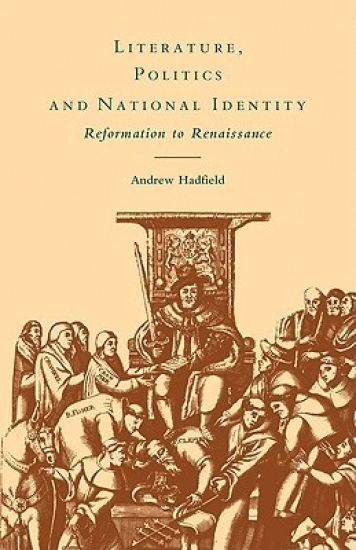
For many years C. S. Lewis's dismissal of the sixteenth century as a 'drab age' influenced literary scholars. Andrew Hadfield offers a challenging reinterpretation, through study of the work of some of the century's most important writers, including Skelton, Bale, Sidney, Spenser, Baldwin and the Earl of Surrey. He argues that all were involved in the establishment of a vernacular literary tradition as a crucial component of English identity, yet also wished to use the category of 'literature' to create a public space for critical political debate. Conventional assumptions - that pre-modern and modern history are neatly separated by the Renaissance, and that literary history is best studied as an autonomous narrative - are called into question: this book is a study of literary texts, but also a contribution to theories and histories of politics, national identity and culture.
Shakespeare and Republicanism

Shakespeare and Republicanism

Andrew Hadfield

Cambridge University Press
2008
pokkari
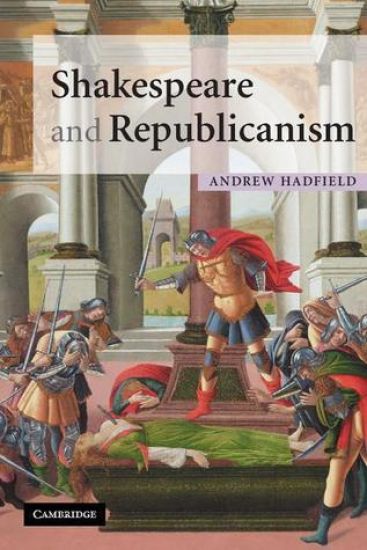
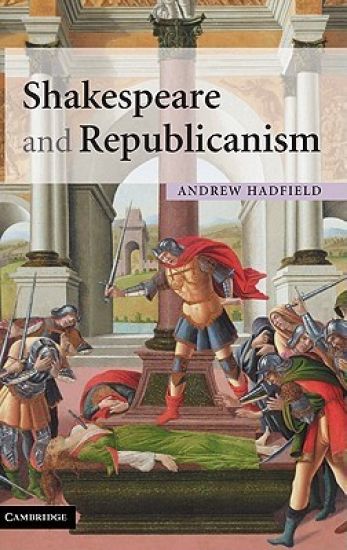
This groundbreaking work, first published in 2005, reveals exactly how Shakespeare was influenced by contemporary strands in political thought that were critical of the English crown and constitution. Shakespeare has often been seen as a conservative political thinker characterised by an over-riding fear of the 'mob'. Hadfield argues instead that Shakespeare's writing emerged out of an intellectual milieu fascinated by republican ideas. From the 1590s onwards, he explored republican themes in his poetry and plays: political assassination, elected government, alternative constitutions, and, perhaps most importantly of all, the problem of power without responsibility. Beginning with Shakespeare's apocalyptic representation of civil war in the Henry VI plays, Hadfield provides a series of powerful new readings of Shakespeare and his time. For anyone interested in Shakespeare and Renaissance culture, this book is required reading.
Shakespeare and Republicanism

Shakespeare and Republicanism

Andrew Hadfield

Cambridge University Press
2005
sidottu
This groundbreaking work, first published in 2005, reveals exactly how Shakespeare was influenced by contemporary strands in political thought that were critical of the English crown and constitution. Shakespeare has often been seen as a conservative political thinker characterised by an over-riding fear of the 'mob'. Hadfield argues instead that Shakespeare's writing emerged out of an intellectual milieu fascinated by republican ideas. From the 1590s onwards, he explored republican themes in his poetry and plays: political assassination, elected government, alternative constitutions, and, perhaps most importantly of all, the problem of power without responsibility. Beginning with Shakespeare's apocalyptic representation of civil war in the Henry VI plays, Hadfield provides a series of powerful new readings of Shakespeare and his time. For anyone interested in Shakespeare and Renaissance culture, this book is required reading.
The English Renaissance 1500-1620

The English Renaissance 1500-1620

Andrew Hadfield

JOHN WILEY AND SONS LTD
2000
nidottu
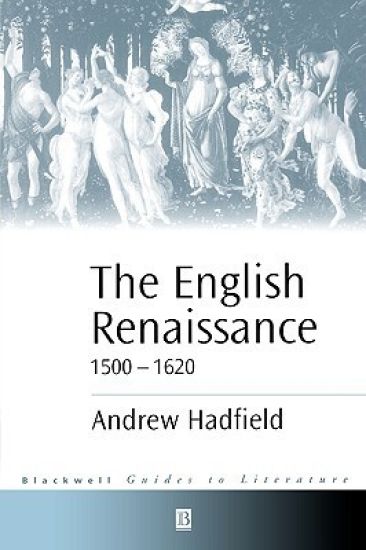
This lively and stimulating book guides students through the historical contexts, key figures, texts, themes and issues in sixteenth- and early seventeenth-century English literature. The English Renaissance, 1500-1620 sets out the historical and cultural contexts of Renaissance England, highlighting the background voices and events which influenced literary production, including the Reformation, the British problem, perceptions of other cultures and the voyages to the Americas. A series of short biographical essays on the key writers of the period explain their significance, and explore a variety of perspectives with which to approach them. In-depth analyses of a number of well-studied texts are also provided, indicating why each text is important and suggesting ways in which each might usefully be read. Texts featured include Astrophil and Stella, Othello, Utopia, Dr Faustus, The Tragedy of Miriam, The Unfortunate Traveller and the Faerie Queene. The volume charts the intricacies of English Renaissance literature, taking in a variety of themes including women, gender and the question of homosexuality; the stage; printing and censorship; humanism and education and rhetoric. Attention is also drawn to current debates in Renaissance criticism such as New Historicism and Cultural Materialism, thus the book provides students with an unparalleled foundation for further study. Fully cross-referenced, with a useful chronology, glossary and suggestions for further reading, this much-needed guide conveys the excitement of reading Renaissance literature.
Literature and Popular Culture in Early Modern England

Literature and Popular Culture in Early Modern England

Andrew Hadfield

Ashgate Publishing Limited
2009
sidottu
1978 witnessed the publication of Peter Burke's groundbreaking study Popular Culture in Early Modern Europe. Now in its third edition this remarkable book has for thirty years set the benchmark for cultural historians with its wide ranging and imaginative exploration of early modern European popular culture. In order to celebrate this achievement, and to explore the ways in which perceptions of popular culture have changed in the intervening years a group of leading scholars are brought together in this new volume to examine Burke's thesis in relation to England. Adopting an appropriately interdisciplinary approach, the collection offers an unprecedented survey of the field of popular culture in early modern England as it currently stands, bringing together scholars at the forefront of developments in an expanding area. Taking as its starting point Burke's argument that popular culture was everyone's culture, distinguishing it from high culture, which only a restricted social group could access, it explores an intriguing variety of sources to discover whether this was in fact the case in early modern England. It further explores the meaning and significance of the term 'popular culture' when applied to the early modern period: how did people distinguish between high and low culture - could they in fact do so? Concluded by an Afterword by Peter Burke, the volume provides a vivid sense of the range and significance of early modern popular culture and the difficulties involved in defining and studying it.
Edmund Spenser

Edmund Spenser

Andrew Hadfield

Routledge
2017
sidottu
This collection represents some of the best recent critical writing on Edmund Spenser, a major Renaissance English poet. The essays cover the whole of Spensers work, from early literary experiments such as The Shepeardes Calendar, to his unfinished crowning work,The Fairie Queene. The introduction provides an overview of critical responses to Spenser, setting his work and the debates which it has generated in their perspective contexts: new historicist, post-structural, psychoanalytic and feminist. His study also covers the critical responses of leading British, Irish and American scholars.
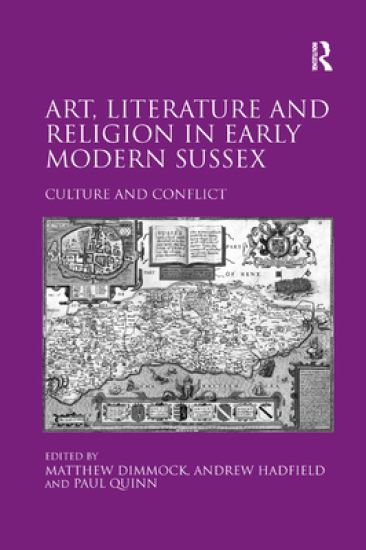
Art, Literature and Religion in Early Modern Sussex
Art, Literature and Religion in Early Modern Sussex is an interdisciplinary study of a county at the forefront of religious, political and artistic developments in early-modern England. Ranging from the schism of Reformation to the outbreak of Civil War, the volume brings together scholars from the fields of art history, religious and intellectual history and English literature to offer new perspectives on early-modern Sussex. Essays discuss a wide variety of topics: the coherence of a county divided between East and West and Catholic and Protestant; the art and literary collections of Chichester cathedral; communities of Catholic gentry; Protestant martyrdom; aristocratic education; writing, preaching and exile; local funerary monuments; and the progresses of Elizabeth I. Contributors include Michael Questier; Nigel Llewellyn; Caroline Adams; Karen Coke; and Andrew Foster. The collection concludes with an Afterword by Duncan Salkeld (University of Chichester). This volume extends work done in the 1960s and 70s on early-modern Sussex, drawing on new work on county and religious identities, and setting it into a broad national context. The result is a book that not only tells us much about Sussex, but which also has a great deal to offer all scholars working in the field of local and regional history, and religious change in England as a whole.
Art, Literature and Religion in Early Modern Sussex

Art, Literature and Religion in Early Modern Sussex

Andrew Hadfield

Ashgate Publishing Limited
2014
sidottu
Art, Literature and Religion in Early Modern Sussex is an interdisciplinary study of a county at the forefront of religious, political and artistic developments in early-modern England. Ranging from the schism of Reformation to the outbreak of Civil War, the volume brings together scholars from the fields of art history, religious and intellectual history and English literature to offer new perspectives on early-modern Sussex. Essays discuss a wide variety of topics: the coherence of a county divided between East and West and Catholic and Protestant; the art and literary collections of Chichester cathedral; communities of Catholic gentry; Protestant martyrdom; aristocratic education; writing, preaching and exile; local funerary monuments; and the progresses of Elizabeth I. Contributors include Michael Questier; Nigel Llewellyn; Caroline Adams; Karen Coke; and Andrew Foster. The collection concludes with an Afterword by Duncan Salkeld (University of Chichester). This volume extends work done in the 1960s and 70s on early-modern Sussex, drawing on new work on county and religious identities, and setting it into a broad national context. The result is a book that not only tells us much about Sussex, but which also has a great deal to offer all scholars working in the field of local and regional history, and religious change in England as a whole.
Literature and Class

Literature and Class

Andrew Hadfield

Manchester University Press
2021
sidottu
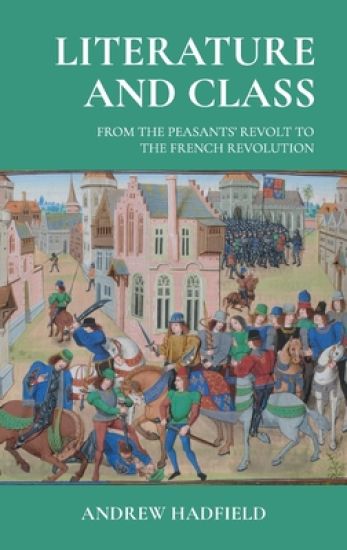
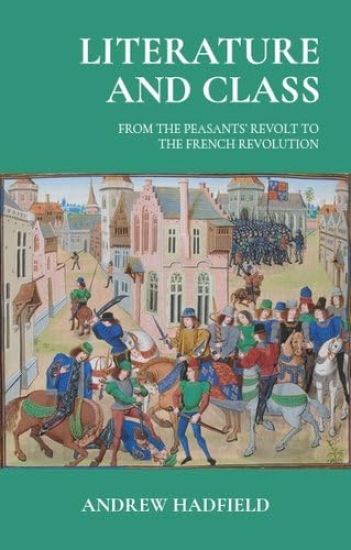
This book explores the intimate relationship between literature and class in England (and later Britain) from the Peasants’ Revolt at the end of the fourteenth century to the impact of the French Revolution at the end of the eighteenth century and beginning of the nineteenth. The book argues throughout that class cannot be seen as a modern phenomenon that occurred after the Industrial revolution but that class divisions and relations have always structured societies and that it makes sense to assume a historical continuity. The book explores a number of themes relating to class: class consciousness; class conflict; commercialisation; servitude; rebellion; gender relations; and colonisation. After outlining the history of class relations, five chapters explore the ways in which social class consciously and unconsciously influenced a series of writers: Chaucer, Shakespeare, Behn, Rochester, Defoe, Duck, Richardson, Burney, Blake and Wordsworth.
Literature and Class

Literature and Class

Andrew Hadfield

MANCHESTER UNIVERSITY PRESS
2025
nidottu
This book explores the intimate relationship between literature and class in England (and later Britain) from the Peasants’ Revolt at the end of the fourteenth century to the impact of the French Revolution at the end of the eighteenth century and beginning of the nineteenth. The book argues throughout that class cannot be seen as a modern phenomenon that occurred after the Industrial revolution but that class divisions and relations have always structured societies and that it makes sense to assume a historical continuity. The book explores a number of themes relating to class: class consciousness; class conflict; commercialisation; servitude; rebellion; gender relations; and colonisation. After outlining the history of class relations, five chapters explore the ways in which social class consciously and unconsciously influenced a series of writers: Chaucer, Shakespeare, Behn, Rochester, Defoe, Duck, Richardson, Burney, Blake and Wordsworth.
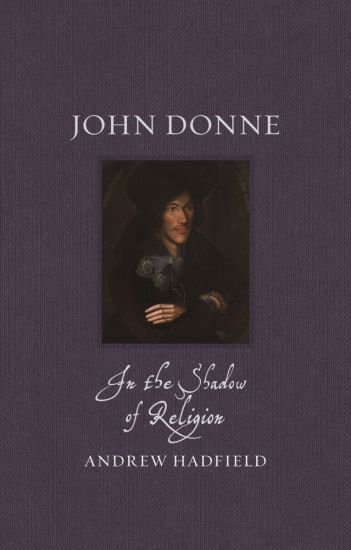
John Donne

John Donne

Andrew Hadfield

Reaktion Books
2021
sidottu
John Donne: In the Shadow of Religion explores the life of one of the most significant figures of the English Renaissance. The book not only provides an overview of Donne’s life and work, but connects his writing and thinking to the ideas, institutions and networks that influenced him. The book shows how Donne’s faith underpinned his career, from aspirational courtier to phenomenally successful clergyman and preacher, when he became dean of St. Paul’s Cathedral. Donne emerges as a figure obsessed with himself, tormented by the fear that his transgressions may have condemned him to eternal damnation.This fine new account uses Donne’s correspondence, writing and poetry to give a rounded portrait of a bold, experimental thinker, who was never afraid of taking risks that few others would have countenanced.
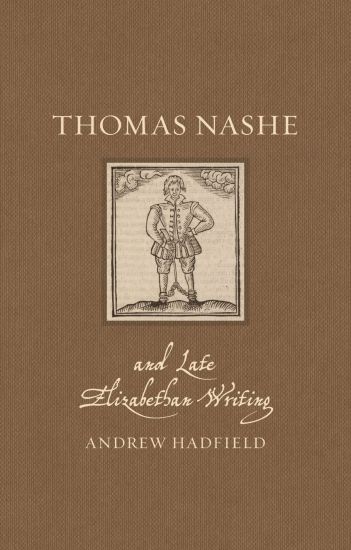
Thomas Nashe and Late Elizabethan Writing

Thomas Nashe and Late Elizabethan Writing

Andrew Hadfield

REAKTION BOOKS
2023
sidottu
This book provides an overview of the life and work of the scandalous Renaissance writer Thomas Nashe (1567–c. 1600), perhaps the only English author whose work led to the closure of theatres and the widespread banning of printed books. Nashe was famous for writing the scurrilous novel The Unfortunate Traveller (1594), but as Andrew Hadfield shows, there was much more to his career than this brilliant work. Nashe played a vital role in establishing English Renaissance theatre, collaborating with Ben Jonson, Christopher Marlowe and William Shakespeare. He was involved in religious controversies; wrote pornographic poetry; reflected on the terrifying impact of the plague on London; and wrote intricate sentences that saw him celebrated as one of the finest prose stylists of the age.