Kirjojen hintavertailu. Mukana 11 342 296 kirjaa ja 12 kauppaa.

Kirjahaku

Etsi kirjoja tekijän nimen, kirjan nimen tai ISBN:n perusteella.

4 kirjaa tekijältä Andrew J. Rotter

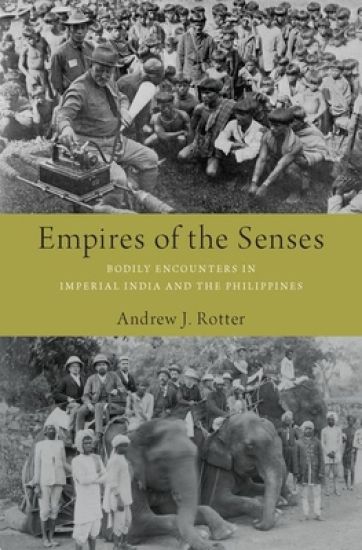
Empires of the Senses

Empires of the Senses

Andrew J. Rotter

Oxford University Press Inc
2019
sidottu
When encountering unfamiliar environments in India and the Philippines, the British and the Americans wrote extensively about the first taste of mango and meat spiced with cumin, the smell of excrement and coconut oil, the feel of humidity and rough cloth against skin, the sound of bells and insects, and the appearance of dark-skinned natives and lepers. So too did the colonial subjects they encountered perceive the agents of empire through their senses and their skins. Empire of course involved economics, geopolitics, violence, a desire for order and greatness, a craving for excitement and adventure. It also involved an encounter between authorities and subjects, an everyday process of social interaction, political negotiation, policing, schooling, and healing. While these all concerned what people thought about each other, perceptions of others, as Andrew Rotter shows, were also formed through seeing, hearing, touching, smelling, and tasting. In this book, Rotter offers a sensory history of the British in India from the formal imposition of their rule to its end (1857-1947) and the Americans in the Philippines from annexation to independence (1898-1946). The British and the Americans saw themselves as the civilizers of what they judged backward societies, and they believed that a vital part of the civilizing process was to properly prioritize the senses and to ensure them against offense or affront. Societies that looked shabby, were noisy and smelly, felt wrong, and consumed unwholesome food in unmannerly ways were unfit for self-government. It was the duty of allegedly more sensorily advanced Anglo-Americans to educate them before formally withdrawing their power. Indians and Filipinos had different ideas of what constituted sensory civilization and to some extent resisted imperial efforts to impose their own versions. What eventually emerged were compromises between these nations' sensory regimes. A fascinating and original comparative work, Empires of the Senses offers new perspectives on imperial history.
Hiroshima

Hiroshima

Andrew J. Rotter

Oxford University Press
2009
nidottu
The US decision to drop an atomic bomb on the Japanese city of Hiroshima on 6 August 1945 remains one of the most controversial events of the twentieth century. However, the controversy over the rights and wrongs of dropping the bomb has tended to obscure a number of fundamental and sobering truths about the development of this fearsome weapon. The principle of killing thousands of enemy civilians from the air was already well established by 1945 and had been practised on numerous occasions by both sides during the Second World War. Moreover, the bomb dropped on Hiroshima was conceived and built by an international community of scientists, not just by the Americans. Other nations (including Japan and Germany) were also developing atomic bombs in the first half of the 1940s, albeit hapharzardly. Indeed, it is difficult to imagine any combatant nation foregoing the use of the bomb during the war had it been able to obtain one. The international team of scientists organized by the Americans just got there first. As this fascinating new history shows, the bomb dropped by a US pilot that hot August morning in 1945 was in many ways the world's offspring, in both a technological and a moral sense. And it was the world that would have to face its consequences, strategically, diplomatically, and culturally, in the years ahead.
Comrades at Odds

Comrades at Odds

Andrew J. Rotter

Cornell University Press
2000
pokkari
Comrades at Odds explores the complicated Cold War relationship between the United States and the newly independent India of Jawaharlal Nehru from a unique perspective—that of culture, broadly defined. In a departure from the usual way of doing diplomatic history, Andrew J. Rotter chose culture as his jumping-off point because, he says, "Like the rest of us, policymakers and diplomats do not shed their values, biases, and assumptions at their office doors. They are creatures of culture, and their attitudes cannot help but shape the policy they make." To define those attitudes, Rotter consults not only government documents and the memoirs of those involved in the events of the day, but also literature, art, and mass media. "An advertisement, a photograph, a cartoon, a film, and a short story," he finds, "tell us in their own ways about relations between nations as surely as a State Department memorandum does."While expanding knowledge about the creation and implementation of democracy, Rotter carries his analysis across the categories of race, class, gender, religion, and culturally infused practices of governance, strategy, and economics.Americans saw Indians as superstitious, unclean, treacherous, lazy, and prevaricating. Indians regarded Americans as arrogant, materialistic, uncouth, profane, and violent. Yet, in spite of these stereotypes, Rotter notes the mutual recognition of profound similarities between the two groups; they were indeed "comrades at odds."
The Path to Vietnam

The Path to Vietnam

Andrew J. Rotter

Cornell University Press
1989
pokkari
What path led Americans to Vietnam? Why and how did the United States become involved in this conflict? Drawing on materials from published and unpublished sources in America and Great Britain, historian Andrew Rotter uncovers and analyzes the surprisingly complex reasons for America's fateful decision to provide economic and military aid to the nations of Southeast Asia in May 1950.